The Team Group T-Force GE Pro 2 TB is the line's sweet spot (2026)
Quick answer
Buy the Team Group T-Force GE Pro 2 TB if the host motherboard already has a PCIe 5.0 M.2 slot and the goal is the practical sweet spot of the line, real Gen5 bandwidth with enough capacity for a library and working files.
Read: 14000 MB/s Write: 11800 MB/s Endurance: 1200 TBW Warranty: 5 years Interface: M.2 5.0
The Team Group T-Force GE Pro 2 TB pairs Innogrit's IG5666 controller with YMTC 232-layer TLC to deliver mid-tier PCIe 5.0 performance at 14,000 MB/s reads and a 1200 TBW rating.
Controller & Memory
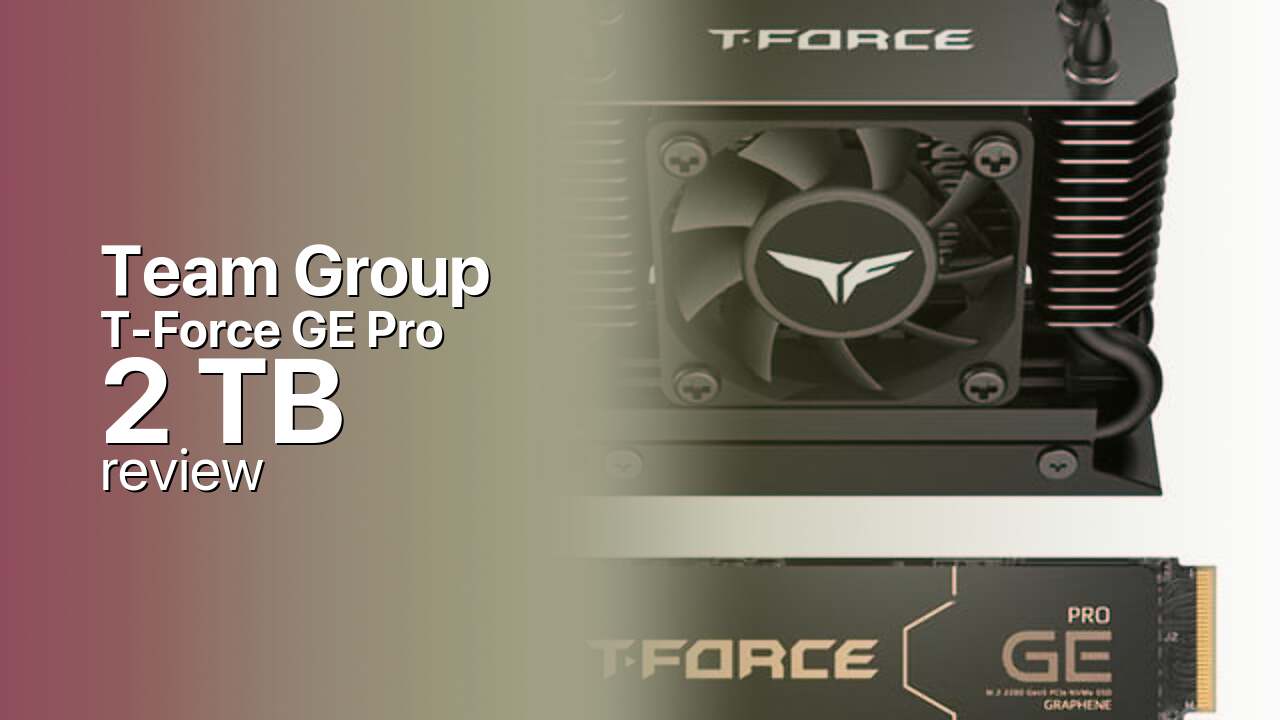
Inside the Team Group T-Force GE Pro 2 TB sits a familiar Gen5 recipe: Innogrit's IG5666 controller paired with YMTC's 232-layer TLC NAND and a discrete DRAM buffer on a single-sided M.2 2280 board. PC World calls the line mid-tier PCIe 5.0 performance, and TweakTown labels it a Chinese Gen5 contender, which is fair: the IG5666 plus YMTC pairing is what separates the GE Pro from the Phison E26 flagships that dominate the top of the market. A PCIe 5.0 x4 link is required to reach the rated bandwidth, so a motherboard with a Gen5 M.2 slot is the baseline.
The GE Pro line spans 1 TB, 2 TB, and 4 TB, and all three capacities carry the same 14,000 MB/s read and 11,800 MB/s write ratings, so the 2 TB gives up no peak speed to its siblings. What scales with size is endurance: 600 TBW on the 1 TB, 1200 TBW on this 2 TB, and 2400 TBW on the 4 TB, a consistent 600 TBW per terabyte. The 2 TB lands as the practical sweet spot, with room for a big game and media library plus working files without the steeper cost of the 4 TB die. Within Team Group's own stack the GE Pro sits above the GC Pro, which tops out around 12,500 MB/s read on the same controller family. The similarly named GA Pro is a different product entirely, built on SK Hynix NAND with 10.0 and 8.5 GB/s speeds in 1 and 2 TB only.
The drive ships as a bare M.2 2280 module with no heatsink included, and at Gen5 power levels a heatsink is mandatory rather than optional. It fits any desktop or laptop with a PCIe 5.0 M.2 slot, and it functions in a PS5, though the console's expansion slot is PCIe 4.0, so Gen5 bandwidth is wasted there. Closest rivals are the Crucial T705 and T710, which push higher peak speeds at the flagship end, the WD Black SN850X for systems that do not need Gen5 bandwidth, and Team Group's own GC Pro as a lower-spec cut of the same hardware family.
Storage Comparisons:
T-Force GE Pro Performance & Benchmarks
The Team Group T-Force GE Pro 2 TB is rated for 14,000 MB/s sequential reads and 11,800 MB/s sequential writes over its PCIe 5.0 x4 interface. Those are paper maxima that show up in short burst runs, where the SLC cache is wide open and the queue depth is stacked in the drive's favor. In real workloads the gap to a good PCIe 4.0 drive narrows considerably: game load times, application launches, and everyday desktop responsiveness feel largely identical, because those tasks are bounded by queue depth and read latency, not raw peak bandwidth.
Team Group T-Force GE Pro 2 TB vs M.2 5.0 peers
Switch between sequential throughput and random IOPS to see how this drive stacks up against other M.2 5.0 SSDs in our database. The highlighted bar is the drive on this page — click any other bar to open that drive.
- Corsair MP700 Pro XT 1 TB: 14,900 MB/s read, 14,200 MB/s write
- Corsair MP700 Pro XT 2 TB: 14,900 MB/s read, 14,500 MB/s write
- Corsair MP700 Pro XT 4 TB: 14,900 MB/s read, 14,400 MB/s write
- Crucial T710 1 TB: 14,900 MB/s read, 13,800 MB/s write
- Team Group T-Force GE Pro 2 TB (this drive): 14,000 MB/s read, 11,800 MB/s write
Where the 2 TB does flex is in sustained throughput. With 2 TB of TLC and a DRAM buffer, the SLC cache holds a solid fraction of the drive, so multi-hundred-gigabyte file transfers, video scratch disk work, and DirectStorage-enabled titles that stream large asset archives benefit most. Once the cache exhausts, writes settle to the native TLC write speed of the YMTC 232-layer NAND, which is meaningfully lower than the burst figure. Team Group does not publish random IOPS figures for the GE Pro, so no reliable 4K random number can be cited.
Independent reviewers find the IG5666 plus YMTC 232-layer combination competitive with other mid-tier Gen5 drives in synthetic bandwidth while trailing the Phison E26 flagships in random 4K and sustained steady-state writes. For gaming and mixed-use workloads that delta is hard to feel, and the 2 TB's larger SLC cache lets it hold peak writes longer than the 1 TB before the step down to the native-TLC rate.
Team Group T-Force GE Pro vs Competitors
See how the T-Force GE Pro stacks up against other M.2 5.0 drives in our database:
Compare with rival drives:
Endurance, TBW & Warranty
Endurance on the Team Group T-Force GE Pro 2 TB is rated at 1200 TBW, twice the 600 TBW of the 1 TB and half the 2400 TBW of the 4 TB, holding a steady 600 TBW per terabyte across the family. The drive is backed by a 5-year limited warranty that ends at whichever of the two limits, time or terabytes written, arrives first. At a typical 20 GB of writes per day, 1200 TBW works out to roughly 164 years of continuous use, which means the warranty will expire on the calendar long before the NAND does. Even a heavier 100 GB-per-day workload still leaves more than three decades of headroom. Team Group does not publish an MTBF for the GE Pro, but drives on the Innogrit IG5666 platform generally sit around 1.6 million hours; treat that as a population statistic for expected reliability across many units, not a guarantee for any individual sample.
Team Group T-Force GE Pro 2 TB Specifications
| Category | Value |
|---|---|
| Capacity [?] | 2 TB |
| Interface [?] | M.2 5.0 |
| Controller [?] | Innogrit IG5666 |
| Memory type [?] | YMTC 232-L TLC |
| DRAM [?] | Yes |
| Read speed (MB/s) [?] | 14000 |
| Write speed (MB/s) [?] | 11800 |
| Read IOPS [?] | n/a |
| Write IOPS [?] | n/a |
| Endurance (TBW) [?] | 1200 |
| MTBF (million hours) [?] | 2000000 |
| Warranty (years) [?] | 5 |
Verdict: Is the T-Force GE Pro Worth It in 2026?
Buy the Team Group T-Force GE Pro 2 TB if the host motherboard already has a PCIe 5.0 M.2 slot and the goal is the practical sweet spot of the line, real Gen5 bandwidth with enough capacity for a library and working files. Skip it when the host platform tops out at PCIe 4.0, because the Gen5 bandwidth goes unused there, or when the budget allows the 4 TB, which doubles endurance and SLC cache for sustained writes. The WD Black SN850X 2 TB is the safer call for a pure gaming rig on a Gen4 board, and the Crucial T705 is the pick for buyers who want maximum Gen5 speed regardless of cost. Our take: the GE Pro 2 TB is the most balanced capacity in the range, delivering mid-tier Gen5 bandwidth and a 1200 TBW cushion at a sensible price, as long as the rest of the system can actually use it.
+ Pros
- 14,000 MB/s rated sequential reads
- 1200 TBW endurance on the 2 TB
- Five-year limited warranty included
- YMTC 232-layer TLC with DRAM buffer
- Innogrit IG5666 Gen5 controller
- Sweet-spot capacity of the GE Pro line
- Cons
- No heatsink included in the box
- Random IOPS unrated by Team Group
- Gen5 bandwidth wasted on PCIe 4.0 systems
- SLC cache slows after sustained transfers
- Speed gain invisible in most current games
Buy this or similar SSD Storage:



Video Review
TeamGroup FIXES PCIE 5 SSD COOLING! T-Force Dark AirFlow I M.2 Heatsink Review