Transcend MTE240S 512GB — High-Endurance PCIe 4.0 NVMe SSD (2026)
Quick answer
The Transcend MTE240S 512 GB is a purpose-built tool for a narrow audience: users whose workloads destroy consumer SSD endurance ratings and who need a 500 GB-class drive with enterprise-leaning TBW.
Read: 3800 MB/s Write: 3200 MB/s Endurance: 850 TBW Warranty: 5 years Interface: M.2 4.0 x 4
The Transcend MTE240S 512GB brings the same exceptional endurance DNA as its 1 TB sibling, offering a write-budget-friendly PCIe 4.0 drive for users who burn through consumer SSD endurance ratings at half the capacity.
Controller & Memory
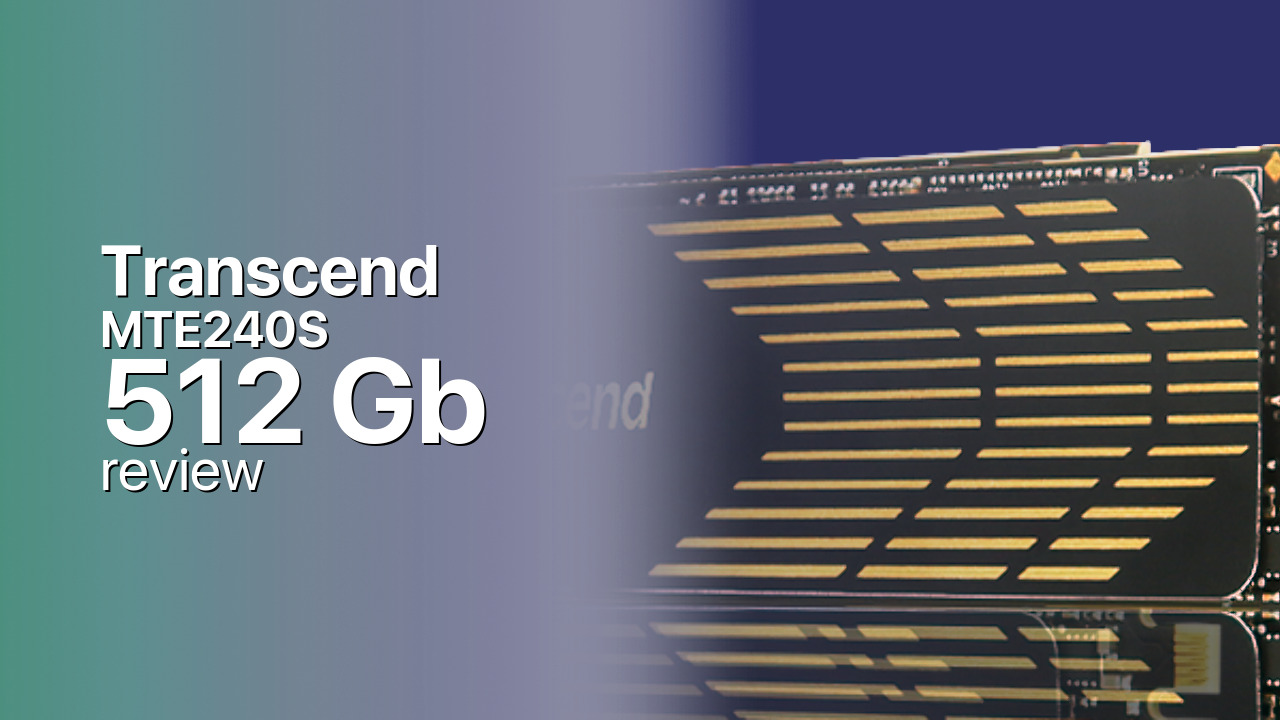
The Transcend MTE240S is an entry-level PCIe 4.0 M.2 2280 NVMe SSD built around a four-channel controller — identified in independent reviews as the Silicon Motion SM2267 — paired with 3D TLC NAND. The SM2267 is a DRAM-less design that uses Host Memory Buffer (HMB) for mapping-table management. The 512 GB capacity is the smaller of two SKUs in the lineup, sitting below the 1 TB variant. Transcend does not publicly disclose the NAND vendor. The single-sided PCB ensures fitment in thin laptops and the PS5 expansion slot.
The 512 GB model is rated at up to 3,800 MB/s sequential reads and 3,200 MB/s sequential writes — identical to the 1 TB variant on paper, though real-world sustained write performance will be lower due to having half the NAND dies. Formatted capacity is approximately 476 GB in Windows, enough for the operating system, essential applications, and a modest amount of user data. The drive's PCIe 4.0 interface provides future-proofing for systems that support it, though the modest peak throughput means users on PCIe 3.0 platforms will see little speed penalty.
The MTE240S's defining characteristic is endurance. Transcend rates the 512 GB model at approximately 850 TBW — roughly 1,700 TBW per terabyte, maintaining the same extraordinary endurance ratio as the 1 TB variant. This is roughly three times the TBW rating of typical consumer 500 GB-class TLC drives like the Samsung 980 500 GB (300 TBW) or WD Blue SN570 500 GB (300 TBW). For write-intensive use cases — video editing scratch, surveillance recording, database logging — the MTE240S 512 GB offers endurance headroom that no other drive at this capacity and price can match. The 5-year warranty backs the TBW rating, with coverage ending at whichever limit is reached first.
Storage Comparisons:
MTE240S Performance & Benchmarks
Transcend rates the 512 GB MTE240S at up to 3,800 MB/s sequential reads and 3,200 MB/s sequential writes, with random performance of up to 370,000 IOPS read and 560,000 IOPS write. These speeds place the MTE240S closer to high-end PCIe 3.0 territory than to the 7,000 MB/s ceiling of PCIe 4.0 flagships — the four-channel SM2267 controller is the limiting factor, not the interface. For boot-drive and general consumer workloads the gap is imperceptible; game load times, application launches, and file transfers feel indistinguishable from faster PCIe 4.0 drives in blind testing.
Transcend MTE240S 512 GB vs M.2 4.0 x 4 peers
Switch between sequential throughput and random IOPS to see how this drive stacks up against other M.2 4.0 x 4 SSDs in our database. The highlighted bar is the drive on this page — click any other bar to open that drive.
- Patriot Viper PV593 1 TB: 14,500 MB/s read, 14,000 MB/s write
- Patriot Viper PV593 2 TB: 14,500 MB/s read, 14,000 MB/s write
- Patriot Viper PV593 4 TB: 14,500 MB/s read, 14,000 MB/s write
- Patriot Viper PV573 2 TB: 14,000 MB/s read, 12,000 MB/s write
- Transcend MTE240S 512 GB (this drive): 3,800 MB/s read, 3,200 MB/s write
The 512 GB capacity imposes a practical performance ceiling on sustained writes compared to the 1 TB variant. With half the NAND dies, the SLC write cache is smaller and fills faster under sustained sequential writes, and post-cache TLC speeds will be lower. For the drive's intended use case — write-heavy workloads where endurance matters more than peak throughput — this trade-off is acceptable. The large overprovisioning implied by the 850 TBW endurance rating means the controller has generous spare area for wear leveling, which helps maintain consistent performance as the drive fills.
Thermal behavior is benign. The four-channel controller and 3D TLC NAND consume modest power, and independent testing of the MTE240S platform shows no thermal throttling under sustained consumer workloads in adequately ventilated enclosures. A dedicated heatsink is not required for desktop or laptop use.
Transcend MTE240S vs Competitors
See how the MTE240S stacks up against other M.2 4.0 x 4 drives in our database:
Compare with rival drives:
Endurance, TBW & Warranty
Transcend backs the MTE240S 512 GB with a 5-year limited warranty capped at approximately 850 TBW — whichever limit is reached first ends coverage. This endurance ratio of roughly 1,700 TBW per terabyte is consistent with the 1 TB variant and is among the highest of any consumer PCIe 4.0 SSD. By comparison, the Samsung 980 500 GB is rated at 300 TBW and the WD Blue SN570 500 GB at 300 TBW — the MTE240S offers nearly triple the write endurance. At a consumer daily write load of 20 to 30 GB, the drive would last 77 to 116 years. At a heavy 150 GB per day for video editing or surveillance, it would still exceed 15 years. Transcend's RMA process is established globally with service centers in North America, Europe, and Asia. Proof of purchase is recommended for warranty claims.
Transcend MTE240S 512 GB Specifications
| Category | Value |
|---|---|
| Capacity [?] | 512 GB |
| Interface [?] | M.2 4.0 x 4 |
| Controller [?] | Silicon Motion SM2267 |
| Memory type [?] | 3D TLC |
| DRAM [?] | Yes |
| Read speed (MB/s) [?] | 3800 |
| Write speed (MB/s) [?] | 3200 |
| Read IOPS [?] | 370000 |
| Write IOPS [?] | 560000 |
| Endurance (TBW) [?] | 850 |
| MTBF (million hours) [?] | 2000000 |
| Warranty (years) [?] | 5 |
Verdict: Is the MTE240S Worth It in 2026?
The Transcend MTE240S 512 GB is a purpose-built tool for a narrow audience: users whose workloads destroy consumer SSD endurance ratings and who need a 500 GB-class drive with enterprise-leaning TBW. The 850 TBW rating and 5-year warranty are unmatched at this capacity, and the modest peak throughput is a fair trade for write longevity. It is best suited as a video editing scratch disk, a surveillance NVR boot drive, a database logging volume, or any application where writes dominate reads and endurance is the binding constraint. Skip it for gaming or general desktop use — the Samsung 980 500 GB or WD Blue SN570 500 GB offer faster effective speeds, better software ecosystems, and more than enough endurance for consumer workloads at a similar price. The MTE240S 512 GB exists for the buyer who knows exactly what TBW means and why they need more of it.
+ Pros
- Exceptional ~850 TBW endurance for a 500 GB-class drive
- 5-year warranty with global RMA support
- 3D TLC NAND with generous overprovisioning
- 3,800 MB/s reads, adequate for PCIe 4.0 consumer workloads
- Single-sided M.2 2280 PCB fits thin laptops
- Cons
- Peak throughput modest for PCIe 4.0, closer to PCIe 3.0 speeds
- DRAM-less HMB architecture, no dedicated DRAM cache
- NAND vendor and controller not officially published by Transcend
- 512 GB capacity limiting for OS plus large application suites
Buy this or similar SSD Storage:



Video Review
Transcend NVMe PCIe Gen4 x4 SSD 240S - Where Speed Meets Durability