Gigabyte Aorus Gen4 500GB Review — The PCIe 4.0 Pioneer, Revisited (2026)
Quick answer
The Gigabyte Aorus Gen4 500 GB in 2026 is a niche buy.
Read: 5000 MB/s Write: 2500 MB/s Endurance: 850 TBW Warranty: 5 years Interface: M.2 4.0 x 4
The Gigabyte Aorus Gen4 500 GB was one of the first PCIe 4.0 drives to hit the market in 2019, and while it has long since been overtaken by faster hardware, its copper heatsink and 850 TBW endurance rating still give it a niche worth understanding.
Controller & Memory
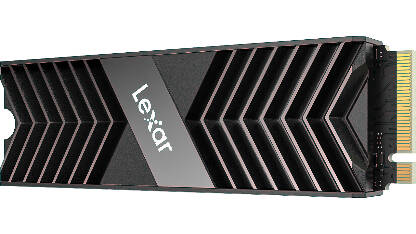
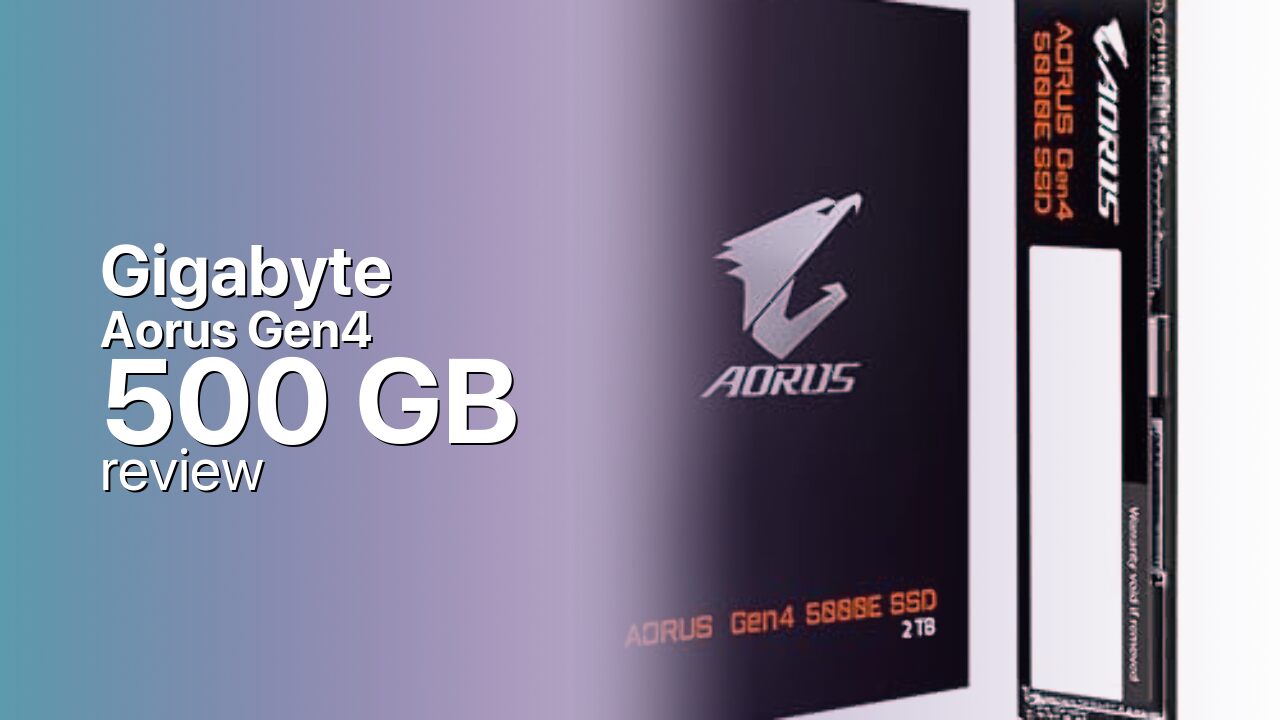
The Aorus Gen4 is built on the Phison PS5016-E16 — the controller that defined the first wave of PCIe 4.0 SSDs. It is an 8-channel design with a dedicated DDR4 DRAM cache, paired here with Kioxia BiCS4 96-layer TLC NAND. The drive is an M.2 2280 form factor, but the star of the physical design is the full-body copper heatsink: 27 fins, a claimed 69% improvement in thermal transfer over aluminium, and a total thickness of 11.4 mm that makes it incompatible with most laptops. This is a desktop-only drive unless your laptop has an unusually generous M.2 cavity.
The Aorus Gen4 family launched with 500 GB, 1 TB, and 2 TB capacities. This 500 GB model is the entry point, and it carries a meaningful performance penalty versus the larger capacities: write speed drops from 4,400 MB/s on the 1 TB model to 2,500 MB/s here, a consequence of fewer NAND dies to parallelise writes across. The read speed holds at 5,000 MB/s across all capacities.
In 2026, the Aorus Gen4 competes against drives that did not exist when it launched — the Samsung 980 Pro, WD Black SN850, and newer Phison E18-based designs all deliver higher throughput and better efficiency. What keeps the Aorus Gen4 relevant is its endurance rating and thermal solution at a used or clearance price.
Storage Comparisons:
Aorus Gen4 Performance & Benchmarks
Rated at 5,000 MB/s sequential reads and 2,500 MB/s sequential writes, the 500 GB Aorus Gen4 delivers first-gen PCIe 4.0 throughput that has since been surpassed by mainstream DRAM-less drives. Random IOPS are 400,000 reads and 550,000 writes — the write IOPS advantage over reads is unusual and reflects the E16 controller's architecture and the 500 GB capacity's NAND configuration.
Gigabyte Aorus Gen4 500 GB vs M.2 4.0 x 4 peers
Switch between sequential throughput and random IOPS to see how this drive stacks up against other M.2 4.0 x 4 SSDs in our database. The highlighted bar is the drive on this page — click any other bar to open that drive.
- Patriot Viper PV593 1 TB: 14,500 MB/s read, 14,000 MB/s write
- Patriot Viper PV593 2 TB: 14,500 MB/s read, 14,000 MB/s write
- Patriot Viper PV593 4 TB: 14,500 MB/s read, 14,000 MB/s write
- Patriot Viper PV573 2 TB: 14,000 MB/s read, 12,000 MB/s write
- Gigabyte Aorus Gen4 500 GB (this drive): 5,000 MB/s read, 2,500 MB/s write
In real-world use, the 5,000 MB/s reads still handle gaming, boot, and general productivity without issue. The 2,500 MB/s writes are the capacity-specific limitation: at 500 GB, the reduced NAND parallelism means large file writes take roughly twice as long as they would on the 1 TB variant. For a boot drive or a light-use system this is acceptable; for anything involving frequent large transfers, the 500 GB Aorus Gen4 is the wrong tool at any price. The copper heatsink does its job — the drive is thermally stable under load — but the E16 controller on 28 nm draws more power than modern alternatives, so the cooling is necessary, not decorative.
Gigabyte Aorus Gen4 vs Competitors
See how the Aorus Gen4 stacks up against other M.2 4.0 x 4 drives in our database:
Compare with rival drives:
Endurance, TBW & Warranty
Gigabyte backs the Aorus Gen4 500 GB with a 5-year warranty limited by 850 TBW of endurance. At 20 GB of writes per day — a realistic figure for a 500 GB boot drive — the endurance budget stretches to over 115 years. The 1.8 million hour MTBF is in line with enterprise-adjacent consumer drives of its era. The 5-year warranty from Gigabyte's established RMA infrastructure is one of the strongest arguments for this drive over no-name alternatives: if it fails, you can reach someone who will process the claim.
Gigabyte Aorus Gen4 500 GB Specifications
| Category | Value |
|---|---|
| Capacity [?] | 500 GB |
| Interface [?] | M.2 4.0 x 4 |
| Controller [?] | Phison PS5016-E16 8 Channel |
| Memory type [?] | Kioxia 96-L TLC |
| DRAM [?] | Yes |
| Read speed (MB/s) [?] | 5000 |
| Write speed (MB/s) [?] | 2500 |
| Read IOPS [?] | 400000 |
| Write IOPS [?] | 550000 |
| Endurance (TBW) [?] | 850 |
| MTBF (million hours) [?] | 1800000 |
| Warranty (years) [?] | 5 |
Verdict: Is the Aorus Gen4 Worth It in 2026?
The Gigabyte Aorus Gen4 500 GB in 2026 is a niche buy. It makes sense if you find it at a steep clearance discount, need a reliable boot drive with a genuine DRAM cache and a copper heatsink, and do not care that modern PCIe 4.0 drives are faster. It is a poor choice if you need laptop compatibility (the heatsink is too thick), if you do frequent large file transfers (2,500 MB/s writes are slow by current standards), or if you are buying at a price close to a newer Phison E18 or E21T-based drive. The Aorus Gen4 was good in 2019; in 2026 it is a budget curiosity with a great heatsink.
+ Pros
- Full copper heatsink with 27 fins — genuine thermal performance, not cosmetic
- 5,000 MB/s reads with a dedicated DDR4 DRAM cache
- 850 TBW endurance rating — strong for a 500 GB drive
- 5-year warranty backed by Gigabyte's established RMA infrastructure
- 8-channel Phison E16 controller with proven firmware maturity
- Cons
- 2,500 MB/s writes — half the speed of the 1 TB variant due to reduced NAND parallelism
- 11.4 mm thick with heatsink — not compatible with laptops or the PS5
- First-gen PCIe 4.0 power draw and thermals are worse than modern alternatives
- Outperformed by current-generation DRAM-less budget drives in sequential throughput
Buy this or similar SSD Storage:



Video Review
Aorus Gen4 - The Best PCIe 4.0 SSD for the Money (Right Now...)