Kingston KC3000 1TB Review — A Phison E18 Flagship Done Right (2026)
Quick answer
The Kingston KC3000 1 TB is the value champion of the premium PCIe 4.0 segment.
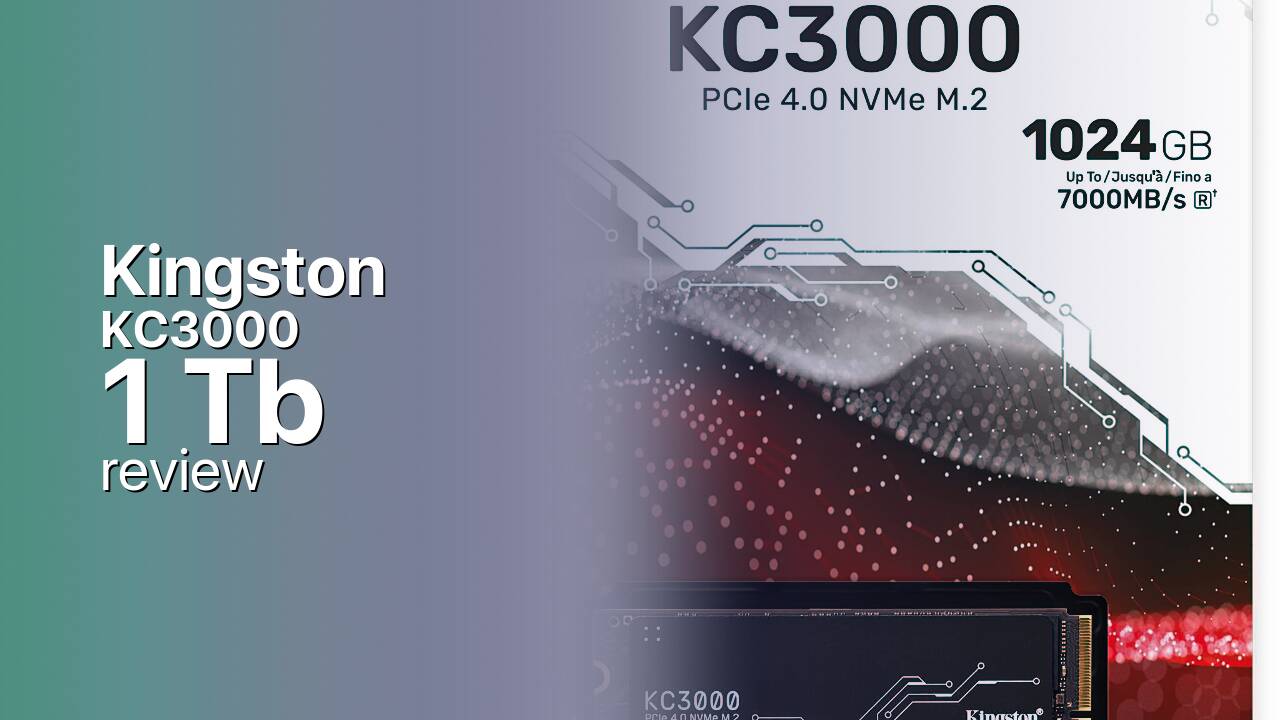
Read: 7000 MB/s Write: 6000 MB/s Endurance: 800 TBW Warranty: 5 years Interface: M.2 4.0 x 4
The Kingston KC3000 1 TB is what happens when a proven Phison E18 reference platform meets Micron's best 176-layer TLC — a PCIe 4.0 drive that consistently punches above its price tag on endurance and sustained throughput.
Controller & Memory
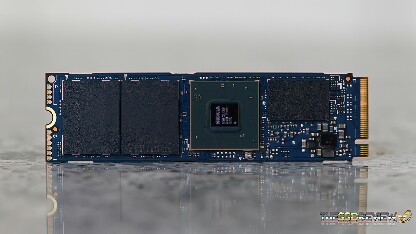
The Kingston KC3000 uses the Phison PS5018-E18 controller — an eight-channel, TSMC 12nm, quad-core ARM Cortex-R5 design that has become the de facto standard for high-end PCIe 4.0 SSDs from brands that do not fabricate their own controllers. Kingston pairs it with Micron 176-layer B47R 3D TLC NAND running at 1,600 MT/s and 1 GB of DDR4-2666 DRAM on a single-sided M.2 2280 PCB. The single-sided layout is a practical win — it fits into thin laptops, ultrabooks, and the PlayStation 5 expansion bay without the compatibility headaches that double-sided drives cause. The drive also includes a graphene-aluminum heat spreader label that provides modest passive cooling, though it is not a substitute for a proper heatsink in sustained-write scenarios.
Kingston positioned the KC3000 as a no-compromise flagship at a price that undercut Samsung and WD, and the 1 TB variant largely delivers on that promise. Sequential reads hit 7,000 MB/s — the practical ceiling for PCIe 4.0 x4 — and writes reach 6,000 MB/s, a figure that distinguishes the 1 TB model from the faster 2 TB and 4 TB variants which push writes to the full 7,000 MB/s. The gap exists because the 1 TB uses fewer NAND packages, reducing the parallelism available for write striping across the E18's eight channels. For read-heavy workloads — gaming, application launches, boot — the difference is invisible. For write-heavy creative work, the 2 TB variant is the stronger tool. The KC3000 also lacks AES-256 hardware encryption, a feature Kingston included on the older KC2500 but removed here. BitLocker users who want hardware acceleration should note this before buying.
The KC3000 shares its Phison E18 and Micron B47R foundation with the Kingston Fury Renegade, which is essentially the same drive with additional overprovisioning and higher endurance ratings. The KC3000 competes directly with the Samsung 980 Pro (faster random I/O, lower endurance at 600 TBW), the WD Black SN850X (slightly faster gaming performance, lower TBW), and the SK hynix P41 (massive IOPS lead, limited retail availability). Among these, the KC3000's combination of 800 TBW endurance, single-sided PCB, and competitive pricing makes it the value pick of the premium Gen4 tier.
Storage Comparisons:
KC3000 Performance & Benchmarks
The Kingston KC3000 1 TB is rated for 7,000 MB/s sequential reads and 6,000 MB/s sequential writes, with random performance of up to 900,000 IOPS reads and 1,000,000 IOPS writes. These are strong numbers that place the KC3000 in the upper tier of PCIe 4.0 drives, though the 1 TB variant's write speed trails the 2 TB and 4 TB models which reach 7,000 MB/s writes thanks to full channel population. The Phison E18's dynamic pSLC cache handles roughly 250 to 300 GB of writes on the 1 TB variant before exhausting to direct-to-TLC mode, where writes settle at approximately 1,500 to 1,800 MB/s — faster post-cache behavior than the Samsung 980 Pro and roughly on par with the WD Black SN850X.
Kingston KC3000 1 TB vs M.2 4.0 x 4 peers
Switch between sequential throughput and random IOPS to see how this drive stacks up against other M.2 4.0 x 4 SSDs in our database. The highlighted bar is the drive on this page — click any other bar to open that drive.
- Patriot Viper PV593 1 TB: 14,500 MB/s read, 14,000 MB/s write
- Patriot Viper PV593 2 TB: 14,500 MB/s read, 14,000 MB/s write
- Patriot Viper PV593 4 TB: 14,500 MB/s read, 14,000 MB/s write
- Patriot Viper PV573 2 TB: 14,000 MB/s read, 12,000 MB/s write
- Kingston KC3000 1 TB (this drive): 7,000 MB/s read, 6,000 MB/s write
Independent reviewers consistently measured the KC3000 hitting or slightly exceeding its rated sequential speeds, and the Micron 176-layer NAND's 1,600 MT/s interface gives the E18 more bandwidth per channel than earlier 96-layer implementations. In real-world PCMark 10 storage benchmarks, the KC3000 trades blows with the 980 Pro — slightly behind on low-queue-depth random reads, slightly ahead on sustained sequential throughput. For gaming, the differences are academic: the KC3000 loads titles within a fraction of a second of any other premium Gen4 drive. For content creation — 4K video ingest, large Lightroom catalog transfers, DaVinci Resolve scratch disks — the KC3000's strong sustained write performance and 800 TBW endurance make it one of the better 1 TB options.
Thermally, the KC3000 runs warm under sustained load but within safe limits. The Phison E18 throttles at roughly 84°C, and reviewers observed peak temperatures in the high 70s to low 80s Celsius during multi-hundred-gigabyte sequential writes with the stock graphene label. A passive motherboard M.2 cover drops this by 5 to 10 degrees. For PS5 use, an aftermarket heatsink is recommended — the graphene label alone is insufficient for the console's enclosed expansion bay, and Sony's own guidance specifies an actively or passively cooled heatsink. The KC3000 measured roughly 6,557 MB/s in PS5 speed tests, safely above Sony's 5,500 MB/s minimum.
Kingston KC3000 vs Competitors
See how the KC3000 stacks up against other M.2 4.0 x 4 drives in our database:
Compare with rival drives:
Endurance, TBW & Warranty
Kingston backs the KC3000 1 TB with a 5-year limited warranty and an endurance rating of 800 TBW. At 800 TBW, the drive is rated to absorb approximately 438 GB of writes per day for the full warranty period — a level of endurance that exceeds the Samsung 980 Pro (600 TBW) and WD Black SN850X (600 TBW) by a meaningful 33 percent. At a typical consumer workload of 20 to 50 GB/day, endurance headroom stretches beyond 40 years. The TBW scales proportionally across the lineup: 400 TBW for 512 GB, 800 TBW for 1 TB, 1,600 TBW for 2 TB, and 3,200 TBW for 4 TB. The MTBF is rated at 1.8 million hours, a standard population statistic. Kingston provides the SSD Manager software utility for firmware updates and drive health monitoring, including a cloning tool for migration. The KC3000 does not include hardware-based AES-256 encryption — a feature present on the older KC2500 — so BitLocker and similar full-disk encryption will rely on software processing.
Kingston KC3000 1 TB Specifications
| Category | Value |
|---|---|
| Capacity [?] | 1 TB |
| Interface [?] | M.2 4.0 x 4 |
| Controller [?] | Phison PS5018-E18 |
| Memory type [?] | Micron TLC |
| DRAM [?] | DDR4 |
| Read speed (MB/s) [?] | 7000 |
| Write speed (MB/s) [?] | 6000 |
| Read IOPS [?] | 900000 |
| Write IOPS [?] | 1000000 |
| Endurance (TBW) [?] | 800 |
| MTBF (million hours) [?] | 1800000 |
| Warranty (years) [?] | 5 |
Verdict: Is the KC3000 Worth It in 2026?
The Kingston KC3000 1 TB is the value champion of the premium PCIe 4.0 segment. It delivers 7,000 MB/s reads, strong post-cache write performance, and 800 TBW of endurance — a combination that the Samsung 980 Pro and WD Black SN850X cannot match on all three axes at once — and it typically sells for less than either. Buy it for a high-end desktop build, a content-creation workstation that needs sustained write throughput, or a PS5 upgrade where the single-sided PCB and 5,500 MB/s-plus speed check every box (just add a heatsink). Skip it if you need hardware encryption for BitLocker or if your workflow is dominated by low-queue-depth random reads, where the 980 Pro or the SK hynix P41 hold a measurable edge. The KC3000's only real design compromise is the missing AES engine, and for most users that matters less than the extra 200 TBW of endurance.
+ Pros
- 7,000 MB/s sequential reads — PCIe 4.0 ceiling for 1 TB class
- 800 TBW endurance — 33 percent more than Samsung 980 Pro and WD SN850X
- Single-sided PCB fits thin laptops, ultrabooks, and PS5
- Phison E18 + Micron 176L TLC is a proven, reliable combination
- Strong post-cache write speed (~1,500-1,800 MB/s)
- Typically priced below Samsung and WD equivalents
- 5-year warranty with Kingston SSD Manager software
- Cons
- No AES-256 hardware encryption — removed from KC2500 predecessor
- 1 TB write speed (6,000 MB/s) trails 2 TB/4 TB variants (7,000 MB/s)
- Graphene label is not a real heatsink — aftermarket cooling needed for PS5
- Random read IOPS (900K) slightly behind Samsung 980 Pro (1M)
- Kingston's history of component swaps raises long-term consistency questions
Buy this or similar SSD Storage:



Video Review
Kingston's FIRST PCIe 4 SSD 👉7000MB/S ! | Kingston KC3000 NVMe SSD Review