Addlink S95 2TB Review — Phison E18 PCIe 4.0 NVMe SSD (2026)
Quick answer
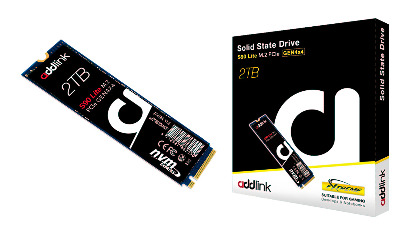
The Addlink S95 2 TB is a full-speed Phison E18 drive sold at a price that reflects the brand, not the silicon.
Read: 7100 MB/s Write: 6800 MB/s Endurance: 1400 TBW Warranty: 5 years Interface: M.2 4.0 x 4
The Addlink S95 2 TB is the fully populated Phison E18 drive that smaller brands use to punch above their weight — 7,100 MB/s reads, 6,800 MB/s writes, and 1,400 TBW of endurance at a price that makes the Sabrent and Corsair equivalents look like brand taxes.
Controller & Memory
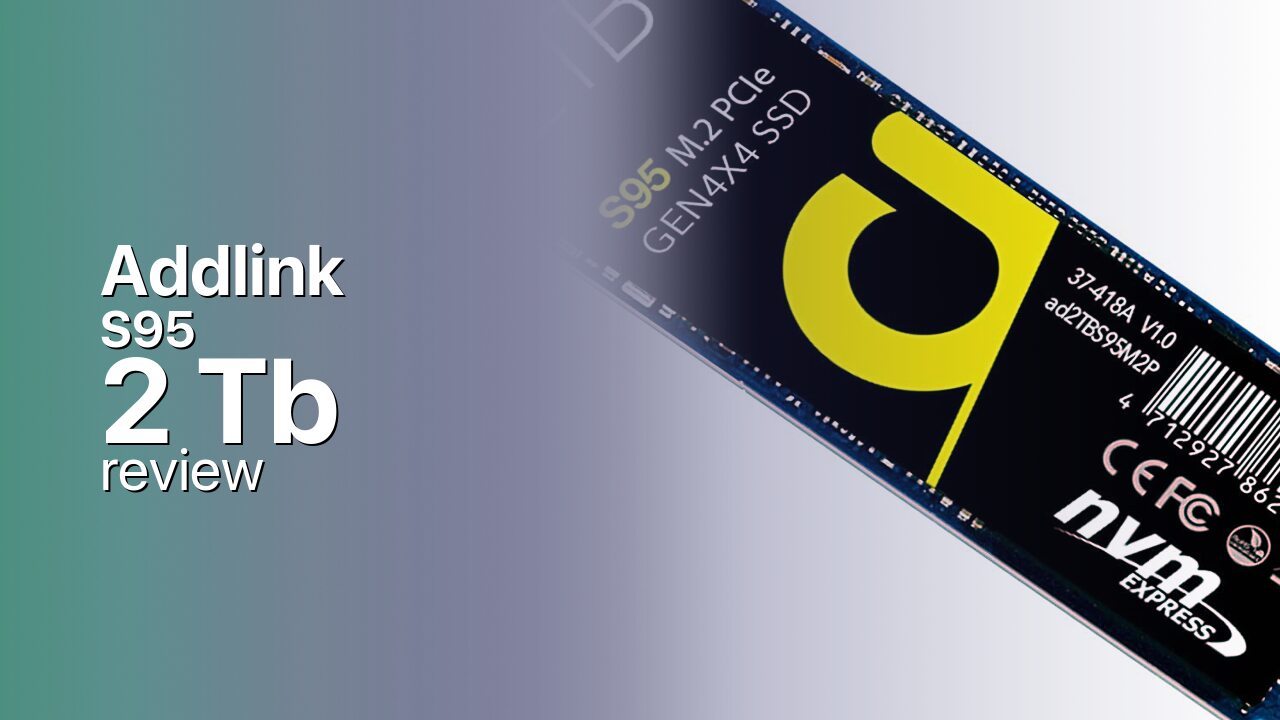
The 2 TB Addlink S95 is built on the Phison PS5018-E18, the 8-channel PCIe 4.0 controller that powered the fastest consumer SSDs before PCIe 5.0 arrived. It pairs the E18 with a DDR4-2666 DRAM cache and Micron 3D TLC NAND spread across both sides of the M.2 2280 PCB. The 2 TB capacity doubles the endurance to 1,400 TBW and fills all available NAND channels, which is what enables the full 6,800 MB/s sequential write speed — the 1 TB variant shares the same controller but may not achieve the same write ceiling on paper.
Addlink also sells the S95 in a 1 TB capacity, which carries 700 TBW endurance. The 2 TB reviewed here is the pick for a single-drive desktop solution — enough space for an OS, a deep game library, and media or project files. The S95 is one of several E18 reference-design drives on the market, joined by the Sabrent Rocket 4 Plus, Corsair MP600 Pro, and Seagate FireCuda 530. All share the same controller silicon; differences come down to NAND vendor, firmware tuning, and the brand's support infrastructure.
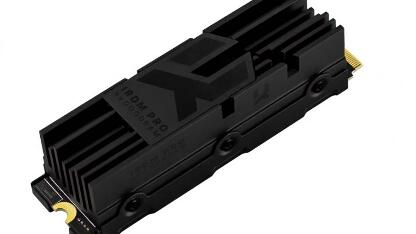
The S95 ships as a bare drive without a heatsink. The E18 runs cooler than first-gen PCIe 4.0 controllers but still needs a heatsink for sustained writes — a motherboard M.2 cover or third-party solution is recommended. As a smaller brand, Addlink cannot match Samsung or WD on firmware update cadence or warranty ease, but the underlying Phison platform is proven and widely deployed. For a builder who reads spec sheets and buys silicon rather than marketing, the 2 TB S95 is one of the most cost-effective ways into a full-speed E18 drive.
Storage Comparisons:
S95 Performance & Benchmarks
Addlink rates the S95 2 TB at up to 7,100 MB/s sequential reads and 6,800 MB/s sequential writes — the practical ceiling of the Phison E18 platform on PCIe 4.0 x4. Random performance is rated at up to 650,000 read IOPS and 700,000 write IOPS. In practice, game loads, OS boots, and application launches are indistinguishable from any high-end NVMe drive — the measurable differences between the S95 and a Samsung 990 Pro exist only in synthetic benchmarks and sustained sequential transfers.
Addlink S95 2 TB vs M.2 4.0 x 4 peers
Switch between sequential throughput and random IOPS to see how this drive stacks up against other M.2 4.0 x 4 SSDs in our database. The highlighted bar is the drive on this page — click any other bar to open that drive.
- Patriot Viper PV593 1 TB: 14,500 MB/s read, 14,000 MB/s write
- Patriot Viper PV593 2 TB: 14,500 MB/s read, 14,000 MB/s write
- Patriot Viper PV593 4 TB: 14,500 MB/s read, 14,000 MB/s write
- Patriot Viper PV573 2 TB: 14,000 MB/s read, 12,000 MB/s write
- Addlink S95 2 TB (this drive): 7,100 MB/s read, 6,800 MB/s write
The 2 TB capacity benefits from a larger SLC write cache than the 1 TB — roughly 300—350 GB based on independent testing of the E18 platform — after which direct-to-TLC writes settle in the 1,500—2,000 MB/s range. This means even large game installs, 4K video ingest, and backup jobs stay at full speed across meaningful transfer sizes. The E18 controller is more thermally efficient than its E16 predecessor but still requires a heatsink for sustained workloads: without one, sequential writes can push the controller past 75 °C and trigger throttling within 5—10 minutes. A motherboard M.2 heatsink resolves this on any desktop board with case airflow.
Addlink S95 vs Competitors
See how the S95 stacks up against other M.2 4.0 x 4 drives in our database:
Compare with rival drives:
Endurance, TBW & Warranty
The 2 TB Addlink S95 carries a 1,400 TBW endurance rating and a 5-year limited warranty, whichever limit is reached first. At a typical desktop write rate of 20—50 GB per day, this translates to roughly 75 to 190 years of usable life. The MTBF is rated at 1.8 million hours. For context, the Samsung 980 Pro 2 TB is rated at 1,200 TBW and the WD Black SN850X 2 TB at 1,200 TBW — the S95 offers roughly 17% more rated endurance. The 1 TB variant is rated at 700 TBW. Addlink handles warranty claims through its distribution network; as a smaller brand, turnaround times may not match the instant-advance-RMA programs that Samsung and WD offer.
Addlink S95 2 TB Specifications
| Category | Value |
|---|---|
| Capacity [?] | 2 TB |
| Interface [?] | M.2 4.0 x 4 |
| Controller [?] | Phison PS5018-E18 |
| Memory type [?] | Micron 3D TLC |
| DRAM [?] | DDR4 Cache |
| Read speed (MB/s) [?] | 7100 |
| Write speed (MB/s) [?] | 6800 |
| Read IOPS [?] | 650000 |
| Write IOPS [?] | 700000 |
| Endurance (TBW) [?] | 1400 |
| MTBF (million hours) [?] | 1.8 |
| Warranty (years) [?] | 5 |
Verdict: Is the S95 Worth It in 2026?
The Addlink S95 2 TB is a full-speed Phison E18 drive sold at a price that reflects the brand, not the silicon. It delivers the same controller, DRAM, and PCIe 4.0 throughput as drives that cost 20—40% more from Sabrent and Corsair, with an endurance rating that beats Samsung and WD's 2 TB flagships. Buy the S95 if you want maximum E18 performance per dollar and are comfortable with a smaller brand's support ecosystem. Skip it if you prioritise firmware update longevity, seamless warranty claims, or the peace of mind that comes with a Samsung or WD logo on your boot drive — those premiums buy real value in post-purchase support. The S95 is a spec-sheet specialist, and at 2 TB it is the capacity that lets that Phison silicon stretch its legs.
+ Pros
- 7,100 MB/s reads and 6,800 MB/s writes on the Phison E18
- 1,400 TBW endurance — beats Samsung 980 Pro 2 TB by 17%
- DDR4 DRAM cache for consistent mixed-workload latency
- 5-year warranty on a proven flagship controller
- Larger SLC cache than the 1 TB variant for sustained writes
- Costs less than brand-name E18 equivalents
- Cons
- No factory heatsink — must budget for one separately
- Smaller brand — warranty and firmware support less certain
- Double-sided PCB may conflict with some thin M.2 slots
- Phison E18 requires a heatsink for sustained write workloads
- Limited retail availability outside select online channels
Buy this or similar SSD Storage:



Video Review
Can an Amazon 1TB SSD compete with a Samsung EVO? Actually... yes | Hardware