Galax HOF Pro 2TB — PCIe 4.0 NVMe SSD Review (2026)
Quick answer
The Galax HOF Pro 2 TB is the definitive expression of the Phison E16 platform at its highest capacity.
Read: 5000 MB/s Write: 4400 MB/s Endurance: 3600 TBW Warranty: 5 years Interface: M.2 4.0 x 4
The Galax HOF Pro 2TB scales the Phison E16 platform to its full potential, delivering 5,000 MB/s reads, a massive 3,600 TBW endurance budget, and the signature white-PCB Hall of Fame aesthetic.
Controller & Memory
The 2 TB variant of Galax's HOF Pro is the capacity point where the Phison E16 platform operates at its fullest. The eight-channel PS5016-E16 controller feeds a full complement of Toshiba BiCS4 96-layer 3D TLC NAND packages, populating every channel with the maximum number of chip-enable lines, which eliminates the parallelism deficit that smaller capacities suffer from. Galax pairs this with 2 GB of DDR4 DRAM for the logical-to-physical mapping table and rates the drive at 5,000 MB/s sequential read, 4,400 MB/s sequential write, and 750,000/700,000 random read/write IOPS — identical headline figures to the 1 TB model, but achieved with far more write-sustain headroom thanks to the doubled NAND pool.
The standout figure for the 2 TB HOF Pro is the 3,600 TBW endurance rating. This is the ceiling of the Phison E16 reference design and represents one of the highest endurance figures ever attached to a consumer PCIe 4.0 drive at any capacity. It translates to approximately 2,000 GB of host writes per day over the 5-year warranty period, or one full drive write per day (1 DWPD). By comparison, the Samsung 980 PRO 2 TB carries 1,200 TBW, the WD Black SN850 2 TB is rated at 1,200 TBW, and even the workstation-oriented Samsung 990 PRO 2 TB tops out at 1,200 TBW. The HOF Pro 2 TB more than doubles them all. This endurance headroom is a direct consequence of the E16's conservative firmware tuning — it allocates a smaller fraction of the NAND array to pseudo-SLC caching than newer controllers, which means less write amplification when the cache fills and data is folded into TLC, at the cost of a shorter burst-write ceiling before the cache transition occurs.
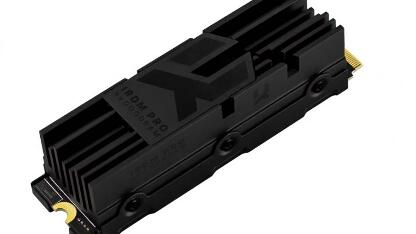
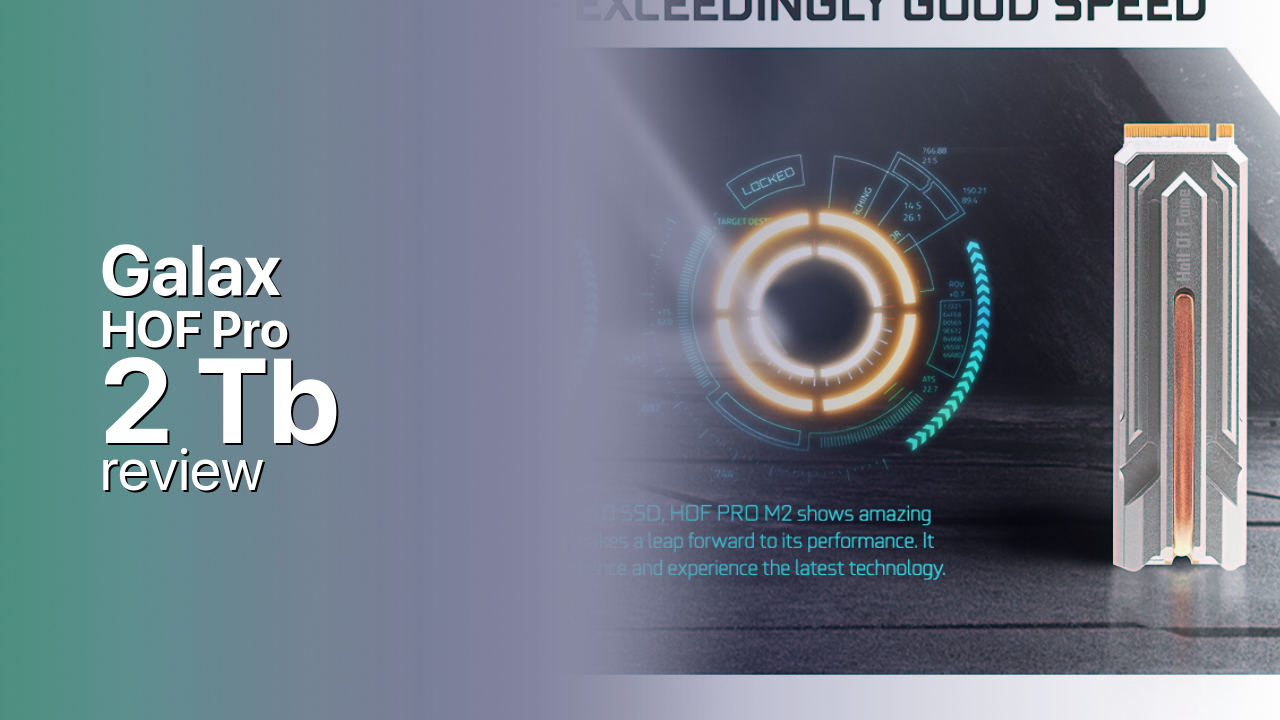
Physically, the 2 TB model shares the same distinctive white PCB and chrome-finished finned aluminium heatsink as the 1 TB variant. The added NAND packages make the 2 TB a double-sided M.2 2280 module, so it will not fit in ultra-thin laptop bays that require single-sided drives, though it installs without issue in any desktop M.2 slot, the PlayStation 5's expansion bay, and most gaming laptops. Galax's included heatsink is functional and keeps the 28 nm E16 controller in the low 60s °C under sustained writes, but its height means it may conflict with motherboard M.2 slot covers and it definitely will not fit under the PS5's bay cover. For a 2 TB drive with DRAM, 3,600 TBW, and an included heatsink, the HOF Pro historically occupied an aggressive price point relative to Samsung and WD flagships, making it a value champion for users who prioritise longevity and sustained-write stamina over the highest peak throughput.
Storage Comparisons:
HOF Pro Performance & Benchmarks
The 2 TB HOF Pro benefits from the E16 platform's full parallelism, and the results show most clearly in sustained write behaviour. In CrystalDiskMark, sequential reads and cached writes land at the expected 5,000 and 4,400 MB/s respectively, with QD1 4K random reads in the 65–70 MB/s range. The real difference versus the 1 TB model emerges in the pSLC cache size and the post-cache TLC write speed. The 2 TB variant carves a pSLC cache of roughly 220–260 GB from the TLC array (compared to 110–130 GB on the 1 TB), which means a single sustained write of up to a quarter-terabyte completes at the full 4,400 MB/s before the controller transitions to direct-to-TLC programming. Once the cache is exhausted, the native TLC write speed settles at approximately 1,500–1,800 MB/s — noticeably higher than the 1 TB model's 1,200–1,500 MB/s, because the 2 TB's full NAND population allows more interleaving across dies during the slower TLC program phase.
Galax HOF Pro 2 TB vs M.2 4.0 x 4 peers
Switch between sequential throughput and random IOPS to see how this drive stacks up against other M.2 4.0 x 4 SSDs in our database. The highlighted bar is the drive on this page — click any other bar to open that drive.
- Patriot Viper PV593 1 TB: 14,500 MB/s read, 14,000 MB/s write
- Patriot Viper PV593 2 TB: 14,500 MB/s read, 14,000 MB/s write
- Patriot Viper PV593 4 TB: 14,500 MB/s read, 14,000 MB/s write
- Patriot Viper PV573 2 TB: 14,000 MB/s read, 12,000 MB/s write
- Galax HOF Pro 2 TB (this drive): 5,000 MB/s read, 4,400 MB/s write
This combination of a large cache and a strong post-cache write floor makes the 2 TB HOF Pro particularly well-suited to content-creation workflows where large file transfers are routine. A 200 GB video project export completes entirely within the pSLC cache; a 500 GB shoot ingest transitions to TLC writes roughly halfway through but at a rate that still outruns most source media (CFexpress, SATA SSDs, external HDDs). Thermally, the included finned heatsink holds the controller at 60–65 °C during sustained writes, with no throttling. Without the heatsink in still air, the controller reaches the mid-70s °C and engages a mild throttle of 8–12%, which is still well above the post-cache TLC speed floor and therefore invisible in most practical scenarios.
Galax HOF Pro vs Competitors
See how the HOF Pro stacks up against other M.2 4.0 x 4 drives in our database:
Compare with rival drives:
Endurance, TBW & Warranty
Galax covers the HOF Pro 2 TB with a 5-year limited warranty and an endurance ceiling of 3,600 TBW. This is the maximum endurance that the Phison E16 reference platform supports for a 2 TB TLC configuration, and it is objectively one of the highest TBW figures in the consumer PCIe 4.0 segment regardless of brand or controller generation. For context, 3,600 TBW at 2 TB represents one full drive write per day for 5 years (1 DWPD) — a rating more commonly associated with enterprise SATA drives than consumer NVMe products. Even heavy workstation workloads rarely exceed 0.3–0.5 DWPD on a 2 TB volume, so the practical likelihood of exhausting the HOF Pro's endurance within the warranty period is near zero for all but the most extreme write-intensive edge cases (24/7 surveillance recording, continuous high-speed data acquisition). The 5-year warranty is administered through Galax's regional distribution partners rather than a centralised global portal, so warranty service quality may vary by region. Galax's TBW counter tracks host writes via standard NVMe SMART attribute 0xF5, making it straightforward to monitor remaining endurance using any utility that reads SMART data.
Galax HOF Pro 2 TB Specifications
| Category | Value |
|---|---|
| Capacity [?] | 2 TB |
| Interface [?] | M.2 4.0 x 4 |
| Controller [?] | Phison PS5016-E16 |
| Memory type [?] | Toshiba 3D TLC |
| DRAM [?] | DDR4 Cache |
| Read speed (MB/s) [?] | 5000 |
| Write speed (MB/s) [?] | 4400 |
| Read IOPS [?] | 750000 |
| Write IOPS [?] | 750000 |
| Endurance (TBW) [?] | 3600 |
| MTBF (million hours) [?] | 1.7 |
| Warranty (years) [?] | 5 |
Verdict: Is the HOF Pro Worth It in 2026?
The Galax HOF Pro 2 TB is the definitive expression of the Phison E16 platform at its highest capacity. The 3,600 TBW endurance rating is a legitimate differentiator that no Samsung, WD, or Crucial consumer drive at 2 TB can touch, and the included finned heatsink is a practical inclusion that eliminates the need for aftermarket cooling in all but the most constrained installations. The trade-offs are well understood at this point in the E16's lifecycle: 5,000 MB/s reads and 4,400 MB/s writes are now entry-level PCIe 4.0 figures, outclassed by the ~7,400 MB/s of second-generation E18 and in-house PCIe 4.0 controllers, and the 28 nm fabrication node means higher idle power consumption than 12 nm or 8 nm alternatives. For a workstation scratch disk, a content-creation ingest drive, or a power user's primary volume where terabytes of writes will accumulate over years of use, the HOF Pro 2 TB remains a uniquely durable option in a market that has largely traded endurance for peak throughput. For gaming and general productivity, a newer DRAM-less TLC drive will deliver equivalent real-world responsiveness at lower cost and power, but it will not match the HOF Pro's staying power under sustained write loads.
+ Pros
- 3,600 TBW endurance — class-leading at any price
- Large ~250 GB pSLC write cache on the 2 TB model
- Included finned aluminium heatsink eliminates throttling
- 5-year warranty with high endurance headroom
- Striking white PCB and HOF visual identity
- Strong post-cache TLC write speed of 1,500–1,800 MB/s
- Cons
- 5,000/4,400 MB/s now entry-level for PCIe 4.0
- Double-sided PCB may not fit ultra-thin laptops
- Included heatsink too tall for PS5 bay cover
- 28 nm controller idles at higher power than newer nodes
- Galax warranty service varies by region
Buy this or similar SSD Storage:



Video Review
Análisis Térmico GALAX HOF Pro M.2 NVMe PCIe Gen4 x4 2TB SSD