BIWIN Black Opal X570 Pro 1TB — PCIe 5.0 NVMe SSD Review (2026)
Quick answer
The BIWIN Black Opal X570 Pro 1TB is a technically sound PCIe 5.0 NVMe drive that delivers what it promises: 14,000 MB/s sequential reads, 10,500 MB/s writes, and a 6nm SM2508 controller that runs cooler than the first-generation Phison E26 drives that dominate this segment.
Read: 14000 MB/s Write: 10500 MB/s Endurance: 750 TBW Warranty: 5 years Interface: M.2 5.0
The BIWIN Black Opal X570 Pro 1TB is a PCIe 5.0 NVMe SSD built on Silicon Motion's SM2508 controller with Micron 232-layer TLC NAND, rated at 14,000 MB/s sequential reads and 10,500 MB/s writes in the compact single-sided M.2 2280 form factor.
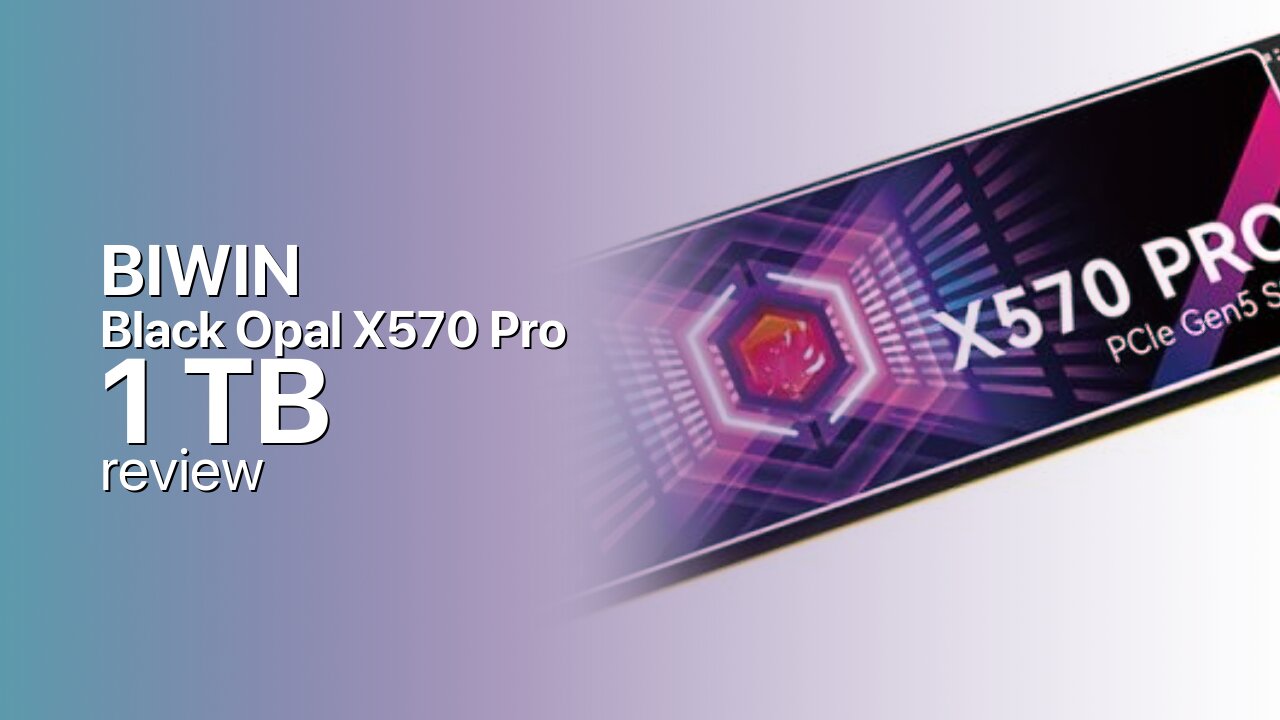
Controller & Memory
Inside the Black Opal X570 Pro sits Silicon Motion's SM2508 — an 8-channel, 6nm PCIe 5.0 controller that is newer and more power-efficient than the 12nm Phison E26 that defined the first wave of Gen5 consumer drives. Paired with 1GB of LPDDR4 DRAM for logical-to-physical address mapping and Micron 232-layer TLC NAND, the X570 Pro operates on PCIe Gen5 x4 (NVMe 2.0) and ships in the standard M.2 2280 single-sided configuration. Single-sided construction keeps the drive within the height clearance required for PS5 expansion and thin laptops with M.2 slot covers, which rules out a number of competing Gen5 drives on those platforms. A graphene thermal film bonded to the NAND package provides passive heat spreading without a traditional aluminium heatsink.
BIWIN (BIWIN Storage Technology Co., Ltd.) is a Shenzhen-based manufacturer with a long history supplying embedded NAND and memory modules to OEM customers — the consumer SSD lineup under the Black Opal branding is a more recent push into the retail market. That context matters for buyers: BIWIN does not have the retail footprint or independent benchmark library of Samsung, WD, or Crucial, though review coverage from KitGuru, igorslab, and Tom's Hardware has grown as the X570 Pro has become more widely available. The 1TB model is the entry point of the lineup, with 2TB and 4TB variants offering higher sequential write speeds (13,000 MB/s) and larger IOPS ratings due to additional NAND die parallelism.
At the PCIe 5.0 tier the Black Opal X570 Pro 1TB competes with the Crucial T705 1TB, Corsair MP700 Pro 1TB, and Seagate FireCuda 540 1TB, most of which use the Phison E26 platform. The SM2508 is a direct competitor to the E26, occupying the same performance tier with a more modern manufacturing process. Pricing for the 1TB model has been reported at approximately $150 USD, which is in line with comparable Phison E26 drives at the same capacity.
Storage Comparisons:
Black Opal X570 Pro Performance & Benchmarks
The BIWIN Black Opal X570 Pro 1TB is rated at 14,000 MB/s sequential reads and 10,500 MB/s sequential writes on PCIe 5.0 x4 — figures that are in line with the first generation of Gen5 consumer SSDs. The 10,500 MB/s write rating is lower than the 2TB and 4TB variants (rated at 13,000 MB/s) because the 1TB model has fewer NAND die available for simultaneous operations and a smaller pSLC write cache. This is a normal capacity-scaling characteristic rather than a quality issue.
BIWIN Black Opal X570 Pro 1 TB vs M.2 5.0 peers
Switch between sequential throughput and random IOPS to see how this drive stacks up against other M.2 5.0 SSDs in our database. The highlighted bar is the drive on this page — click any other bar to open that drive.
- Corsair MP700 Pro XT 1 TB: 14,900 MB/s read, 14,200 MB/s write
- Corsair MP700 Pro XT 2 TB: 14,900 MB/s read, 14,500 MB/s write
- Corsair MP700 Pro XT 4 TB: 14,900 MB/s read, 14,400 MB/s write
- Crucial T710 1 TB: 14,900 MB/s read, 13,800 MB/s write
- BIWIN Black Opal X570 Pro 1 TB (this drive): 14,000 MB/s read, 10,500 MB/s write
For random access, BIWIN rates the 1TB at 1,600,000 read IOPS and 1,600,000 write IOPS. In workloads that exercise sustained sequential throughput — video editing, large game asset transfers, bulk media ingestion — the 14,000 MB/s read figure represents roughly double the bandwidth available on the fastest PCIe 4.0 x4 drives. For DirectStorage-enabled titles that decompress game assets from the SSD to the GPU, the Gen5 bandwidth headroom is directly exploitable. For everyday OS and application use, the difference over a well-optimised PCIe 4.0 drive narrows substantially, as those workloads are gated by random 4K latency and OS overhead rather than sequential bandwidth.
The SM2508's 6nm process gives it a thermal advantage over the 12nm Phison E26. KitGuru's 4TB X570 Pro thermal testing recorded a peak of 60°C under stress without an external heatsink, which is notably cooler than equivalent E26 testing. The graphene thermal film on the NAND contributes to this. That said, the drive is not recommended for installations without any airflow or thermal contact, and motherboards with built-in M.2 thermal pads are the preferred environment for sustained-write workloads. The 1GB LPDDR4 DRAM cache is sized for the 1TB capacity and ensures the SLC buffer is backed by real on-board address-translation memory rather than the Host Memory Buffer workaround used by DRAMless designs.
BIWIN Black Opal X570 Pro vs Competitors
See how the Black Opal X570 Pro stacks up against other M.2 5.0 drives in our database:
Compare with rival drives:
Endurance, TBW & Warranty
BIWIN backs the Black Opal X570 Pro with a 5-year limited warranty across all capacity variants. The 1TB model carries a TBW (terabytes written) endurance rating of 750 TBW — the total write volume covered before the endurance warranty clause applies. At a typical desktop write workload of 30 GB per day, 750 TBW represents approximately 68 years of use before the endurance budget is exhausted. Even at a heavier 100 GB per day write rate — common in content creation workflows — the drive would take over 20 years to reach its rated limit. The 5-year clock will expire long before TBW becomes relevant for the vast majority of buyers. Video editors and data engineers writing 300 GB or more per day will see a shorter effective horizon, but that use case is better served by the 2TB or 4TB models with their 1,500 TBW and 3,000 TBW ratings respectively. Warranty service is handled through BIWIN's support process; as a brand with limited retail presence in Western markets, buyers should confirm regional warranty availability before purchasing from grey-market or import channels.
BIWIN Black Opal X570 Pro 1 TB Specifications
| Category | Value |
|---|---|
| Capacity [?] | 1 TB |
| Interface [?] | M.2 5.0 |
| Controller [?] | Silicon Motion SM2508 8 Channel |
| Memory type [?] | Micron 232-L TLC |
| DRAM [?] | Yes |
| Read speed (MB/s) [?] | 14000 |
| Write speed (MB/s) [?] | 10500 |
| Read IOPS [?] | 1600000 |
| Write IOPS [?] | 1600000 |
| Endurance (TBW) [?] | 750 |
| MTBF (million hours) [?] | 2000000 |
| Warranty (years) [?] | 5 |
Verdict: Is the Black Opal X570 Pro Worth It in 2026?
The BIWIN Black Opal X570 Pro 1TB is a technically sound PCIe 5.0 NVMe drive that delivers what it promises: 14,000 MB/s sequential reads, 10,500 MB/s writes, and a 6nm SM2508 controller that runs cooler than the first-generation Phison E26 drives that dominate this segment. The 5-year warranty and 750 TBW endurance rating are competitive for the price. The single-sided M.2 2280 design is a practical advantage for PS5 installations and laptops with strict M.2 height clearances.
The honest caveats are brand recognition and retail availability. BIWIN does not yet have the review depth, tooling ecosystem, or established return/RMA network in Western markets that Samsung, WD, or Crucial offer. Buyers comfortable purchasing from a Shenzhen-based manufacturer with growing but limited Western retail presence will find the X570 Pro 1TB a competitive choice at its price point. Buyers who prioritise established brand support and the broadest compatibility software ecosystem should look at the Crucial T705 1TB or Corsair MP700 Pro 1TB first. The 1TB write speed of 10,500 MB/s is also noticeably lower than the 2TB model's 13,000 MB/s; users who anticipate sustained-write workloads should budget for the 2TB.
+ Pros
- 14,000 MB/s sequential reads on PCIe 5.0 x4
- Silicon Motion SM2508 controller on 6nm — runs cooler than Phison E26
- Micron 232-layer TLC NAND with 1GB LPDDR4 DRAM cache
- Single-sided M.2 2280 — compatible with PS5 and slim laptops
- 5-year warranty with 750 TBW endurance
- Graphene thermal film for passive heat spreading without a bulky heatsink
- NVMe 2.0 with PCIe 4.0 and 3.0 backward compatibility
- Cons
- Sequential write speed (10,500 MB/s) is notably lower than the 2TB/4TB models (13,000 MB/s)
- Limited brand recognition and retail presence in Western markets
- No bundled heatsink — relies on graphene film alone for thermal management
- Regional warranty support may be limited outside Asia for grey-market imports
- Smaller independent benchmark library than established brands like Samsung or WD
Buy this or similar SSD Storage:



Video Review
CRAZY FAST Biwin X570 Pro 2TB 14000MBPS PCIe Gen5 NVME m2 with DRAM cache