Corsair MP600 Core 4TB — High-Capacity QLC NVMe SSD (2026)
Quick answer
The Corsair MP600 Core 4 TB is the capacity where QLC PCIe 4.0 starts to justify itself.
Read: 4950 MB/s Write: 3950 MB/s Endurance: 800 TBW Warranty: 5 years Interface: M.2 4.0 x 4
The Corsair MP600 Core 4 TB is the flagship of Corsair's QLC PCIe 4.0 lineup, using dense Micron 96-layer NAND and the Phison E16 controller to deliver near-TLC performance at the highest capacity the series offers.
Controller & Memory
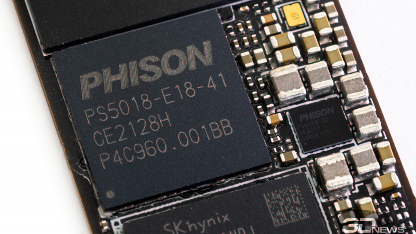
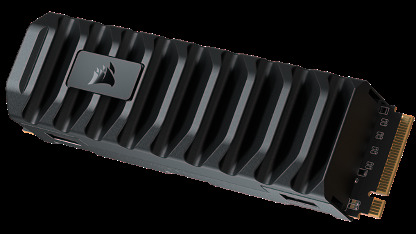
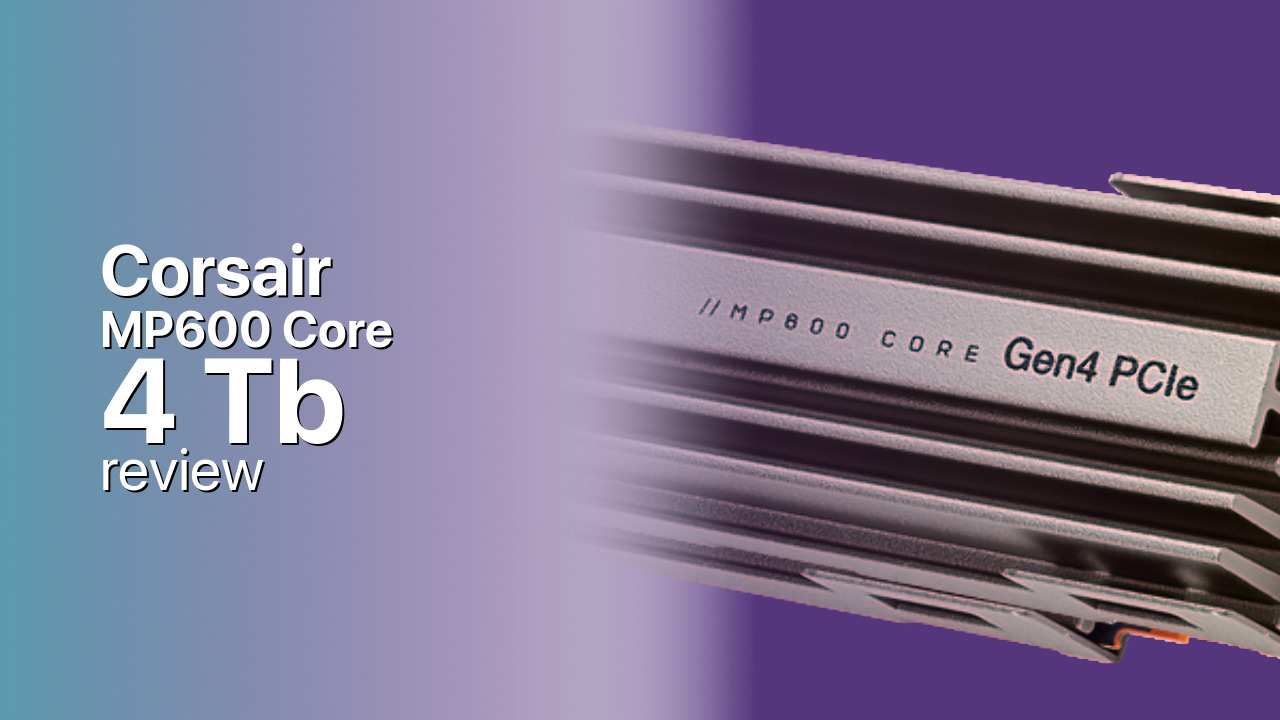
The 4 TB MP600 Core packs eight Micron 96L QLC NAND packages and 2 GB of SK Hynix LPDDR4 DRAM onto a double-sided M.2 2280 PCB, all under the same gunmetal aluminum heatsink found on the smaller capacities. The Phison PS5016-E16 8-channel controller leverages the massive NAND die count for the best performance in the Core series — 4,950 MB/s reads and 3,950 MB/s writes are within striking distance of early TLC PCIe 4.0 drives.
A double-sided PCB means this drive may not fit in some ultra-thin laptops or single-sided-only M.2 slots; check your system's clearance before buying. For desktops and the PS5, thickness is the more relevant constraint, and the factory heatsink adds roughly 7 mm of height. Also available in 1 TB and 2 TB variants, both with lower write speeds and endurance.
At 4 TB, the QLC architecture starts working in its favor. More NAND die means deeper write queues, larger pseudo-SLC caches (the 4 TB model can allocate significantly more space to the write cache), and higher sustained writes before the QLC cliff hits. The main competitors at this capacity are the Sabrent Rocket Q4 4 TB (same Phison E16 + QLC platform) and the Crucial P3 Plus 4 TB (DRAM-less QLC, PCIe 4.0). TLC alternatives at 4 TB, like the Samsung 990 Pro 4 TB, command a significant price premium.
Storage Comparisons:
MP600 Core Performance & Benchmarks
The MP600 Core 4 TB leads its siblings with 4,950 MB/s sequential reads, 3,950 MB/s sequential writes, 630K random read IOPS, and 580K random write IOPS. These are the best numbers in the Core lineup and represent what the Phison E16 platform can achieve when given maximum NAND parallelism. AnandTech's testing of the 4 TB Sabrent Rocket Q4 — an identical platform — found that the large SLC cache on high-capacity QLC drives can absorb over 100 GB of writes before exhausting, after which speeds settle to QLC-native levels around 80–150 MB/s depending on the workload.
Corsair MP600 Core 4 TB vs M.2 4.0 x 4 peers
Switch between sequential throughput and random IOPS to see how this drive stacks up against other M.2 4.0 x 4 SSDs in our database. The highlighted bar is the drive on this page — click any other bar to open that drive.
- Patriot Viper PV593 1 TB: 14,500 MB/s read, 14,000 MB/s write
- Patriot Viper PV593 2 TB: 14,500 MB/s read, 14,000 MB/s write
- Patriot Viper PV593 4 TB: 14,500 MB/s read, 14,000 MB/s write
- Patriot Viper PV573 2 TB: 14,000 MB/s read, 12,000 MB/s write
- Corsair MP600 Core 4 TB (this drive): 4,950 MB/s read, 3,950 MB/s write
The real-world implication is that the 4 TB model is the only MP600 Core variant where QLC does not feel like a compromise for most users. Game loads, application launches, and typical desktop tasks are indistinguishable from TLC PCIe 4.0 drives. Even moderate file transfers stay within the SLC cache. Only sustained writes exceeding 100 GB — think cloning a full drive or exporting hours of 4K video — will trigger the QLC cliff, and even then the larger cache delays it significantly compared to the 1 TB model.
Corsair MP600 Core vs Competitors
See how the MP600 Core stacks up against other M.2 4.0 x 4 drives in our database:
Compare with rival drives:
Endurance, TBW & Warranty
Corsair rates the MP600 Core 4 TB at 800 TBW endurance with a five-year limited warranty. At 800 TBW, you can write approximately 438 GB per day for five years before reaching the rated limit. For a 4 TB drive used primarily as a game library and media storage — where most operations are reads — this is more than sufficient. The 1.7 million hour MTBF figure matches the rest of the Core series. Corsair's SSD Toolbox software provides S.M.A.R.T. health data, estimated remaining endurance, and firmware update capability. Warranty claims go through Corsair's online portal; the drive must be registered for the full five-year coverage.
Corsair MP600 Core 4 TB Specifications
| Category | Value |
|---|---|
| Capacity [?] | 4 TB |
| Interface [?] | M.2 4.0 x 4 |
| Controller [?] | Phison PS5016-E16 |
| Memory type [?] | 3D QLC |
| DRAM [?] | SK Hynix DRAM Cache |
| Read speed (MB/s) [?] | 4950 |
| Write speed (MB/s) [?] | 3950 |
| Read IOPS [?] | 630000 |
| Write IOPS [?] | 580000 |
| Endurance (TBW) [?] | 800 |
| MTBF (million hours) [?] | 1.7 |
| Warranty (years) [?] | 5 |
Verdict: Is the MP600 Core Worth It in 2026?
The Corsair MP600 Core 4 TB is the capacity where QLC PCIe 4.0 starts to justify itself. The 3,950 MB/s writes, 630K random read IOPS, and a large pseudo-SLC cache make this the most consistent performer in the Core lineup. Add 800 TBW endurance and a five-year warranty, and it becomes a strong contender for a high-capacity game library or media drive. The catch is the double-sided PCB, which rules out some laptops and single-sided M.2 slots. If your system can accommodate it, and you value capacity and price-per-GB over absolute peak write speed, the MP600 Core 4 TB is a practical alternative to pricier TLC options like the Samsung 990 Pro 4 TB. Content creators who constantly write large files should still lean toward TLC; everyone else will find little reason to pay more.
+ Pros
- 4,950 MB/s reads, 3,950 MB/s writes — best in Core lineup
- 630K random read IOPS, 580K random write IOPS
- 800 TBW endurance with 5-year warranty
- Large pseudo-SLC cache absorbs 100+ GB sustained writes
- 2 GB LPDDR4 DRAM cache
- Factory heatsink included
- Cons
- Double-sided PCB may not fit thin laptops
- QLC write speeds still drop after cache exhaustion
- No hardware AES encryption
- Factory heatsink adds height — may conflict with some motherboard shields
- NVMe 1.3 protocol, not NVMe 1.4
Buy this or similar SSD Storage:



Video Review
Worth the Premium Price? - Corsair MP600 PRO Review