Corsair MP700 Pro XT 1TB — PCIe 5.0 NVMe SSD for Enthusiasts (2026)
Quick answer
The Corsair MP700 Pro XT 1TB makes a strong case as the entry point into Phison's E28 generation: 14,900 MB/s reads, 3.3 million write IOPS, low operating power, and Corsair's 5-year warranty behind it.
Read: 14900 MB/s Write: 14200 MB/s Endurance: 700 TBW Warranty: 5 years Interface: M.2 5.0
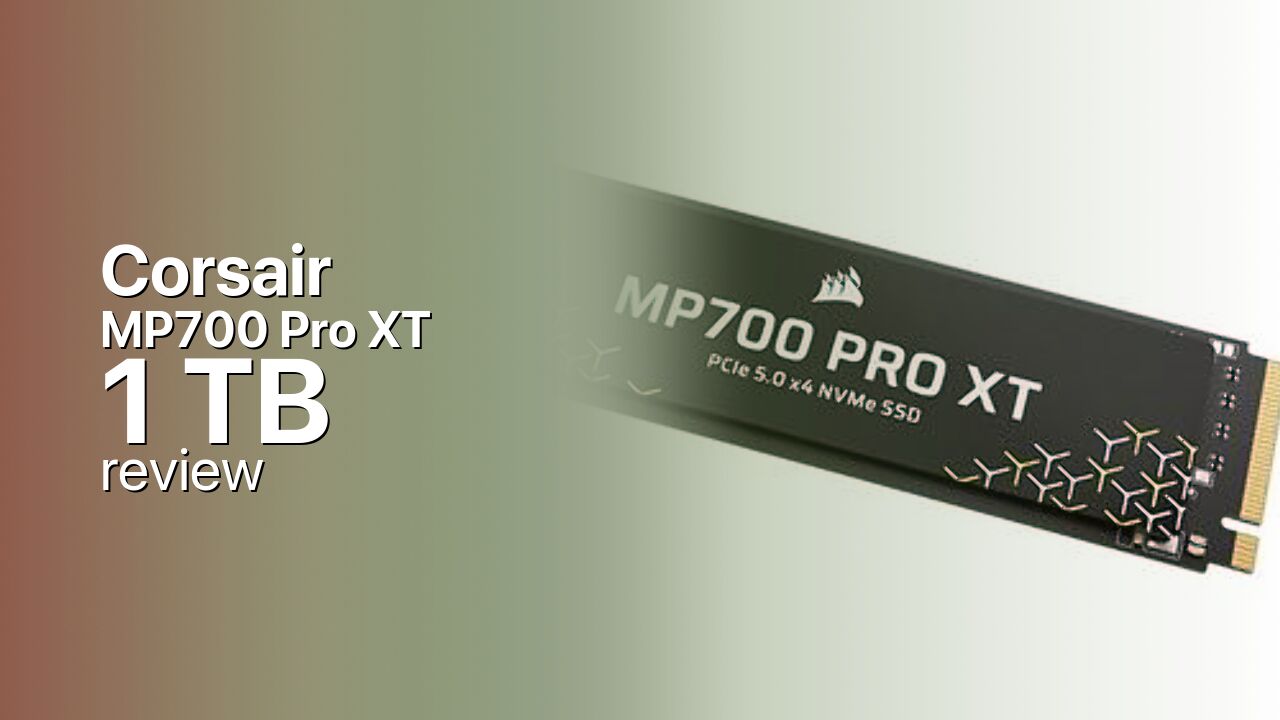
The Corsair MP700 Pro XT 1TB is a PCIe 5.0 NVMe drive built on the Phison PS5028-E28 controller with Kioxia BiCS8 218-layer TLC NAND, rated at 14,900 MB/s sequential reads and 14,200 MB/s sequential writes.
Controller & Memory
At the core of the MP700 Pro XT sits Phison's PS5028-E28: an 8-channel, 6nm PCIe 5.0 controller and the direct successor to the E26 that powered Corsair's previous flagship, the MP700 Pro. The E28 delivers a meaningful generational improvement — not just in peak bandwidth but in power efficiency, dropping typical operating power to 3–4W versus the 6–9W common on first-generation Gen5 drives. That thermal and efficiency advantage matters in real-world use, where sustained workloads on E26 platforms often triggered aggressive throttling without active cooling.
Corsair pairs the E28 with Kioxia BiCS8 218-layer 3D TLC NAND and 1GB of SK hynix LPDDR4 DRAM for the logical-to-physical address translation table. The DRAM is sized at 1GB per terabyte of capacity, a ratio consistent with well-specified SSDs in this segment. The drive ships without a heatsink, but a copper thermal layer embedded in the product label provides passive heat spreading, and the E28's improved power envelope means the drive copes well with standard M.2 thermal pads that most Z890 and X670E motherboards include.
The MP700 Pro XT is the second major PCIe 5.0 product from Corsair and represents a deliberate step up from the original MP700 (also E26-based, pre-dating the Pro branding). Corsair positions the Pro XT as its performance flagship, competing directly with the Crucial T705, Seagate FireCuda 540, and ADATA XPG Legend 970 Pro — all of which use either E26 or E28 controllers at the PCIe 5.0 tier. Against PCIe 4.0 alternatives like the WD Black SN850X or Samsung 990 Pro, the raw sequential bandwidth advantage is substantial, though those older drives still hold ground in fine-grained random access patterns that matter most for OS and application responsiveness.
The 1TB model is the entry-level capacity in the Pro XT lineup, joined by 2TB and 4TB variants. Higher capacities benefit from greater NAND die parallelism, which translates to higher sequential write speeds (14,500 MB/s for the 2TB) and a larger pSLC write cache. For most workloads — gaming installs, OS drives, large-file transfers — the 1TB's 14,200 MB/s write and 14,900 MB/s read are more than sufficient, and the smaller footprint keeps acquisition cost at the lower end of the Gen5 range.
Storage Comparisons:
MP700 Pro XT Performance & Benchmarks
The Corsair MP700 Pro XT 1TB is rated at 14,900 MB/s sequential reads and 14,200 MB/s sequential writes under PCIe 5.0 x4 — bandwidth figures that roughly double the ceiling of the fastest PCIe 4.0 x4 drives. Sequential write speeds on the 1TB sit 300 MB/s below the 2TB model's 14,500 MB/s, a normal result of fewer NAND die operating in parallel and a proportionally smaller pSLC write cache. Once the SLC cache is saturated on large sustained write jobs the 1TB transitions to native TLC write speeds, which are lower; users with heavy sequential-write workloads (video capture, large backup jobs, disk imaging) will feel this ceiling sooner than on the 2TB.
Corsair MP700 Pro XT 1 TB vs M.2 5.0 peers
Switch between sequential throughput and random IOPS to see how this drive stacks up against other M.2 5.0 SSDs in our database. The highlighted bar is the drive on this page — click any other bar to open that drive.
- Corsair MP700 Pro XT 1 TB (this drive): 14,900 MB/s read, 14,200 MB/s write
- Corsair MP700 Pro XT 2 TB: 14,900 MB/s read, 14,500 MB/s write
- Corsair MP700 Pro XT 4 TB: 14,900 MB/s read, 14,400 MB/s write
- Crucial T710 1 TB: 14,900 MB/s read, 13,800 MB/s write
- Team Group Z54E 1 TB: 14,900 MB/s read, 14,000 MB/s write
For random access, Corsair rates the 1TB at 1,500,000 read IOPS and 3,300,000 write IOPS — an asymmetric profile that is characteristic of the Phison E28 architecture. The controller is specifically engineered for high random write density, and the 3.3 million write IOPS figure is among the highest published for a consumer NVMe drive at any capacity. Random read IOPS at 1.5 million is competitive but not exceptional in the Gen5 field; workloads dominated by random reads (database operations, game shader compilation) will not see a meaningful advantage over a well-optimized E26 drive.
Thermal behaviour is a key improvement over the previous-generation MP700 Pro. The E28's 6nm process operates with a typical power draw of 3–4W, allowing the drive to maintain rated speeds under sustained load without active cooling in most consumer motherboard environments. Drives built on the 12nm E26 frequently exceeded 9W and required dedicated airflow or heatsinks to prevent thermal throttling. The copper thermal layer in the MP700 Pro XT's label is a passive supplement, and the drive is well-suited to installations on motherboards with standard M.2 thermal pads.
Corsair MP700 Pro XT vs Competitors
See how the MP700 Pro XT stacks up against other M.2 5.0 drives in our database:
Compare with rival drives:
Endurance, TBW & Warranty
Corsair backs the MP700 Pro XT with a 5-year limited warranty across all capacity variants. The 1TB model carries a TBW (terabytes written) endurance rating of 700 TBW — the cumulative write volume covered before the endurance warranty clause applies. At a typical desktop write workload of 30 GB per day, 700 TBW represents over 63 years of use before the endurance budget is exhausted. Even at 100 GB per day — typical of active content creation workflows — the drive would take nearly 20 years to reach its rated limit. For the overwhelming majority of buyers the 5-year warranty clock will expire long before the TBW ceiling becomes relevant. Video editors or data engineers writing 300 GB or more per day should consider the 2TB model, which carries a higher TBW rating in proportion to its capacity. Corsair handles warranty service directly through its established RMA process, with coverage available across major Western markets through Corsair's retail and online distribution network.
Corsair MP700 Pro XT 1 TB Specifications
| Category | Value |
|---|---|
| Capacity [?] | 1 TB |
| Interface [?] | M.2 5.0 |
| Controller [?] | Phison PS5028-E28 8 Channel |
| Memory type [?] | Kioxia BiCS8 218-L TLC |
| DRAM [?] | Yes |
| Read speed (MB/s) [?] | 14900 |
| Write speed (MB/s) [?] | 14200 |
| Read IOPS [?] | 1500000 |
| Write IOPS [?] | 3300000 |
| Endurance (TBW) [?] | 700 |
| MTBF (million hours) [?] | 2000000 |
| Warranty (years) [?] | 5 |
Verdict: Is the MP700 Pro XT Worth It in 2026?
The Corsair MP700 Pro XT 1TB makes a strong case as the entry point into Phison's E28 generation: 14,900 MB/s reads, 3.3 million write IOPS, low operating power, and Corsair's 5-year warranty behind it. The E28's efficiency advantage over first-generation Gen5 drives is real — this is a PCIe 5.0 SSD that does not require active cooling to sustain performance, which removes one of the main friction points of early Gen5 adoption.
The 1TB is the right buy for enthusiasts building a high-end desktop who want the fastest available interface without the premium for the 2TB. It is a less obvious upgrade for anyone coming from a current PCIe 4.0 drive used primarily for gaming and OS tasks — the sequential bandwidth gap is large on paper but largely invisible in those workloads. Buyers who regularly move large files, work with uncompressed video, or want the most future-proof storage tier available today will find the Pro XT 1TB delivers on its specifications. Those who can wait or stretch budget should compare the 2TB, where higher write speed and a larger SLC cache change the sustained-write picture meaningfully.
+ Pros
- 14,900 MB/s sequential reads — top-tier PCIe 5.0 performance
- Phison E28 (6nm) runs at 3–4W typical — cooler than first-gen E26 drives
- Kioxia BiCS8 218-layer TLC with 1GB SK hynix LPDDR4 DRAM
- 3,300,000 write IOPS — among the highest on any consumer NVMe
- 5-year warranty with 700 TBW endurance
- No external heatsink required for standard consumer workloads
- Corsair brand with established Western RMA and support network
- Cons
- 1TB write speed (14,200 MB/s) is 300 MB/s below the 2TB model
- Premium PCIe 5.0 pricing; limited real-world benefit over Gen4 for gaming and OS use
- No heatsink included — relies on copper label layer and motherboard thermal pads
- Smallest capacity in the Pro XT lineup; heavy sustained-write users will outgrow the TBW budget faster than larger variants
- PCIe 5.0 requires a Gen5-capable M.2 slot to reach rated speeds — older platforms cap at Gen4
Buy this or similar SSD Storage:
Video Review
The Fastest Gen5 SSD? - Corsair MP700 Pro XT Review