PCIe Gen 5 Boot and Primary Game Drive Built Around Next-Generation NAND (2026)
Quick answer
The Crucial T710 1TB is a well-defined PCIe 5.0 drive for the system builder who wants a fast, compact boot and primary game volume without paying for unused capacity.
Read: 14900 MB/s Write: 13800 MB/s Endurance: 600 TBW Warranty: 5 years Interface: M.2 5.0
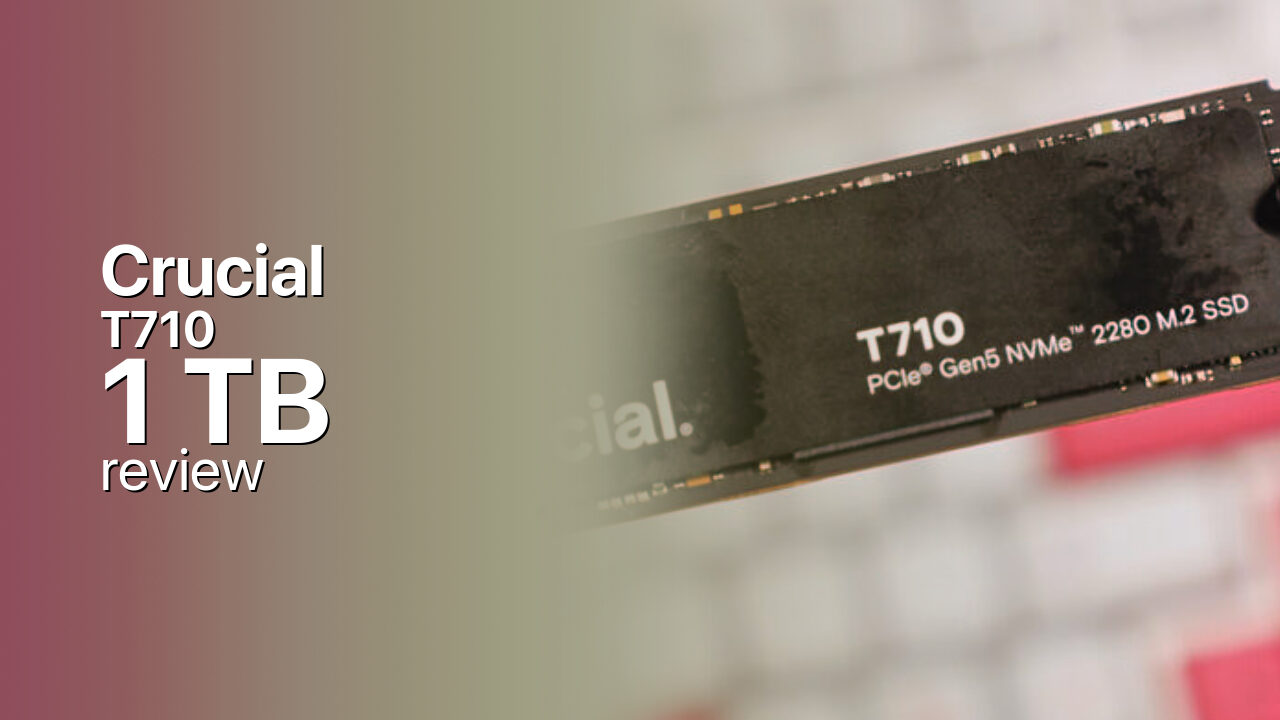
The Crucial T710 1TB pairs the Silicon Motion SM2508 controller with Micron's 276-layer G9 TLC NAND to deliver 14,900 MB/s sequential reads and 2.2 million write IOPS from a single M.2 2280 slot.
Controller & Memory
The Crucial T710 1TB is the entry point into Crucial's second-generation PCIe 5.0 lineup, and it arrives with a hardware change that matters: Micron's G9 276-layer 3D TLC NAND. That is a meaningful step beyond the 232-layer B58R NAND used in the T705 and competing drives from Corsair and others. The extra layers translate to roughly a 50% increase in per-die IO speed, reaching 3.6 GT/s, which the SM2508 controller's eight channels are built to fully exploit. The practical result is higher sustained throughput without increasing die count, which also allows the drive to operate within 8.25 watts — 26.6% below the T705.
The SM2508 is built on TSMC's 6nm process and supports NVMe 2.0, including the L1.2 low-power state, TCG Opal 2.01 encryption, and native DirectStorage compatibility. Paired with 1GB of LPDDR4-4266 DRAM, the controller handles both large sequential transfers and small random workloads efficiently. At 1.8 million read IOPS and 2.2 million write IOPS, the 1TB model's random performance sits below the 2TB and 4TB variants, which reach 2.2 million on both read and write, because NAND parallelism scales with die count. For a boot drive and primary game volume, the practical gap between 1.8M and 2.2M IOPS is negligible in everyday use.
The 1TB capacity fits a clear role: Windows installation, core applications, and one or two large titles. Modern open-world games occupy 80 to 150GB, so 1TB handles the OS alongside a couple of current releases without constant management. Users building a deeper game library typically find the 2TB a better long-term fit, but the 1TB has a cost advantage when paired with a secondary NVMe drive for overflow storage.
The T710 1TB's sequential read of 14,900 MB/s is slightly higher than the 2TB and 4TB at 14,500 MB/s, which is an atypical relationship that reflects the 1TB die configuration. Write speed is rated identically at 13,800 MB/s across all three capacities. On the competitive side, the Corsair MP700 Pro XT 1TB reaches 14,000 MB/s, the ADATA XPG Legend 970 Pro 1TB 14,600 MB/s, and the predecessor T705 1TB 14,100 MB/s. None of those drives carry 276-layer G9 NAND, which remains the T710's clear hardware differentiator.
Storage Comparisons:
T710 Performance & Benchmarks
Crucial rates the T710 1TB at 14,900 MB/s sequential read and 13,800 MB/s sequential write. Random performance is rated at 1.8 million read IOPS and 2.2 million write IOPS at QD32. These figures are specific to the 1TB model — the 2TB and 4TB variants are rated at 14,500 MB/s sequential read and 2.2 million IOPS on both read and write directions.
Crucial T710 1 TB vs M.2 5.0 peers
Switch between sequential throughput and random IOPS to see how this drive stacks up against other M.2 5.0 SSDs in our database. The highlighted bar is the drive on this page — click any other bar to open that drive.
- Crucial T710 1 TB (this drive): 14,900 MB/s read, 13,800 MB/s write
- Corsair MP700 Pro XT 1 TB: 14,900 MB/s read, 14,200 MB/s write
- Corsair MP700 Pro XT 2 TB: 14,900 MB/s read, 14,500 MB/s write
- Corsair MP700 Pro XT 4 TB: 14,900 MB/s read, 14,400 MB/s write
- Team Group Z54E 1 TB: 14,900 MB/s read, 14,000 MB/s write
The 14,900 MB/s sequential read makes the T710 1TB one of the fastest single-capacity PCIe 5.0 SSDs available. In large file transfers — game installs from local sources, video project media, and OS image deployments — that bandwidth is tangible. Sequential write at 13,800 MB/s handles large saves, capture output, and package extraction without hesitation.
The 1GB LPDDR4-4266 DRAM cache keeps 4K random latency low under typical desktop workloads. Sustained write performance eventually transitions to NAND native speed once the SLC write cache is exhausted, as with all TLC drives. At 1TB, the SLC cache region is proportionally smaller than on 2TB and 4TB models, so cache exhaustion appears sooner under continuous write loads. For OS and gaming use, this threshold is rarely reached within a single session.
Crucial T710 vs Competitors
See how the T710 stacks up against other M.2 5.0 drives in our database:
Compare with rival drives:
Endurance, TBW & Warranty
Crucial covers the T710 1TB with a five-year limited warranty and an endurance rating of 600 TBW. At a typical desktop write rate of 30 to 40GB per day, 600 TBW projects to more than 15 years of use — well beyond the warranty period. Endurance scales linearly across the T710 range: the 2TB carries 1,200 TBW and the 4TB carries 2,400 TBW, all at 600 TBW per terabyte of capacity. The MTBF rating is 2,000,000 hours. Crucial's warranty covers manufacturing defects and drive failure within the endurance threshold. For a primary OS and game drive with typical write patterns, the 600 TBW on the 1TB model is not a practical constraint over the warranty period.
Crucial T710 1 TB Specifications
| Category | Value |
|---|---|
| Capacity [?] | 1 TB |
| Interface [?] | M.2 5.0 |
| Controller [?] | Silicon Motion SM2508 |
| Memory type [?] | Micron G9 276-L TLC |
| DRAM [?] | Yes |
| Read speed (MB/s) [?] | 14900 |
| Write speed (MB/s) [?] | 13800 |
| Read IOPS [?] | 1800000 |
| Write IOPS [?] | 2200000 |
| Endurance (TBW) [?] | 600 |
| MTBF (million hours) [?] | 2000000 |
| Warranty (years) [?] | 5 |
Verdict: Is the T710 Worth It in 2026?
The Crucial T710 1TB is a well-defined PCIe 5.0 drive for the system builder who wants a fast, compact boot and primary game volume without paying for unused capacity. The 276-layer G9 NAND is the hardware differentiator that separates the T710 from competing Gen 5 drives, delivering higher sustained per-die IO speed in a lower-power envelope. Sequential reads of 14,900 MB/s, 600 TBW, and a five-year warranty round out a package that fits cleanly as a primary M.2 drive on any Intel or AMD PCIe 5.0 platform.
+ Pros
- 276-layer G9 NAND is Micron's newest flash generation, offering faster per-die IO than 232-layer competitors
- 14,900 MB/s sequential read — highest rated speed among the T710 capacity options
- SM2508 controller on TSMC 6nm with NVMe 2.0, L1.2 power state, and DirectStorage support
- 8.25W active power draw is 26.6% lower than the T705 predecessor
- 600 TBW endurance backed by a 5-year limited warranty
- M.2 2280 form factor fits standard desktop and workstation slots; optional heatsink variant available
- Cons
- 1TB IOPS (1.8M read / 2.2M write) are lower than 2TB and 4TB variants (2.2M / 2.2M) due to fewer NAND dies
- 1TB SLC write cache is smaller than higher-capacity models, so sustained writes exhaust it sooner
- Full rated speed requires a PCIe 5.0 x4 M.2 slot; capped near 7,000 MB/s on PCIe 4.0 platforms
- No heatsink in the base model — a motherboard or aftermarket cooler is needed for sustained workloads
- 1TB is a tight fit for a primary drive once a large game library is installed
Buy this or similar SSD Storage:



Video Review
Crucial T710 Gen 5 SSD Review - Pointlessly Fast