The Team Group Z54E 1 TB runs Phison's newest E28 controller (2026)
Quick answer
Buyers who already own a PCIe 5.0-ready motherboard and want the newest E28 silicon on a single-sided M.2 2280 board are the natural audience for the Team Group Z54E 1 TB.
Read: 14900 MB/s Write: 14000 MB/s Endurance: 600 TBW Warranty: 5 years Interface: M.2 5.0
The Team Group Z54E 1 TB delivers manufacturer-rated 14,900 MB/s reads on Phison's newest E28 controller, making it a flagship-tier PCIe 5.0 drive awaiting independent validation.
Controller & Memory
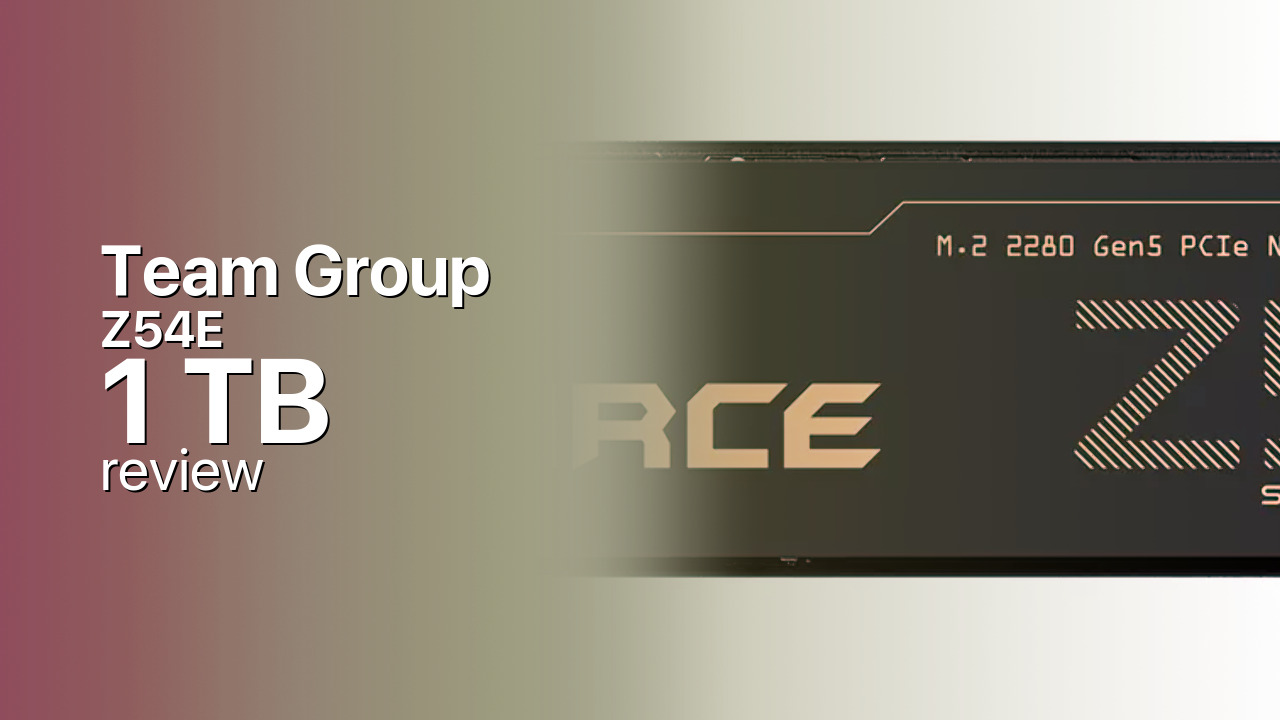
The Team Group Z54E 1 TB is built on Phison's PS5028-E28, the eight-channel PCIe 5.0 controller that succeeds the E26 found in earlier Gen5 drives like the Crucial T705 and Corsair MP700. It pairs that silicon with 232-layer 3D TLC NAND and a DRAM buffer on a standard M.2 2280 module, and ships as a bare drive with no heatsink in the box. That matters: PCIe 5.0 silicon runs hot enough that most modern motherboards require an active cooler to sustain peak speeds. The 1 TB sits at the bottom of a three-drive stack alongside a 2 TB (1200 TBW) and 4 TB (2400 TBW); peak sequential ratings hold steady at 14,900 MB/s read and 14,000 MB/s write across all three, so the only reasons to step up are capacity and the 600 TBW-per-TB endurance that scales linearly.
Compatibility is straightforward on paper but narrow in practice. The Z54E needs a PCIe 5.0 M.2 slot to hit its rated numbers, which means a current-gen AMD X670E or X870E, or an Intel Z790 or Z890 desktop board; drop it into a PCIe 4.0 slot or a laptop and it caps at roughly half speed, and Sony's PS5 expansion slot is likewise PCIe 4.0, so the Z54E is wasted there despite clearing the console's 5,500 MB/s bar. That Gen5 premium only pays off against direct rivals. The Crucial T705 posts slightly higher peak reads on the older E26 platform and ships in heatsink-backed trims; the Corsair MP700 covers the same E26 ground at a comparable tier; and anyone not chasing synthetic peaks will get effectively identical real-world game loads from Samsung's PCIe 4.0 990 Pro on a mature platform. With no independent reviews of the Z54E yet, those are the comparisons to hold it against.
Storage Comparisons:
Z54E Performance & Benchmarks
Team Group rates the 1 TB Z54E at 14,900 MB/s sequential read and 14,000 MB/s sequential write, with up to 2,600,000 random read and 3,000,000 random write IOPS. Those are headline numbers on the Phison E28 platform, and they sit at the ceiling of what current PCIe 5.0 x4 bandwidth allows. In practice, the gap between a 14,900 MB/s Gen5 drive and a 7,400 MB/s Gen4 flagship shows up mainly in sequential workloads: large file transfers, video assets moving between NVMe drives, and DirectStorage-enabled titles that stream textures straight from storage. Random 4K reads, which govern OS responsiveness and most game load times, sit far below the sequential ceiling, so boot times and everyday application launches feel indistinguishable from a good PCIe 4.0 drive.
Team Group Z54E 1 TB vs M.2 5.0 peers
Switch between sequential throughput and random IOPS to see how this drive stacks up against other M.2 5.0 SSDs in our database. The highlighted bar is the drive on this page — click any other bar to open that drive.
- Team Group Z54E 1 TB (this drive): 14,900 MB/s read, 14,000 MB/s write
- Corsair MP700 Pro XT 1 TB: 14,900 MB/s read, 14,200 MB/s write
- Corsair MP700 Pro XT 2 TB: 14,900 MB/s read, 14,500 MB/s write
- Corsair MP700 Pro XT 4 TB: 14,900 MB/s read, 14,400 MB/s write
- Crucial T710 1 TB: 14,900 MB/s read, 13,800 MB/s write
The Z54E, like all TLC drives on the E28 platform, leans on an SLC cache for its peak burst writes: short transfers fill the cache at full speed, then settle to the native TLC write rate once it fills. On a 1 TB module that cache is modest, so sustained writes of hundreds of gigabytes (large game installs, footage dumps, sustained video capture) will drop well below the 14,000 MB/s line. Independent reviewers have not yet published validated benchmarks for the Z54E specifically, so treat the manufacturer figures as targets rather than measured results. Until third-party data lands, the safe assumption is E28-class behaviour: blistering on burst, throttling under sustained load, and heat-bound without active cooling.
Team Group Z54E vs Competitors
See how the Z54E stacks up against other M.2 5.0 drives in our database:
Compare with rival drives:
Endurance, TBW & Warranty
The 1 TB Z54E carries a 600 TBW endurance rating and a 5-year limited warranty, with coverage ending at whichever comes first. 600 TBW is an enormous ceiling for a 1 TB drive: at roughly 20 GB of writes per day, it translates to about 82 years, and even heavier workloads measured in the hundreds of gigabytes per day still clear decades. In realistic desktop and gaming use, the warranty term will expire long before the NAND wears out. Team Group does not publish a formal MTBF figure for the Z54E, but Phison E28-class drives typically land around 1.6 to 2 million hours; treat that as a population-reliability statistic rather than a per-unit guarantee, since it describes aggregate failure rates across a large batch under controlled conditions. Real-world lifespan is governed far more by write workload, operating temperature, and power-event handling than by the headline endurance number, and the 5-year term remains the binding constraint for almost every owner.
Team Group Z54E 1 TB Specifications
| Category | Value |
|---|---|
| Capacity [?] | 1 TB |
| Interface [?] | M.2 5.0 |
| Controller [?] | Phison PS5028-E28 8 Channel |
| Memory type [?] | 232-L 3D TLC |
| DRAM [?] | Yes |
| Read speed (MB/s) [?] | 14900 |
| Write speed (MB/s) [?] | 14000 |
| Read IOPS [?] | 2600000 |
| Write IOPS [?] | 3000000 |
| Endurance (TBW) [?] | 600 |
| MTBF (million hours) [?] | 2000000 |
| Warranty (years) [?] | 5 |
Verdict: Is the Z54E Worth It in 2026?
Buyers who already own a PCIe 5.0-ready motherboard and want the newest E28 silicon on a single-sided M.2 2280 board are the natural audience for the Team Group Z54E 1 TB. Skip it if the system only has PCIe 4.0 slots, if the plan is a PS5 upgrade, or if a heatsink is not already in hand, since the drive ships bare and runs hot under sustained load. Anyone weighing value over synthetic peaks should look at the Samsung 990 Pro 1 TB instead, which matches real-world game loads on a mature PCIe 4.0 platform. The Z54E is a credible Gen5 flagship on paper, but with no independent validation yet and a narrow compatibility envelope, we see it as a bet on the newest silicon rather than a proven upgrade.
+ Pros
- 14,900 MB/s rated sequential reads
- 232-layer TLC NAND with DRAM buffer
- Phison E28 controller, newer than E26
- 600 TBW endurance on the 1 TB
- 5-year limited warranty
- Cons
- No heatsink included in the box
- PCIe 5.0 speed wasted on PCIe 4.0 systems
- No independent reviews yet for the Z54E
- Gen5 premium over PCIe 4.0 flagships
- Modest SLC cache on the 1 TB
Buy this or similar SSD Storage:
Video Review
Which SSD Generation Should PC Builders Buy?