Corsair MP700 Pro XT 2TB — The Mainstream PCIe 5.0 Sweet Spot (2026)
Quick answer
The Corsair MP700 Pro XT 2TB is the strongest configuration in the Pro XT lineup for most buyers.
Read: 14900 MB/s Write: 14500 MB/s Endurance: 1400 TBW Warranty: 5 years Interface: M.2 5.0
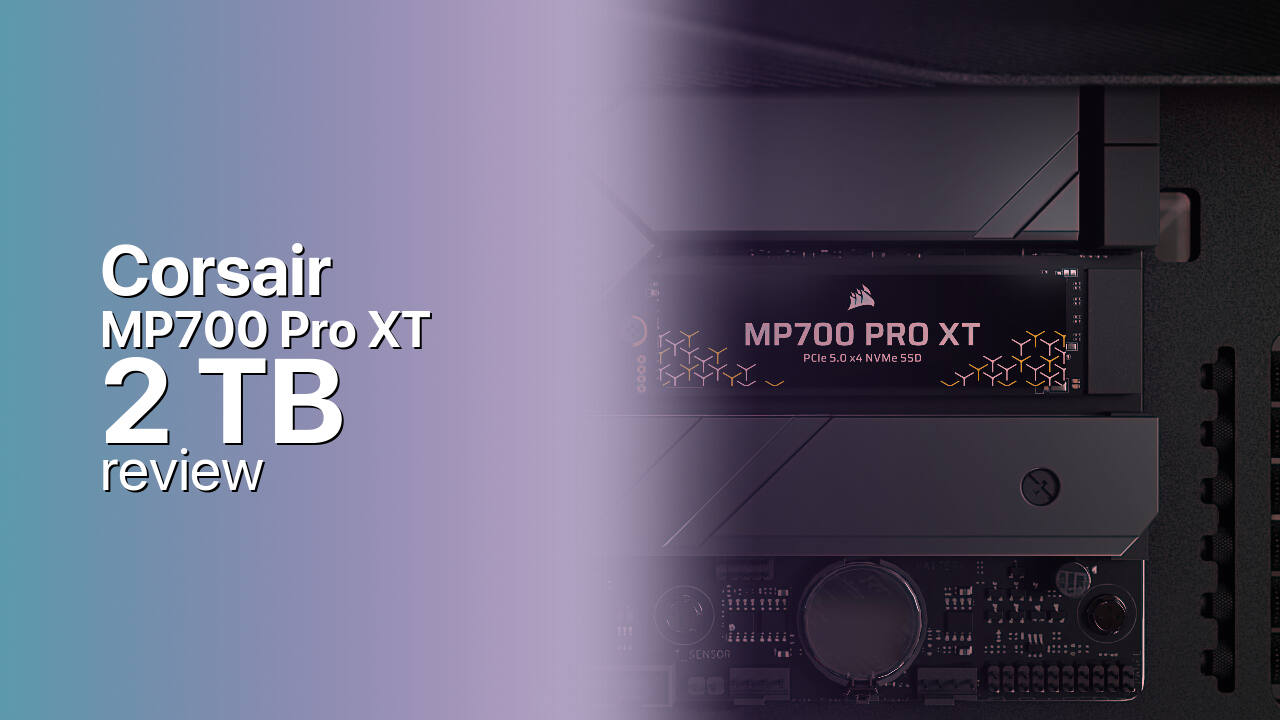
The Corsair MP700 Pro XT 2TB is a PCIe 5.0 NVMe drive built on the Phison PS5028-E28 controller with Kioxia BiCS8 218-layer TLC NAND, rated at 14,900 MB/s sequential reads, 14,500 MB/s writes, and 2,700,000 read IOPS.
Controller & Memory
At the core of the MP700 Pro XT sits Phison's PS5028-E28: an 8-channel, 6nm PCIe 5.0 controller and the successor to the E26 that powered Corsair's previous flagship. The E28 brings meaningful efficiency gains over first-generation Gen5 hardware — typical operating power at the 2TB capacity runs at 4–6.5W under sustained load, compared to the 9W or more common on E26 platforms. That shift removes much of the thermal anxiety that made early PCIe 5.0 SSDs difficult to deploy without dedicated heatsinks or active airflow.
Corsair pairs the E28 with Kioxia BiCS8 218-layer 3D TLC NAND and 2GB of SK hynix LPDDR4 DRAM — sized at 1GB per terabyte of capacity across the Pro XT lineup. The DRAM handles the logical-to-physical address table, keeping random-access latency consistent under mixed workloads. The 2TB's larger NAND die count directly improves two areas relative to the 1TB: the pSLC write cache is proportionally larger, and sequential write speed increases from 14,200 MB/s to 14,500 MB/s due to greater NAND die parallelism. Random read IOPS also increase, reaching 2,700,000 versus 1,500,000 on the 1TB — again a product of more flash channels active in parallel.
The drive ships without an aluminium heatsink, but a copper thermal layer embedded in the product label provides passive heat spreading. For typical consumer workloads on a board with standard M.2 thermal pads, this is sufficient. Builds without any M.2 thermal contact — open-air platforms or older boards — can benefit from an inexpensive aftermarket heatsink, particularly if sustained sequential writes are expected.
The MP700 Pro XT 2TB occupies the middle position in a three-SKU lineup alongside the 1TB and 4TB variants. At this capacity tier it competes directly with the Crucial T705 2TB (Phison E26), Seagate FireCuda 540 2TB (E26), and ADATA XPG Legend 970 Pro 2TB (E28). The Corsair's E28 efficiency advantage over the E26-based competitors is real and measurable; the distinction against other E28 drives like the Legend 970 Pro comes down to brand support, bundled software, and pricing rather than hardware differences. Against PCIe 4.0 alternatives like the WD Black SN850X 2TB or Samsung 990 Pro 2TB, the Pro XT offers roughly double the sequential bandwidth — an advantage visible in large-file workloads but less meaningful for gaming or typical OS use.
Storage Comparisons:
MP700 Pro XT Performance & Benchmarks
The Corsair MP700 Pro XT 2TB is rated at 14,900 MB/s sequential reads and 14,500 MB/s sequential writes under PCIe 5.0 x4. The 2TB write speed is 300 MB/s faster than the 1TB's 14,200 MB/s, a direct result of more NAND die operating in parallel. This advantage is most noticeable in sustained large-file write workloads: the 2TB's larger pSLC cache absorbs more data before transitioning to native TLC write speeds, and the native TLC write rate is itself higher due to greater parallelism.
Corsair MP700 Pro XT 2 TB vs M.2 5.0 peers
Switch between sequential throughput and random IOPS to see how this drive stacks up against other M.2 5.0 SSDs in our database. The highlighted bar is the drive on this page — click any other bar to open that drive.
- Corsair MP700 Pro XT 2 TB (this drive): 14,900 MB/s read, 14,500 MB/s write
- Corsair MP700 Pro XT 1 TB: 14,900 MB/s read, 14,200 MB/s write
- Corsair MP700 Pro XT 4 TB: 14,900 MB/s read, 14,400 MB/s write
- Crucial T710 1 TB: 14,900 MB/s read, 13,800 MB/s write
- Team Group Z54E 1 TB: 14,900 MB/s read, 14,000 MB/s write
For random access, Corsair rates the 2TB at 2,700,000 read IOPS and 3,300,000 write IOPS. The asymmetric IOPS profile — write IOPS exceeding read IOPS — is characteristic of the Phison E28 architecture, which is specifically engineered for high random write density through its internal buffer design. The 2TB's 2,700,000 read IOPS is substantially higher than the 1TB's 1,500,000, reflecting the additional NAND die parallelism at this capacity. For workloads dominated by random read depth — game shader compilation, database reads, OS paging — the 2TB has a tangible IOPS advantage over the smaller variant.
Power draw sits at approximately 4–6.5W average for the 2TB under active workloads, slightly above the 1TB due to more NAND die drawing current simultaneously. This remains well below the sustained power levels of E26-based competitors, which frequently exceed 9W under sequential writes. The copper thermal layer in the product label and the E28's comparatively modest power envelope together allow the drive to maintain rated speeds under typical consumer workloads without requiring an active cooler. For extended sequential-write sessions at high ambient temperatures, a standard M.2 thermal pad or low-profile heatsink keeps temperatures within the controller's comfortable operating range.
Corsair MP700 Pro XT vs Competitors
See how the MP700 Pro XT stacks up against other M.2 5.0 drives in our database:
Compare with rival drives:
Endurance, TBW & Warranty
Corsair backs the MP700 Pro XT with a 5-year limited warranty across all capacity variants. The 2TB model carries an endurance rating of 1,400 TBW — exactly double the 1TB's 700 TBW, in line with the proportional scaling Corsair applies across the lineup. At 30 GB per day written, a typical desktop workload, 1,400 TBW represents over 127 years before reaching the rated limit. At 100 GB per day — characteristic of active content creation — that extends to approximately 38 years. Even demanding workflows writing 500 GB per day would take nearly eight years to exhaust 1,400 TBW, meaning the 5-year warranty clock will expire first for virtually every buyer. The 2TB endurance headroom is large enough to make this drive viable for video capture, large archive workflows, and other write-intensive professional use cases that would more quickly strain the 1TB's 700 TBW budget. Corsair processes warranty claims directly through its established RMA system, with coverage available across major Western markets through Corsair's retail and online distribution network.
Corsair MP700 Pro XT 2 TB Specifications
| Category | Value |
|---|---|
| Capacity [?] | 2 TB |
| Interface [?] | M.2 5.0 |
| Controller [?] | Phison PS5028-E28 8 Channel |
| Memory type [?] | Kioxia BiCS8 218-L TLC |
| DRAM [?] | Yes |
| Read speed (MB/s) [?] | 14900 |
| Write speed (MB/s) [?] | 14500 |
| Read IOPS [?] | 2700000 |
| Write IOPS [?] | 3300000 |
| Endurance (TBW) [?] | 1400 |
| MTBF (million hours) [?] | 2000000 |
| Warranty (years) [?] | 5 |
Verdict: Is the MP700 Pro XT Worth It in 2026?
The Corsair MP700 Pro XT 2TB is the strongest configuration in the Pro XT lineup for most buyers. The step up from 1TB delivers three compounding improvements: 300 MB/s more sequential write bandwidth, 1.8 million additional read IOPS, and doubled endurance headroom — all while doubling available storage. Those gains are meaningful for creators moving large files, developers working with large datasets, and enthusiasts who want the most capable single drive in their build.
The 2TB is the right buy over the 1TB for anyone whose use case regularly involves sustained sequential writes or large NAND-parallel random-read workloads. It is the right buy over the 4TB when budget matters — the 4TB commands a significant premium for capacity that most users will not fill. Buyers coming from a current PCIe 4.0 drive used primarily for gaming or general desktop tasks should calibrate expectations: the Pro XT's bandwidth advantage is real in benchmarks, but day-to-day OS responsiveness and game load times will improve marginally if at all. The upgrade case is strongest for those who move data at scale.
+ Pros
- 14,900 MB/s sequential reads — full PCIe 5.0 x4 bandwidth
- 14,500 MB/s sequential writes — 300 MB/s faster than the 1TB model
- 2,700,000 read IOPS — substantially higher than 1TB due to increased NAND die parallelism
- 1,400 TBW endurance with 5-year warranty across all capacities
- Kioxia BiCS8 218-layer TLC with 2GB SK hynix LPDDR4 DRAM
- Phison E28 (6nm) runs at 4–6.5W — cooler than first-gen E26 Gen5 drives
- Larger SLC cache than 1TB: better sustained-write performance at high queue depths
- Cons
- Premium PCIe 5.0 pricing; limited real-world benefit over Gen4 for gaming and OS use
- No heatsink included — relies on copper label layer and motherboard thermal pads
- Up to 6.5W average power draw under sustained loads — slightly higher than the 1TB
- PCIe 5.0 requires a Gen5-capable M.2 slot for full rated speeds — older platforms cap at Gen4
- Competing E28-based drives offer similar hardware at potentially lower street prices
Buy this or similar SSD Storage:



Video Review
Insanely fast NVMe M.2 SSD 🏃♂️💨 CORSAIR MP700 PRO XT