Kingston Fury Renegade G5 2 TB PCIe 5.0 NVMe SSD Review (2026)
Quick answer
Buy the Kingston Fury Renegade G5 2 TB if you want a single PCIe 5.0 drive that holds your OS, your game library, and your working files without compromise on speed or thermals.
Read: 14700 MB/s Write: 14000 MB/s Endurance: 2000 TBW Warranty: 5 years Interface: M.2 5.0
The Kingston Fury Renegade G5 2 TB pairs Silicon Motion's cooler-running SM2508 controller with Kioxia 218-layer TLC, delivering 14,700 MB/s reads and full-speed writes without first-wave Gen5 heat problems.
Controller & Memory
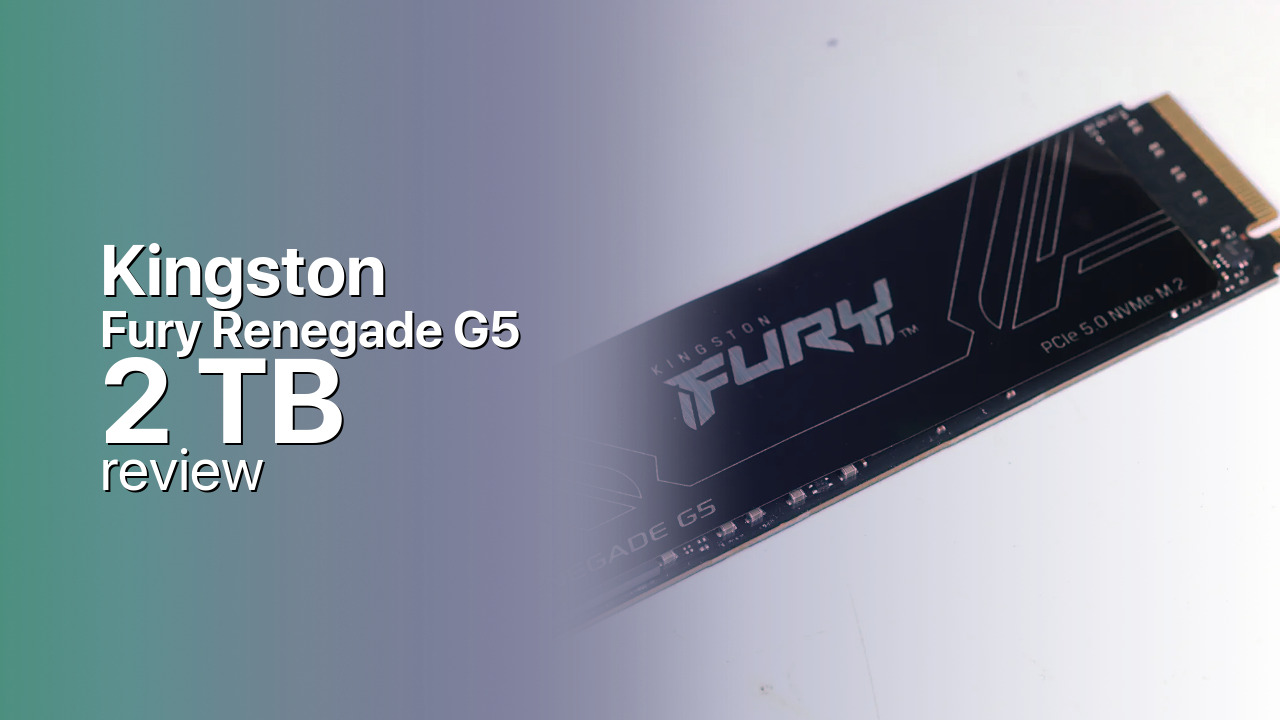
The Kingston Fury Renegade G5 2 TB is the mid-capacity SKU of Kingston's first PCIe 5.0 lineup and the one most reviewers actually test, because 2 TB is the realistic enthusiast sweet spot for a Gen5 boot drive with a game library attached. Inside is Silicon Motion's SM2508, an eight-channel controller built on a 4 nm process with four Arm Cortex-R8 cores and a low-power Cortex-M0 core. The headline benefit is thermals: SM2508 runs noticeably cooler than the Phison E26 platform that defined Gen5's first wave, which means the G5 can sustain peak throughput under a passive heatsink where E26 boards often throttle. The controller is fed by Kioxia 218-layer BiCS8 3D TLC NAND and a 2 GB LPDDR4 DRAM cache that holds the flash translation layer.
Where the 2 TB sits in the family matters. Kingston sells the Renegade G5 in 1 TB, 2 TB and 4 TB, and the speeds step up with capacity. The 2 TB is rated at 14,700 MB/s sequential read and 14,000 MB/s sequential write, sitting between the 1 TB's 14,200 / 11,000 MB/s and the 4 TB flagship's 14,800 / 14,000 MB/s. Endurance scales linearly: 2,000 TBW on this 2 TB versus 1,000 TBW on the 1 TB and 4,000 TBW on the 4 TB. Unlike the 1 TB (single-sided), the 2 TB uses a double-sided PCB, which matters for very slim laptop slots but not for desktop M.2 mounts or PS5 bays with adequate clearance.
The 2 TB is the right pick for a buyer who wants one Gen5 drive to hold the OS, applications, a working set of creative files, and a rotating game library without juggling multiple drives. The capacity is large enough that the SLC cache is meaningful in practice, so sustained writes for video projects and large archives hold up better than on the 1 TB. Plan for a heatsink; Kingston ships a bare stick and while the SM2508 is efficient, Gen5 throughput still wants passive cooling under sustained load. Direct rivals include the Crucial T705 2 TB, the WD Black SN8100N 2 TB (same SM2508 platform), and the Corsair MP700 Pro 2 TB.
Storage Comparisons:
Fury Renegade G5 Performance & Benchmarks
Kingston rates the Fury Renegade G5 2 TB at 14,700 MB/s sequential read and 14,000 MB/s sequential write over PCIe 5.0 x4, with up to 2,200,000 random read IOPS and 2,200,000 random write IOPS. These are top-tier Gen5 figures: roughly double the sequential throughput of a flagship PCIe 4.0 drive like the Samsung 990 Pro, and enough that DirectStorage-enabled games can stream assets with the storage layer removed as a meaningful bottleneck.
Kingston Fury Renegade G5 2 TB vs M.2 5.0 peers
Switch between sequential throughput and random IOPS to see how this drive stacks up against other M.2 5.0 SSDs in our database. The highlighted bar is the drive on this page — click any other bar to open that drive.
- Corsair MP700 Pro XT 1 TB: 14,900 MB/s read, 14,200 MB/s write
- Corsair MP700 Pro XT 2 TB: 14,900 MB/s read, 14,500 MB/s write
- Corsair MP700 Pro XT 4 TB: 14,900 MB/s read, 14,400 MB/s write
- Crucial T710 1 TB: 14,900 MB/s read, 13,800 MB/s write
- Kingston Fury Renegade G5 2 TB (this drive): 14,700 MB/s read, 14,000 MB/s write
Independent reviewers including TechPowerUp and StorageReview have benchmarked the 2 TB and consistently report the platform setting fresh records for sequential 1M read and write throughput alongside class-leading random read IOPS. The 2,200,000 IOPS random read number is the more practical headline than peak sequential, because random I/O dominates OS behaviour, application launches, and mixed-queue workloads. The SM2508's strength is sustained random performance under load, not just burst peaks. The 2 TB's larger SLC cache also helps here: under sustained writes the drive rides its cache for tens of gigabytes before settling to native TLC write rates, and the larger capacity means less frequent cache exhaustion than on the 1 TB. The cooler-running 4 nm controller means the G5 is less prone to thermal throttling than E26-based Gen5 drives under sustained loads, which is one of the reasons reviewers consistently prefer it for thermally constrained builds.
Kingston Fury Renegade G5 vs Competitors
See how the Fury Renegade G5 stacks up against other M.2 5.0 drives in our database:
Compare with rival drives:
Endurance, TBW & Warranty
Kingston rates the Fury Renegade G5 2 TB at 2,000 TBW (terabytes written) over a five-year limited warranty, whichever comes first. That endurance matches the linear 1,000 TBW-per-TB pattern across the family: 1,000 TBW on the 1 TB and 4,000 TBW on the 4 TB. At a typical consumer write workload of 20 to 50 GB per day, the 2 TB reaches its TBW ceiling in roughly 110 to 274 years, so the warranty term, not the endurance rating, is the binding limit for essentially every buyer. Kingston ties warranty coverage to the Kingston SSD Manager "Percentage Used" SMART attribute, so remaining endurance is visible without guesswork. The five-year term matches the rest of the G5 family and equals or beats the coverage on rivals like the Crucial T705 and Corsair MP700 Pro. MTBF is rated at 2,000,000 hours, the standard figure for enterprise-adjacent consumer NVMe drives; treat it as a population statistic, not a per-unit lifespan. RMAs are handled through Kingston or via the retailer with serial-based validation.
Kingston Fury Renegade G5 2 TB Specifications
| Category | Value |
|---|---|
| Capacity [?] | 2 TB |
| Interface [?] | M.2 5.0 |
| Controller [?] | Silicon Motion SM2508 |
| Memory type [?] | Toshiba 218-L TLC |
| DRAM [?] | Yes |
| Read speed (MB/s) [?] | 14700 |
| Write speed (MB/s) [?] | 14000 |
| Read IOPS [?] | 2200000 |
| Write IOPS [?] | 2200000 |
| Endurance (TBW) [?] | 2000 |
| MTBF (million hours) [?] | 2000000 |
| Warranty (years) [?] | 5 |
Verdict: Is the Fury Renegade G5 Worth It in 2026?
Buy the Kingston Fury Renegade G5 2 TB if you want a single PCIe 5.0 drive that holds your OS, your game library, and your working files without compromise on speed or thermals. Skip it if your motherboard is PCIe 4.0 only, in which case a high-end Gen4 drive like the Samsung 990 Pro delivers indistinguishable real-world game load times for less money, or if you regularly move hundred-gigabyte working sets, where stepping up to the 4 TB's larger SLC cache and higher TBW pays off. The closest direct rival is the WD Black SN8100N 2 TB, which uses the same SM2508 platform and trades blows on price and firmware tuning. For most upgraders building or refreshing a Gen5-capable desktop, the 2 TB G5 is the sweet spot: enough capacity to actually use the speed, a cooler-running controller than first-wave Gen5, and a five-year warranty that outlasts the rest of the build.
+ Pros
- 14,700 MB/s sequential reads on PCIe 5.0
- Cool-running SM2508 4 nm controller
- 2,000 TBW endurance rating
- Five-year limited warranty
- 2 GB LPDDR4 DRAM cache
- Class-leading 2,200K random read IOPS
- Cons
- Double-sided PCB fouls some slim slots
- No heatsink included in the box
- PCIe 5.0 requires a Gen5 motherboard slot
- Premium pricing versus PCIe 4.0 flagships
Buy this or similar SSD Storage:
Video Review
Kingston's First Gen5 SSD - Fury Renegade G5 Review