What the Team Group Z54E 2 TB brings to a Gen5 build (2026)
Quick answer
Buy the Team Group Z54E 2 TB for a PCIe 5.0 desktop build or upgrade that wants a current-generation Phison E28 drive before the platform matures.
Read: 14900 MB/s Write: 14000 MB/s Endurance: 1200 TBW Warranty: 5 years Interface: M.2 5.0
The Team Group Z54E 2 TB pairs Phison's newest E28 controller with 232-layer TLC to hit 14,900 MB/s reads, making it one of the fastest PCIe 5.0 drives on the market.
Controller & Memory
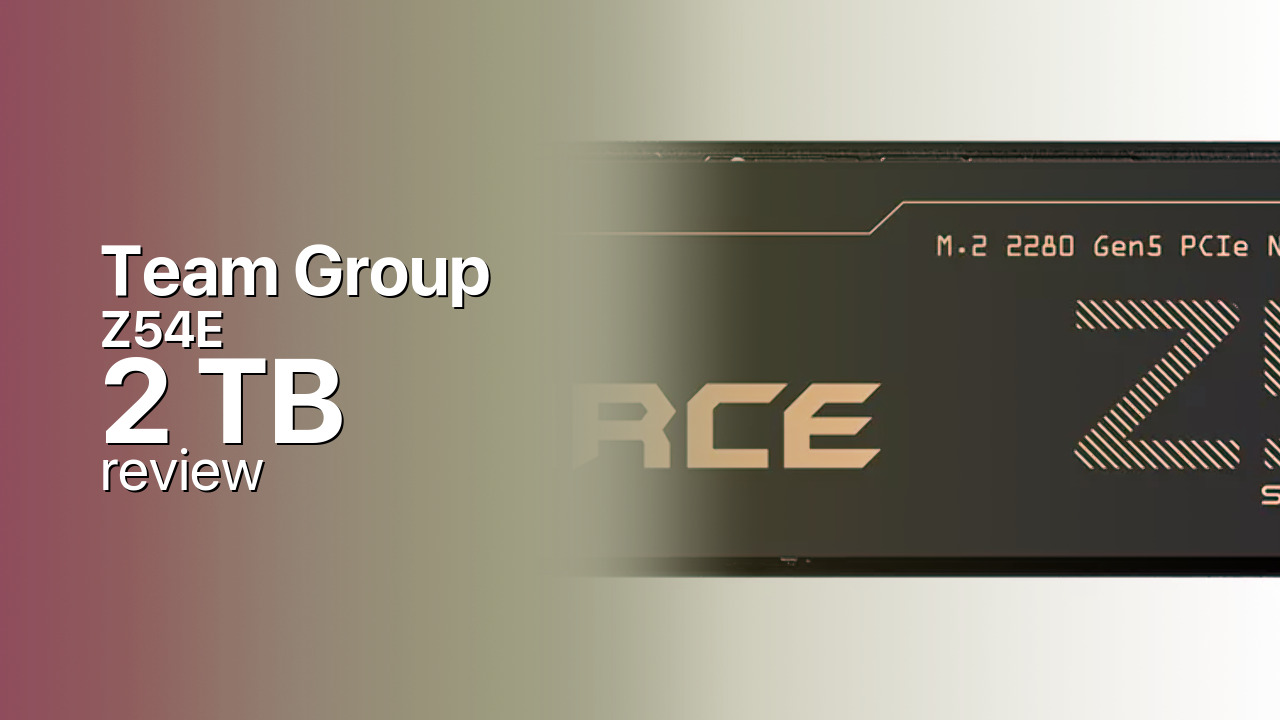
The Team Group Z54E 2 TB is a conservative but genuinely fast entry into the newest Phison E28 generation of PCIe 5.0 drives. Inside, an eight-channel Phison PS5028-E28 controller runs over a PCIe 5.0 x4 link, paired with 232-layer 3D TLC NAND and a DRAM buffer that holds the flash-translation table in dedicated memory. The E28 is the direct successor to the E26 used in first-generation Gen5 drives, and it is what lets the Z54E reach its 14,900 MB/s sequential read rating. Team Group ships it as a bare M.2 2280 stick with no heatsink in the box, which matters because PCIe 5.0 silicon runs noticeably hotter than PCIe 4.0 and most modern motherboards now route a dedicated Gen5 heatsink under the M.2 shroud.
The 2 TB sits in the middle of a three-capacity lineup alongside 1 TB and 4 TB siblings. Team Group rates the whole family at the same 14,900 MB/s read and 14,000 MB/s write ceiling, with up to 2,600,000 random read and 3,000,000 random write IOPS, so the only spec that scales with capacity is endurance: 600 TBW on the 1 TB, 1,200 TBW on this 2 TB, and 2,400 TBW on the 4 TB. That 600 TBW-per-terabyte pattern matches what Team Group uses across its other Gen5 drives (the Z540, GC Pro, and GE Pro), so the endurance figure is consistent with the rest of the family rather than a one-off number.
Compatibility is straightforward on paper but conditional in practice. Any desktop with a PCIe 5.0 M.2 slot runs the Z54E at full speed, laptops are case-by-case since few currently ship a Gen5 slot, and the PS5 expansion bay is electrically PCIe 4.0 so the Z54E will run at roughly half its rated throughput there, making it wasteful for a console. On the Gen5 bench, the Crucial T705 posts slightly faster peak reads on the older Phison E26, the Corsair MP700 covers similar E26 ground, and anyone who does not specifically need Gen5 can get most of the real-world benefit from Samsung's PCIe 4.0 990 Pro for less money.
Storage Comparisons:
Z54E Performance & Benchmarks
The Team Group Z54E 2 TB is rated for 14,900 MB/s sequential reads and 14,000 MB/s sequential writes, with up to 2,600,000 random read IOPS and 3,000,000 random write IOPS on the Phison E28 platform. Those are manufacturer figures, and they sit at the top of what current PCIe 5.0 x4 drives advertise.
Team Group Z54E 2 TB vs M.2 5.0 peers
Switch between sequential throughput and random IOPS to see how this drive stacks up against other M.2 5.0 SSDs in our database. The highlighted bar is the drive on this page — click any other bar to open that drive.
- Team Group Z54E 2 TB (this drive): 14,900 MB/s read, 14,000 MB/s write
- Corsair MP700 Pro XT 1 TB: 14,900 MB/s read, 14,200 MB/s write
- Corsair MP700 Pro XT 2 TB: 14,900 MB/s read, 14,500 MB/s write
- Corsair MP700 Pro XT 4 TB: 14,900 MB/s read, 14,400 MB/s write
- Crucial T710 1 TB: 14,900 MB/s read, 13,800 MB/s write
In practice, sequential numbers this high only appear under specific conditions: large-block transfers hitting a warmed-up pseudo-SLC cache, a Gen5 motherboard slot, and a host capable of sinking roughly 14 GB/s. For everyday workloads, the gap between a 14,900 MB/s Gen5 drive and a 7,400 MB/s PCIe 4.0 drive is much smaller than the headline suggests. DirectStorage-enabled games shave only a fraction of a second off load times versus a fast Gen4 drive, and most current engines are not yet structured to exploit the extra bandwidth. The Z54E pulls ahead meaningfully on large-file transfers, video scratch space, and deep-queue random workloads, the tasks that fill the pseudo-SLC cache and then stress how gracefully the controller falls back to native TLC write speed once that cache is exhausted.
Independent reviewers have not yet published Z54E-specific benchmarks, so no sourced real-world numbers are quoted here. Across the wider Phison E28 category, manufacturer-rated peaks tend to hold near their advertised ceiling on a compliant platform in short bursts, then settle well below the SLC-cached maximum once the cache fills and writes go directly to TLC.
Team Group Z54E vs Competitors
See how the Z54E stacks up against other M.2 5.0 drives in our database:
Compare with rival drives:
Endurance, TBW & Warranty
Team Group rates the Z54E 2 TB at 1,200 TBW (terabytes written) over a five-year limited warranty, whichever expires first. That 1,200 TBW is exactly twice the 600 TBW on the 1 TB and half the 2,400 TBW on the 4 TB, consistent with the 600 TBW-per-terabyte rule Team Group applies across its Gen5 lineup. On the standard baseline of about 20 GB of writes per day, 1,200 TBW works out to roughly 164 years, so the warranty term, not the endurance ceiling, will always be the binding limit for any normal user, gamer, or even a busy video workstation writing several hundred GB a day. Most drives in this Gen5 class carry MTBF ratings around 1.6 to 2 million hours, but treat that as a population-level reliability statistic for the drive family rather than a guarantee that any individual unit runs for nearly two centuries.
Team Group Z54E 2 TB Specifications
| Category | Value |
|---|---|
| Capacity [?] | 2 TB |
| Interface [?] | M.2 5.0 |
| Controller [?] | Phison PS5028-E28 8 Channel |
| Memory type [?] | 232-L 3D TLC |
| DRAM [?] | Yes |
| Read speed (MB/s) [?] | 14900 |
| Write speed (MB/s) [?] | 14000 |
| Read IOPS [?] | 2600000 |
| Write IOPS [?] | 3000000 |
| Endurance (TBW) [?] | 1200 |
| MTBF (million hours) [?] | 2000000 |
| Warranty (years) [?] | 5 |
Verdict: Is the Z54E Worth It in 2026?
Buy the Team Group Z54E 2 TB for a PCIe 5.0 desktop build or upgrade that wants a current-generation Phison E28 drive before the platform matures. Skip it for laptops without a confirmed Gen5 slot, for PS5 expansion where the Gen5 bandwidth is wasted on a PCIe 4.0 slot, or for chasing the absolute highest benchmark numbers, since the Crucial T705 edges it on peak speed. Anyone who does not specifically need Gen5 will capture nearly all the real-world benefit for less money from Samsung's PCIe 4.0 990 Pro. Our read: the Z54E 2 TB is a conservatively rated entry into the newest E28 generation with Team Group's proven endurance math, reasonable for early Gen5 adopters, but not yet a value leader, and its bare-drive packaging means a heatsink must be factored into the build.
+ Pros
- 14,900 MB/s Gen5 sequential reads
- 2,600,000 Random Read IOPS Rated
- 1,200 TBW Endurance At 2 TB
- Phison E28 Eight-Channel Controller
- 232-Layer 3D TLC NAND
- Five-Year Limited Warranty Included
- Cons
- No Heatsink Included In Box
- No Independent Reviews Published Yet
- Gen5 Premium Over PCIe 4.0 Rivals
- PS5 Expansion Slot Is Only PCIe 4.0
- PCIe 5.0 Speed Unused By Most Games
Buy this or similar SSD Storage:



Video Review
Which SSD Generation Should PC Builders Buy?