Acer Predator GM9 4TB — DRAM-less PCIe 5.0 NVMe SSD (2026)
Quick answer
The Acer Predator GM9 4TB is a smart buy if you want PCIe 5.0 sequential bandwidth without paying a premium for DRAM.
Read: 14500 MB/s Write: 11000 MB/s Endurance: 2400 TBW Warranty: 5 years Interface: M.2 5.0
The Acer Predator GM9 4TB is a DRAM-less PCIe 5.0 NVMe SSD that reaches 14,500 MB/s reads using the Maxio MAP1806A controller, making it one of the most affordable routes into Gen5 storage.

Controller & Memory
The Predator GM9 is Acer's first PCIe 5.0 SSD under the Predator gaming brand, built around the Maxio MAP1806A eight-channel controller paired with Micron B58R 232-layer 3D TLC NAND. Unlike most high-end Gen5 drives, the GM9 uses a DRAM-less design that relies on Host Memory Buffer (HMB) technology, where the drive borrows a small portion of system RAM for cache mapping. This keeps costs down and power draw lower than DRAM-equipped competitors.
The drive uses a single-sided M.2 2280 PCB, making it compatible with thin laptops and PlayStation 5 consoles (though PS5 limits it to PCIe 4.0 speeds). Acer includes a copper-graphene composite thermal pad for cooling instead of a bulky heatsink, which helps maintain sustained performance during extended write workloads. The controller's thermal throttling and power management systems automatically adjust under load.
At 4TB, the GM9 delivers sequential writes of 11000 MB/s — the 4TB variant benefits from higher NAND parallelism. Competitors include the Acer Predator GM9000 (which uses the SM2508 controller with DRAM) and the Sabrent Rocket 5, both of which cost more but offer higher sustained write performance. The DRAM-less Phison E31T-based drives are the closest peer group in terms of architecture and pricing.
Storage Comparisons:
Predator GM9 Performance & Benchmarks
The Predator GM9 4TB is rated for sequential reads up to 14,500 MB/s and writes up to 11000 MB/s over PCIe 5.0 x4. Random 4K performance reaches 2,000K read IOPS and 1,500K write IOPS. In practice, CrystalDiskMark benchmarks reviewed by independent testers show sequential reads averaging 14,741 MB/s and writes around 10,177 MB/s on the 2 TB model — slightly exceeding its rated specifications.
Acer Predator GM9 4 TB vs M.2 5.0 peers
Switch between sequential throughput and random IOPS to see how this drive stacks up against other M.2 5.0 SSDs in our database. The highlighted bar is the drive on this page — click any other bar to open that drive.
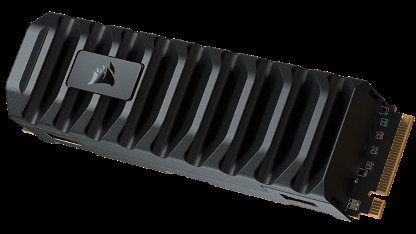
- Corsair MP700 Pro XT 1 TB: 14,900 MB/s read, 14,200 MB/s write
- Corsair MP700 Pro XT 2 TB: 14,900 MB/s read, 14,500 MB/s write
- Corsair MP700 Pro XT 4 TB: 14,900 MB/s read, 14,400 MB/s write
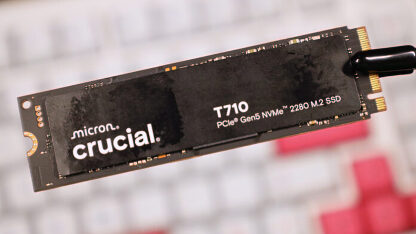
- Crucial T710 1 TB: 14,900 MB/s read, 13,800 MB/s write
- Acer Predator GM9 4 TB (this drive): 14,500 MB/s read, 11,000 MB/s write
The drive uses a pSLC write cache that absorbs incoming data at full speed. On the 2 TB model, the SLC pool measures approximately 325 GB. After the cache fills, write speeds settle to the native TLC pace, which remains competent thanks to the Micron 232-layer NAND's density. For typical desktop workloads — OS booting, application loading, game level transitions — the SLC cache rarely exhausts, so users experience peak write performance virtually all the time.
4K random read performance at low queue depths (QD1-QD4) is where DRAM-less designs typically trail DRAM-equipped drives. The MAP1806A controller's HMB implementation narrows this gap significantly, but buyers who prioritize random IOPS — database servers, VMs, heavy multitasking — should consider the DRAM-equipped Predator GM9000 instead.
Acer Predator GM9 vs Competitors
See how the Predator GM9 stacks up against other M.2 5.0 drives in our database:
Compare with rival drives:
Endurance, TBW & Warranty
Acer backs the Predator GM9 with a 5-year limited warranty and an endurance rating of 2400 TBW for the 4TB model. At a typical consumer workload of 20 GB of writes per day, this works out to over 160 years before hitting the TBW ceiling, making endurance a non-issue for most buyers. The MTBF is rated at 1.5 million hours. Warranty claims are handled through Acer's authorized service network. The TBW limit scales with capacity across the 1 TB, 2 TB, and 4 TB variants.
Acer Predator GM9 4 TB Specifications
| Category | Value |
|---|---|
| Capacity [?] | 4 TB |
| Interface [?] | M.2 5.0 |
| Controller [?] | Maxio MAP1806A-F2C 8 Channel |
| Memory type [?] | 3D TLC |
| DRAM [?] | No (HMB) |
| Read speed (MB/s) [?] | 14500 |
| Write speed (MB/s) [?] | 11000 |
| Read IOPS [?] | 2000000 |
| Write IOPS [?] | 1500000 |
| Endurance (TBW) [?] | 2400 |
| MTBF (million hours) [?] | 1500000 |
| Warranty (years) [?] | 5 |
Verdict: Is the Predator GM9 Worth It in 2026?
The Acer Predator GM9 4TB is a smart buy if you want PCIe 5.0 sequential bandwidth without paying a premium for DRAM. Its 14,500 MB/s reads match much more expensive drives in sequential throughput, and the copper-graphene thermal pad keeps it cool in tight spaces.
Skip it if your workload is heavy on 4K random writes — database servers, VM hosts, or sustained large-file transfers — where a DRAM-equipped drive like the Predator GM9000 or Crucial T705 will hold up better.
The Sabrent Rocket 5 or Samsung 9100 Pro are the alternatives to consider if your budget stretches further and you need guaranteed sustained write performance. For general use and gaming, the GM9 delivers flagship Gen5 speeds at a mid-range price.
+ Pros
- 14,500 MB/s sequential reads
- Copper-graphene thermal pad included
- Single-sided M.2 2280 fits laptops and PS5
- Competitive pricing for PCIe 5.0
- 5-year warranty
- Cons
- DRAM-less HMB limits random IO performance
- Write speeds trail DRAM-equipped Gen5 rivals
- No bundled software or cloning utility
- 2-year warranty listed incorrectly in some retailers
Buy this or similar SSD Storage:



Video Review
Acer Predator GM7 4TB SSD Review – 9 Reasons NOT to Buy ⚠️💾