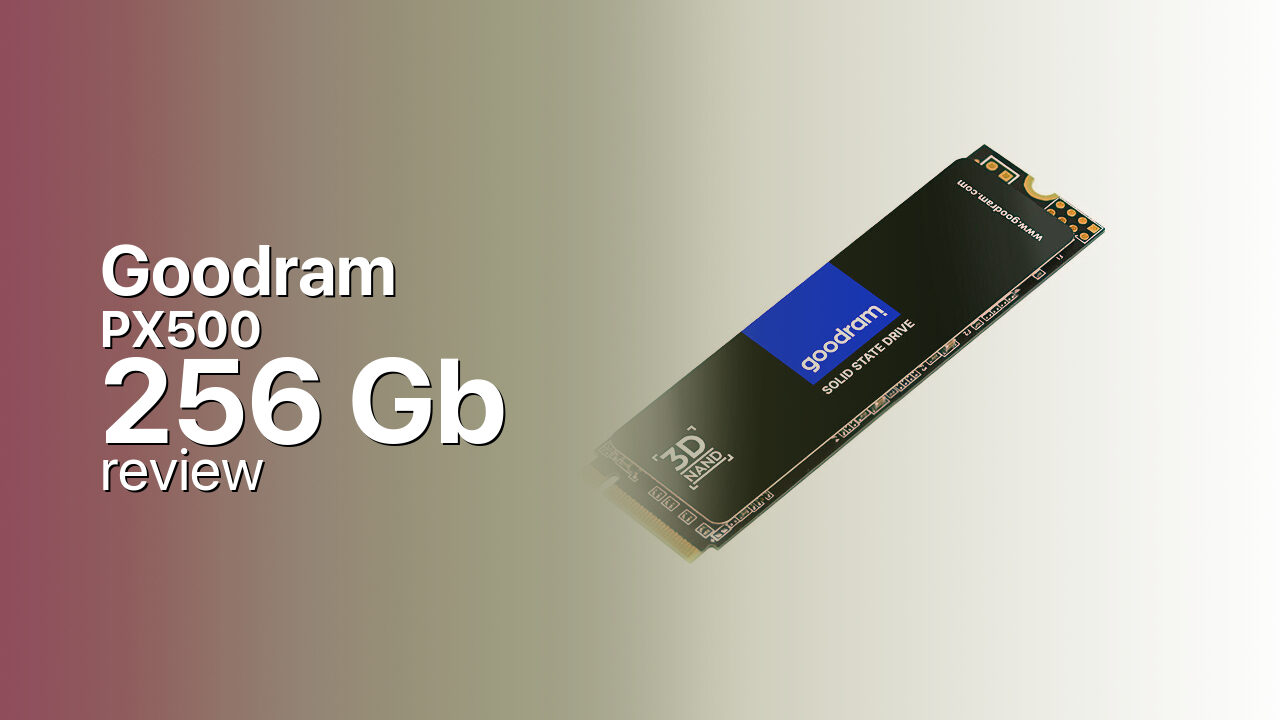
Goodram PX500 256GB — Entry-Level PCIe 3.0 NVMe SSD (2026)
Quick answer
The Goodram PX500 256GB is a basic entry-level NVMe drive that makes sense only at a significant discount.
Read: 1850 MB/s Write: 950 MB/s Endurance: 170 TBW Warranty: 3 years Interface: PCIe 3.0 x 4
The Goodram PX500 256GB is a budget DRAM-less PCIe 3.0 NVMe drive using the Silicon Motion SM2263XT controller and YMTC 64-layer TLC NAND, targeting cost-conscious builders who want NVMe speeds over SATA.
Controller & Memory
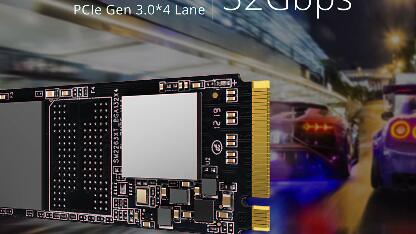
The Goodram PX500 256GB uses the Silicon Motion SM2263XT controller with YMTC 64-layer TLC NAND. It is a PCIe 3.0 x4 NVMe 1.3 drive in the M.2 2280 form factor. The SM2263XT is a DRAM-less design that uses HMB (Host Memory Buffer) — borrowing a small portion of system RAM to store the flash-translation-layer mapping table instead of carrying a dedicated DRAM chip on the PCB. This keeps costs down but results in lower random I/O performance compared to DRAM-cached alternatives.
The PX500 is available in 256GB, 512GB, and 1TB capacities. All models are single-sided, which is an advantage for ultrabook compatibility. Goodram applies a copper-and-graphite thermal coating to the PCB to improve heat dissipation without adding height — a thoughtful touch for a budget drive. The PX500 supports TRIM, SMART, garbage collection, and static and dynamic wear leveling.
At 256GB, the PX500 is the entry-level model. Sequential speeds are modest compared to the 512GB and 1TB variants, and the 256GB capacity fills up quickly with modern applications. Goodram rates the 256GB model at 170 TBW endurance and backs it with a 3-year warranty. The drive is rated for 2 million hours MTBF.
Key rivals include the WD Blue SN570 250GB (faster, 5-year warranty), the Crucial P3 250GB (similar tier, 5-year warranty), and the Kingston NV2 250GB (similar DRAM-less design). The PX500's 3-year warranty and modest speeds put it at a disadvantage against these alternatives unless it is priced significantly lower.
Storage Comparisons:
PX500 Performance & Benchmarks
Goodram rates the PX500 256GB at up to 1,850 MB/s sequential reads and 950 MB/s sequential writes, with random performance up to 148,000 read IOPS and 135,000 write IOPS. These are the lowest speeds in the PX500 lineup — the 512GB and 1TB models are substantially faster at 2,000/1,600 and 2,050/1,650 MB/s respectively.
Goodram PX500 256 GB vs PCIe 3.0 x 4 peers
Switch between sequential throughput and random IOPS to see how this drive stacks up against other PCIe 3.0 x 4 SSDs in our database. The highlighted bar is the drive on this page — click any other bar to open that drive.
- Asura Genesis Xtreme 256 GB: 3,400 MB/s read, 3,000 MB/s write
- Asura Genesis Xtreme 512 GB: 3,400 MB/s read, 3,000 MB/s write
- Asura Genesis Xtreme 1 TB: 3,400 MB/s read, 3,000 MB/s write
- Asura Genesis Xtreme 2 TB: 3,400 MB/s read, 3,000 MB/s write
- Goodram PX500 256 GB (this drive): 1,850 MB/s read, 950 MB/s write
The SM2263XT controller uses a dynamic SLC cache to absorb burst writes. On the 256GB model, the cache is smaller than on larger capacities, so sustained writes exhaust it more quickly. Once the cache fills, write speeds drop to the native TLC direct-write rate, which is where the DRAM-less design and limited NAND parallelism show their limitations.
The HMB implementation uses 64 MB of system RAM for FTL mapping. This is sufficient for basic workloads but results in higher random I/O latency compared to drives with dedicated DRAM. For OS boot and light productivity, the difference is barely noticeable. For heavy multitasking or database workloads, a DRAM-cached drive is a better choice.
Goodram PX500 vs Competitors
See how the PX500 stacks up against other PCIe 3.0 x 4 drives in our database:
Compare with rival drives:
Endurance, TBW & Warranty
Goodram backs the PX500 256GB with a 3-year limited warranty capped at 170 TBW total bytes written. The 170 TBW rating is modest — at 20 GB of writes per day, it would take roughly 23 years to reach the limit. The 3-year warranty is shorter than the 5-year standard from competitors like WD and Crucial. The drive is rated for 2 million hours MTBF.
Goodram PX500 256 GB Specifications
| Category | Value |
|---|---|
| Capacity [?] | 256 GB |
| Interface [?] | PCIe 3.0 x 4 |
| Controller [?] | Silicon Motion SMI 2263XT |
| Memory type [?] | 3D TLC |
| DRAM [?] | HMB |
| Read speed (MB/s) [?] | 1850 |
| Write speed (MB/s) [?] | 950 |
| Read IOPS [?] | 148000 |
| Write IOPS [?] | 135000 |
| Endurance (TBW) [?] | 170 |
| MTBF (million hours) [?] | 1.5 |
| Warranty (years) [?] | 3 |
Verdict: Is the PX500 Worth It in 2026?
The Goodram PX500 256GB is a basic entry-level NVMe drive that makes sense only at a significant discount. The 1,850/950 MB/s speeds are adequate for a boot drive but noticeably slower than the 512GB and 1TB PX500 models. The 3-year warranty and 170 TBW endurance are below average. For a similar price, the WD Blue SN570 250GB offers faster speeds and a 5-year warranty. The PX500 256GB is only worth considering if it is the cheapest NVMe option available.
+ Pros
- Single-sided PCB fits ultrabooks
- Copper-graphite thermal coating
- 170 TBW endurance rating
- NVMe 1.3 protocol support
- Cons
- DRAM-less HMB design — lower random I/O
- 3-year warranty vs 5 years from competitors
- Modest speeds — 1,850/950 MB/s
- 256GB capacity is very limiting
- 170 TBW is below average for the capacity
Buy this or similar SSD Storage:



Video Review
Обзор Goodram PX500 256GB M.2 2280 PCIe 3.0 x4 NVMe 3D NAND TLC из Rozetka