Crucial T500 2TB: the fastest PCIe 4.0 Crucial has built (2026)
Quick answer
Buy the Crucial T500 2 TB for the fastest mainstream PCIe 4.0 drive Crucial sells, with a DRAM cache, 1,200 TBW of endurance, and double the capacity of a typical flagship without the 990 Pro price tag.
Read: 7400 MB/s Write: 7000 MB/s Endurance: 1200 TBW Warranty: 5 years Interface: M.2 4.0 x 4
The Crucial T500 2 TB is the peak of the line, delivering 7,400 MB/s reads and 7,000 MB/s writes on PCIe 4.0 with Micron 232-layer TLC, a discrete DRAM cache, and 1,200 TBW of endurance.
Controller & Memory
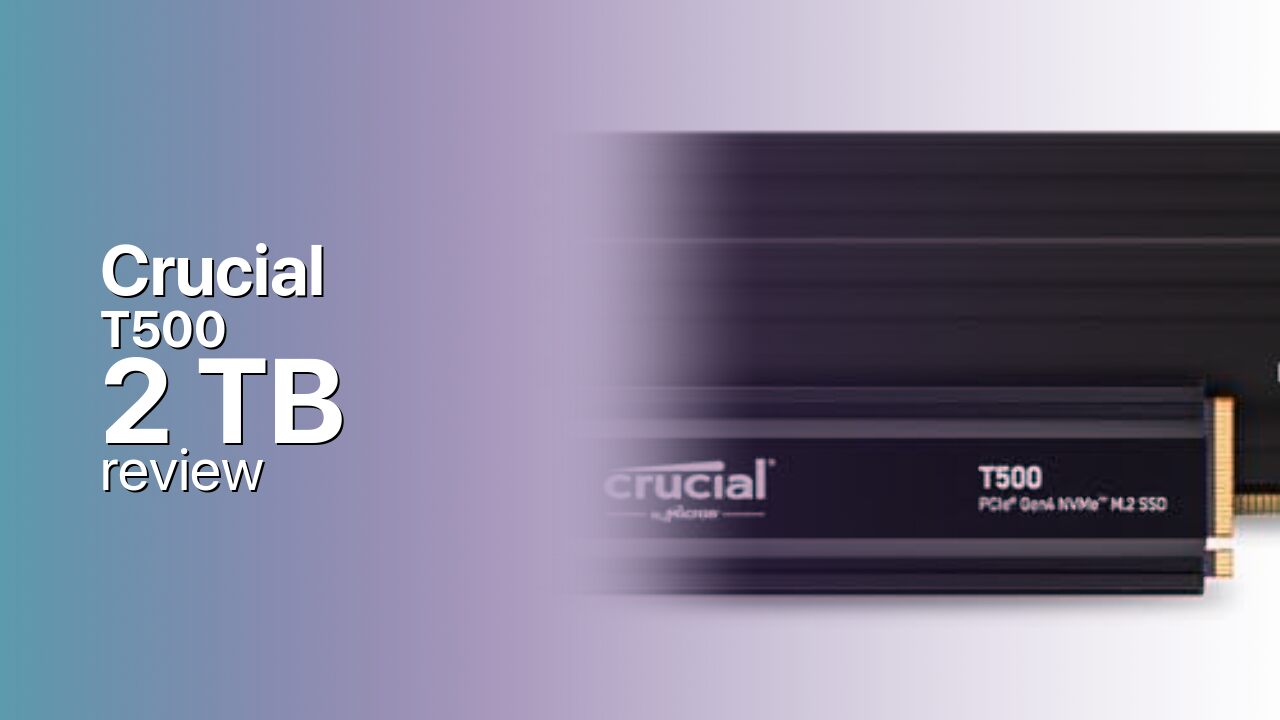
The Crucial T500 2 TB is the fastest module in the T500 family and, by Crucial's own claim, the quickest PCIe 4.0 drive the company has released. It pairs Phison's PS5025-E25 controller with Micron's 232-layer 3D TLC NAND and a discrete 1 GB LPDDR4 DRAM cache per terabyte, so the flash translation layer lives in dedicated memory rather than borrowing host RAM. Rated at 7,400 MB/s sequential reads and 7,000 MB/s writes over PCIe 4.0 x4, it sits at the top of the mainstream Gen4 field.
The range spans 1 TB, 2 TB, and 4 TB, and the 2 TB is the performance sweet spot: the 1 TB drops to 7,300/6,800 MB/s and the 4 TB to 7,000/6,900 MB/s, while this model keeps the fastest peak numbers. Endurance scales the other way, at 600 TBW for the 1 TB, 1,200 TBW here, and 2,400 TBW for the 4 TB. All three carry a five-year limited warranty. The 2 TB is sold bare or with an integrated heatsink; the heatsink SKU is the PS5-compatible option and adds support for TCG Opal 2.01 hardware encryption.
In real-world use the T500 2 TB is a serious performer. KitGuru's review measured it sustaining close to its rated speed across typical workloads with well-behaved thermals, crediting the efficient E25 controller. Against the WD Black SN850X and Samsung 990 Pro, the T500 matches them on real-world loads and undercuts their price per gigabyte. For a gaming PC, a content-creation workstation, or a console upgrade, the 2 TB T500 offers a rare combination of DRAM-equipped performance and a strong endurance rating.
Storage Comparisons:
T500 Performance & Benchmarks
The 2 TB T500 is rated at 7,400 MB/s sequential reads and 7,000 MB/s writes over PCIe 4.0, with up to 1,180,000 random read IOPS and 1,440,000 random write IOPS. Those are flagship-class numbers, and the 2 TB is the only capacity in the T500 line rated this high on both reads and writes. Independent reviews, including KitGuru's, found the drive sustaining close to its rated speed on the usual suites and holding up well under thermal stress.
Crucial T500 2 TB vs M.2 4.0 x 4 peers
Switch between sequential throughput and random IOPS to see how this drive stacks up against other M.2 4.0 x 4 SSDs in our database. The highlighted bar is the drive on this page — click any other bar to open that drive.
- Patriot Viper PV593 1 TB: 14,500 MB/s read, 14,000 MB/s write
- Patriot Viper PV593 2 TB: 14,500 MB/s read, 14,000 MB/s write
- Patriot Viper PV593 4 TB: 14,500 MB/s read, 14,000 MB/s write
- Patriot Viper PV573 2 TB: 14,000 MB/s read, 12,000 MB/s write
- Crucial T500 2 TB (this drive): 7,400 MB/s read, 7,000 MB/s write
For gaming the bandwidth is effectively invisible next to cheaper Gen4 drives, because load times are bounded by the CPU and the game's decompression rather than the drive once a module clears roughly 3,000 MB/s. Where the T500's speed matters is large-file work: video editing, rendering scratch disks, and moving multi-gigabyte project files. The 2 TB capacity also gives ample room for a full game library, and the SLC cache on this capacity is large enough to absorb long sustained writes before dropping to the native TLC rate.
Like all TLC NVMe drives, the T500 writes at full speed inside its SLC cache and then slows to the raw NAND rate when the cache fills. On the 2 TB the cache is bigger than the 1 TB's, so sustained transfers hold peak speed longer, though a truly huge contiguous write will eventually drop below rated speeds. The E25 controller runs cool enough that thermal throttling is rarely a factor, and the bundled graphene label with copper layer handles everyday heat without issue.
Crucial T500 vs Competitors
See how the T500 stacks up against other M.2 4.0 x 4 drives in our database:
Compare with rival drives:
Endurance, TBW & Warranty
Crucial covers the T500 2 TB with a five-year limited warranty, limited by its 1,200 TBW endurance rating, whichever comes first. That endurance works out to roughly 164 years at a typical 20 GB per day of writes, or about 33 years even at a heavy 100 GB per day, so the NAND will outlast the warranty term in almost any realistic scenario. The rating scales across the line, from 600 TBW on the 1 TB up to 2,400 TBW on the 4 TB. Crucial lists MTBF at 2,000,000 hours, which is a population statistic describing expected failure rates across a fleet rather than a guarantee for one drive. Returns run through Crucial or the retailer, and the bare 2 TB ships without a heatsink, so motherboard M.2 cooling or the heatsink-bundled SKU is recommended for sustained workloads.
Crucial T500 2 TB Specifications
| Category | Value |
|---|---|
| Capacity [?] | 2 TB |
| Interface [?] | M.2 4.0 x 4 |
| Controller [?] | Phison PS5025-E25 |
| Memory type [?] | Micron 232-L TLC |
| DRAM [?] | Yes |
| Read speed (MB/s) [?] | 7400 |
| Write speed (MB/s) [?] | 7000 |
| Read IOPS [?] | 1180000 |
| Write IOPS [?] | 1440000 |
| Endurance (TBW) [?] | 1200 |
| MTBF (million hours) [?] | 2000000 |
| Warranty (years) [?] | 5 |
Verdict: Is the T500 Worth It in 2026?
Buy the Crucial T500 2 TB for the fastest mainstream PCIe 4.0 drive Crucial sells, with a DRAM cache, 1,200 TBW of endurance, and double the capacity of a typical flagship without the 990 Pro price tag. Skip it when the workload never writes more than a few gigabytes at a time, since a DRAM-less budget drive will feel nearly identical in games and cost far less. The natural rivals are the WD Black SN850X 2 TB and Samsung 990 Pro 2 TB, both a little more expensive per gigabyte and matching it on real-world results. We rate the 2 TB T500 the pick of the T500 line for most buyers: the fastest numbers and a capacity that suits a serious game library or creative work.
+ Pros
- 7,400 MB/s reads and 7,000 MB/s writes, line peak
- Discrete 1 GB DRAM cache per TB
- Micron 232-layer TLC NAND
- 1,200 TBW endurance rating
- Five-year limited warranty
- Heatsink SKU is PS5-compatible
- Cons
- Only marginally faster than the cheaper 1 TB
- Bare version ships without a heatsink
- No meaningful edge over Gen4 rivals in games
- Smaller SLC cache than the 4 TB
Buy this or similar SSD Storage:
Video Review
A worthy flagship? Crucial T500 2TB NVMe SSD Review