Mushkin Pilot 1TB SSD — In-Depth Review & Specs (2026)
Quick answer
The Mushkin Pilot 1TB is a competent, DRAM-equipped PCIe 3.0 NVMe drive that delivers exactly what the SM2262 platform promises: solid mainstream performance with no HMB compromises.
Read: 2710 MB/s Write: 1775 MB/s Endurance: 488 TBW Warranty: 3 years Interface: M.2 3.0 x 4
The Mushkin Pilot 1TB is the full-system-drive option in Mushkin's original Pilot NVMe line. With a full terabyte of 3D TLC NAND, dedicated Nanya DDR3L DRAM cache, and the proven Silicon Motion SM2262 controller, it delivers a genuine PCIe 3.0 x4 experience at a capacity that can serve as both OS drive and game library in a single slot. This review covers real-world performance, the SM2262 platform's strengths and limits, and whether the Pilot 1TB still makes sense as a budget system builder's pick.
Controller & Memory
The Silicon Motion SM2262 is an 8-channel PCIe 3.0 x4 controller with a dedicated DRAM interface — no host memory buffer compromises. At the 1TB capacity point the eight NAND channels operate at full parallelism, delivering rated sequential throughput of up to 2,710 MB/s read and 1,775 MB/s write. The controller pairs with Nanya DDR3L for consistent mixed-workload latency; unlike DRAM-less HMB designs that borrow system RAM, the SM2262 keeps its mapping tables local, so small-file performance stays steady even when the host system is under memory pressure.
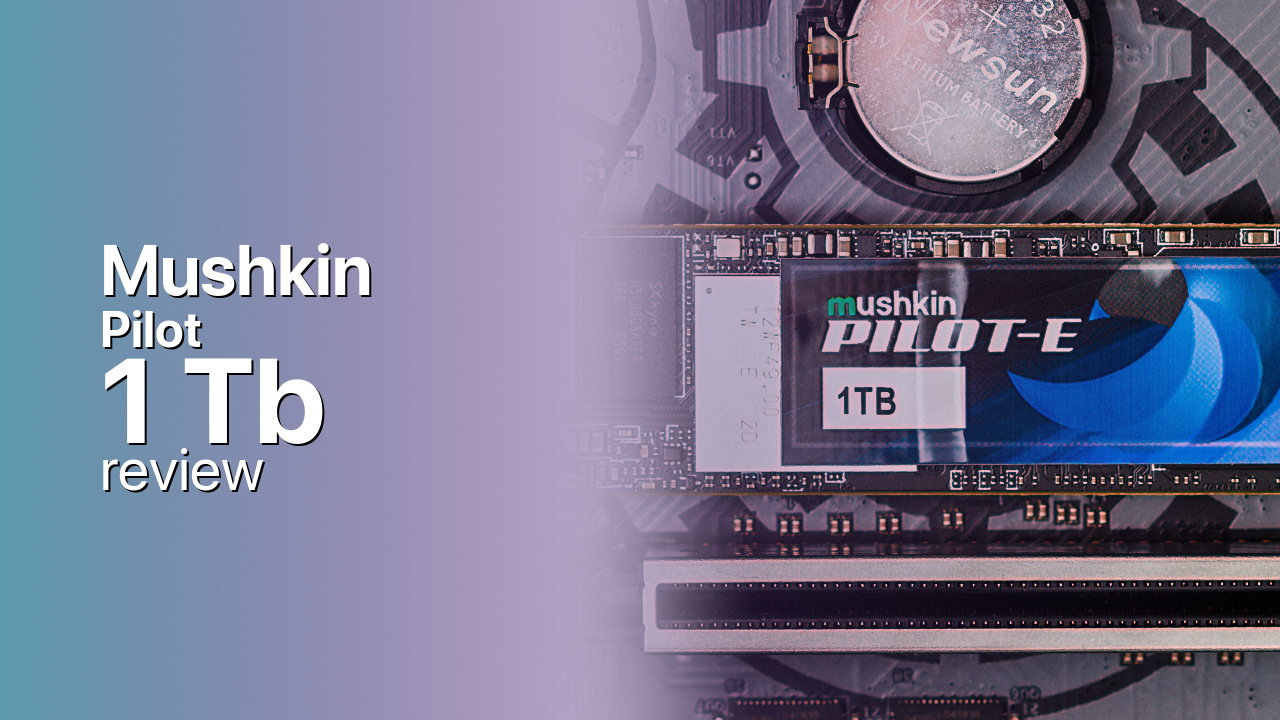
Mushkin's implementation uses 3D TLC NAND behind an SLC write cache — large sequential writes land in fast pseudo-SLC buffers before folding to TLC in the background. This keeps burst write speeds high while preserving the TLC cost advantage. The drive also carries Mushkin's MEDS (Mushkin Enhanced Data-protection Suite), which bundles LDPC error correction, end-to-end data path protection, and thermal throttling. Endurance is rated at 488 terabytes written, typical for a value-oriented 1TB TLC drive of this generation. The M.2 2280 single-sided form factor fits desktops, laptops, and Ultrabook-class enclosures without clearance issues.
Power draw is modest: roughly 5.7 W under load and 0.3 W at idle. NVMe 1.3 support includes autonomous power state transitions and low-power L1.2 substates, so laptop battery life impact is reasonable. The SM2262 runs warm under sustained sequential writes — a motherboard heatsink or at least modest case airflow is recommended for any workload longer than a few minutes of full-speed transfer.
Storage Comparisons:
Pilot Performance & Benchmarks
Rated sequential throughput of 2,710 MB/s read and 1,775 MB/s write places the Pilot 1TB in the upper half of PCIe 3.0 x4 drives. Independent testing by Hardware Asylum recorded 2,710/1,775 MB/s in continuous transfers, essentially matching the rated numbers. Random 4K performance hits up to 283,000 IOPS read and 280,000 IOPS write — enough to keep Windows boot, application launches, and moderate database workloads feeling snappy.
Mushkin Pilot 1 TB vs M.2 3.0 x 4 peers
Switch between sequential throughput and random IOPS to see how this drive stacks up against other M.2 3.0 x 4 SSDs in our database. The highlighted bar is the drive on this page — click any other bar to open that drive.
- ADATA SX 8800 Pro 512 GB: 3,500 MB/s read, 2,700 MB/s write
- ADATA SX 8800 Pro 1 TB: 3,500 MB/s read, 2,700 MB/s write
- ADATA XPG Spectrix S40G RGB 256 GB: 3,500 MB/s read, 3,000 MB/s write
- ADATA XPG Spectrix S40G RGB 512 GB: 3,500 MB/s read, 3,000 MB/s write
- Mushkin Pilot 1 TB (this drive): 2,710 MB/s read, 1,775 MB/s write
The SLC write cache absorbs most real-world writes without a speed drop. Only once the cache is exhausted — typically after roughly 150-200 GB of sustained writes on the 1TB model — does speed fold to native TLC rates around 500-600 MB/s. For a desktop gamer or content creator who isn't dumping terabyte-sized datasets daily, cache exhaustion is rare. Game load times, OS boots, and application launches remain indistinguishable from higher-tier NVMe drives in practice, though heavy 4K random mixed-workload scenarios (e.g., virtual-machine storage with multiple VMs hitting the disk simultaneously) will reveal the gap between this and a high-end PCIe 4.0 drive.
Mushkin Pilot vs Competitors
See how the Pilot stacks up against other M.2 3.0 x 4 drives in our database:
Compare with rival drives:
Endurance, TBW & Warranty
Mushkin backs the Pilot with a 3-year limited warranty. Endurance is rated at 488 terabytes written over the warranty period. As with most consumer SSDs, the warranty is tied to the original purchaser and does not cover data recovery — regular backups remain essential.
Mushkin Pilot 1 TB Specifications
| Category | Value |
|---|---|
| Capacity [?] | 1 TB |
| Interface [?] | M.2 3.0 x 4 |
| Controller [?] | Silicon Motion SM2262 |
| Memory type [?] | Micron TLC |
| DRAM [?] | Nanya DDR3L |
| Read speed (MB/s) [?] | 2710 |
| Write speed (MB/s) [?] | 1775 |
| Read IOPS [?] | 283000 |
| Write IOPS [?] | 280000 |
| Endurance (TBW) [?] | 488 |
| MTBF (million hours) [?] | 1 |
| Warranty (years) [?] | 3 |
Verdict: Is the Pilot Worth It in 2026?
The Mushkin Pilot 1TB is a competent, DRAM-equipped PCIe 3.0 NVMe drive that delivers exactly what the SM2262 platform promises: solid mainstream performance with no HMB compromises. The 2,710/1,775 MB/s throughput keeps it relevant for any PCIe 3.0 system, and the 1TB capacity is the sweet spot for a single-drive build that doesn't force capacity-versus-speed tradeoffs. Dedicated DRAM means consistent latency regardless of host memory load, which matters more for mixed-workload responsiveness than peak sequential numbers suggest. The 3-year warranty and 488 TBW endurance are standard for the value segment. For a budget build, a laptop upgrade, or a secondary game drive in a PCIe 3.0 system, the Pilot 1TB remains a practical choice.
+ Pros
- Dedicated Nanya DDR3L DRAM — consistent mixed-workload latency
- 2,710/1,775 MB/s — matches the SM2262 platform ceiling at 1TB
- Single-sided M.2 2280 — universal fit including Ultrabooks
- 488 TBW endurance — solid for value-segment TLC
- SLC write cache handles real-world bursts without slowdown
- MEDS data-protection suite with LDPC and thermal throttling
- Cons
- SM2262 runs warm under sustained write loads — heatsink recommended
- Post-cache TLC write speed drops to ~500 MB/s
- 3-year warranty is shorter than some competitors' 5-year coverage
- Not competitive with DRAM-less PCIe 4.0 drives at similar price points today
- Limited retail availability compared to major brands
- No hardware encryption support (TCG Opal / Pyrite)
Buy this or similar SSD Storage:



Video Review
SSD Review — 8 NVMe M.2 Drives Tested — Which Should You Buy? — 2019 Edition