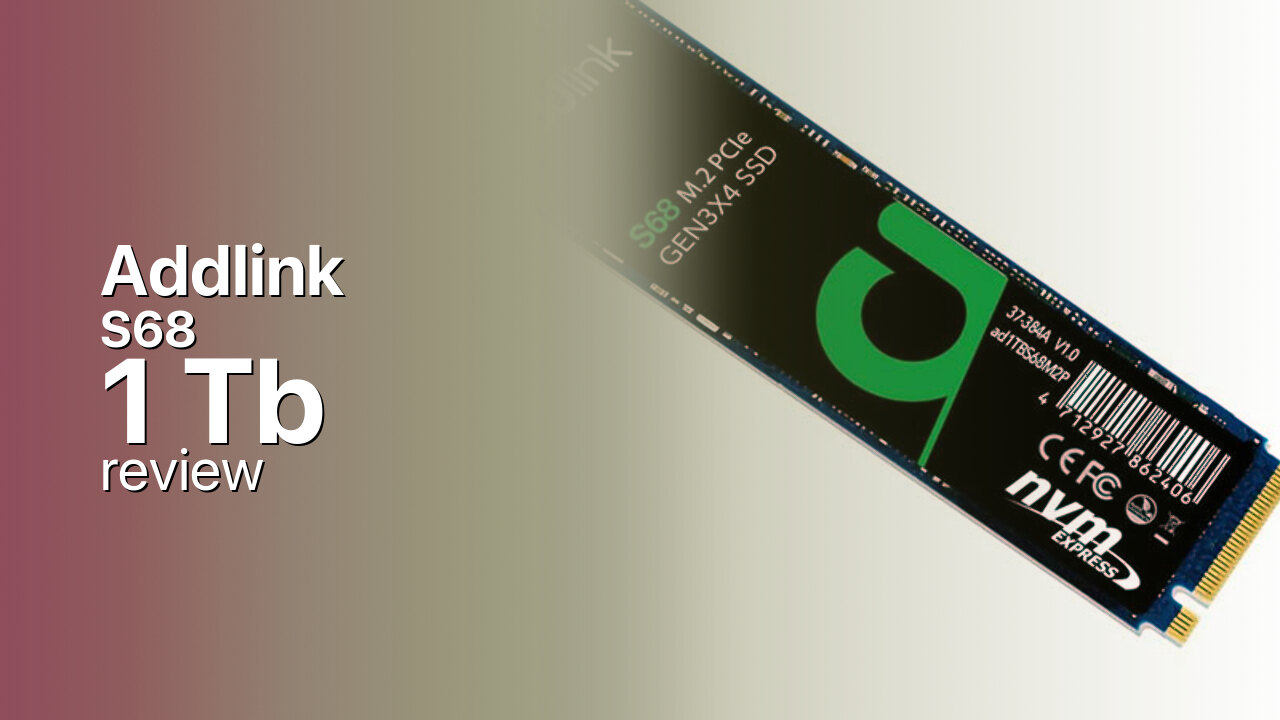
Addlink S68 1TB SSD — In-Depth Review & Specs (2026)
Quick answer
The Addlink S68 1TB is the capacity play in the ultra-budget NVMe segment.
Read: 2500 MB/s Write: 2100 MB/s Endurance: 800 TBW Warranty: 5 years Interface: M.2 3.0 x 4
The Addlink S68 1TB is the flagship capacity in Addlink's most affordable NVMe line. Built on the Phison PS5013-E13T — a 4-channel DRAM-less PCIe 3.0 controller — the 1TB model delivers the platform's full performance potential: 2,500 MB/s read, 2,100 MB/s write, and up to 430,000 random write IOPS. At 1TB the S68 becomes a genuinely practical single-drive solution, combining adequate NVMe performance with a full terabyte of capacity and a 5-year warranty. This review examines whether the S68 1TB overcomes the Phison E13T platform's limitations at its maximum capacity.
Controller & Memory
The Phison PS5013-E13T is a 4-channel DRAM-less PCIe 3.0 x4 NVMe controller that uses Host Memory Buffer to borrow system RAM for the flash translation layer. At 1TB, the four NAND channels operate at full interleave, delivering the controller's ceiling throughput of 2,500 MB/s read and 2,100 MB/s write — roughly 4.5x and 3.8x SATA SSD speeds respectively. Random 4K performance reaches up to 295,000 IOPS read and 430,000 IOPS write.
Addlink pairs the E13T with 3D TLC NAND behind an SLC write cache. At 1TB the dynamic cache is large — typically 150-250 GB — meaning virtually all real-world consumer writes complete at full cache speed. Game installs, large file copies, and OS updates rarely if ever exhaust the cache. Only sustained single-operation transfers exceeding roughly 200 GB will push past the cache and expose native TLC write speeds around 400-500 MB/s.
The single-sided M.2 2280 form factor ensures universal compatibility with desktops, laptops, and Ultrabook-class systems. The DRAM-less, low-power E13T design keeps thermals benign even in passively cooled laptop M.2 slots. Addlink provides a 5-year limited warranty — notably longer than the 3-year coverage typical in the budget segment — and the drive supports LDPC error correction, SLC caching, and NVMe 1.3 power management.
Storage Comparisons:
S68 Performance & Benchmarks
Rated sequential throughput of 2,500 MB/s read and 2,100 MB/s write represents the Phison E13T platform's maximum. Reads are roughly 4.5x faster than a SATA SSD; writes are about 3.8x faster. For an all-in-one system drive — OS, applications, and a large game library — the 2,500 MB/s read speed ensures Windows boots in under 15 seconds and game levels load in single-digit seconds. The 2,100 MB/s write speed means game installs from Steam complete as fast as gigabit internet allows.
Addlink S68 1 TB vs M.2 3.0 x 4 peers
Switch between sequential throughput and random IOPS to see how this drive stacks up against other M.2 3.0 x 4 SSDs in our database. The highlighted bar is the drive on this page — click any other bar to open that drive.
- ADATA SX 8800 Pro 512 GB: 3,500 MB/s read, 2,700 MB/s write
- ADATA SX 8800 Pro 1 TB: 3,500 MB/s read, 2,700 MB/s write
- ADATA XPG Spectrix S40G RGB 256 GB: 3,500 MB/s read, 3,000 MB/s write
- ADATA XPG Spectrix S40G RGB 512 GB: 3,500 MB/s read, 3,000 MB/s write
- Addlink S68 1 TB (this drive): 2,500 MB/s read, 2,100 MB/s write
Random 4K performance at 295K/430K IOPS is the E13T's ceiling. The HMB-sourced FTL keeps lightly-threaded random I/O responsive for everyday use. The DRAM-less architecture does show its limits under heavy mixed workloads — simultaneous large file copies, application installs, and background tasks can stress the HMB-based mapping table — but for the single-task usage pattern typical of the budget gaming and home/office market, the S68 1TB performs without obvious bottlenecks.
The 1TB capacity is the transformative feature. Windows and applications occupy roughly 60-80 GB, leaving over 900 GB for games and files — enough for 10-12 large AAA titles. This is the capacity point where the S68 transitions from boot-drive specialist to legitimate all-in-one solution. The large SLC cache means real-world write performance stays in the fast lane, and thermals remain cool even under extended use.
Addlink S68 vs Competitors
See how the S68 stacks up against other M.2 3.0 x 4 drives in our database:
Compare with rival drives:
Endurance, TBW & Warranty
Addlink provides a 5-year limited warranty for the S68 1TB — notably longer than the 3-year warranty common on budget NVMe drives. Endurance is rated at 800 TBW for the 1TB model per Addlink's product announcement, providing roughly 0.44 drive-writes-per-day over the warranty period. The warranty is tied to the original purchaser and does not cover data recovery.
Addlink S68 1 TB Specifications
| Category | Value |
|---|---|
| Capacity [?] | 1 TB |
| Interface [?] | M.2 3.0 x 4 |
| Controller [?] | Phison PS5013-E13T |
| Memory type [?] | 3D TLC |
| DRAM [?] | HMB |
| Read speed (MB/s) [?] | 2500 |
| Write speed (MB/s) [?] | 2100 |
| Read IOPS [?] | 295000 |
| Write IOPS [?] | 430000 |
| Endurance (TBW) [?] | 800 |
| MTBF (million hours) [?] | 1.5 |
| Warranty (years) [?] | 5 |
Verdict: Is the S68 Worth It in 2026?
The Addlink S68 1TB is the capacity play in the ultra-budget NVMe segment. The Phison E13T DRAM-less platform is not a performance leader — 2,500/2,100 MB/s is adequate rather than impressive by PCIe 3.0 standards — but at 1TB with a 5-year warranty and 800 TBW endurance, the S68 delivers exactly what budget buyers at this capacity care about: a full terabyte of NVMe storage with warranty coverage that outlasts most competitors. For a single-drive budget build where maximizing capacity-per-dollar matters more than chasing benchmark numbers, the S68 1TB is a sensible, warrantied choice. For users who can stretch the budget, the S70 1TB (Phison E12, DRAM-equipped, 3,500/2,700 MB/s) is a meaningful step up in both performance and platform maturity.
+ Pros
- 2,500/2,100 MB/s — 4.5x SATA read speed, E13T platform ceiling at 1TB
- 1TB capacity — genuine single-drive solution for OS, apps, and large game library
- Large SLC cache at 1TB — real-world writes rarely exit the fast cache
- 800 TBW endurance — solid for the budget segment
- 5-year warranty — longer than most budget NVMe competitors
- Single-sided M.2 2280 — universal compatibility, cool-running
- Cons
- DRAM-less HMB design — latency penalty under heavy mixed workloads
- Phison E13T is 4-channel — cannot match 8-channel Gen3 drives
- 2,500 MB/s read is well below PCIe 3.0 x4 ceiling for DRAM-equipped drives
- Limited brand recognition and availability vs. major manufacturers
- No hardware encryption (TCG Opal / Pyrite)
- S70 offers dramatically better performance for a modest price increase
Buy this or similar SSD Storage:



Video Review
Can an Amazon 1TB SSD compete with a Samsung EVO? Actually... yes | Hardware