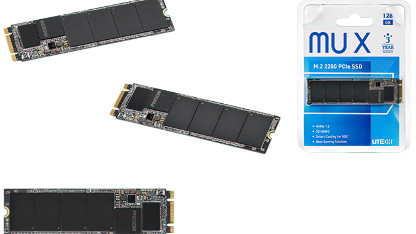
Patriot P300 1TB PCIe 3.0 NVMe SSD (2026)
Quick answer
The Patriot P300 1 TB is a solid budget NVMe SSD that delivers 2,100 MB/s reads and 1 TB of storage at a competitive price.
Read: 2100 MB/s Write: 1650 MB/s Endurance: 240 TBW Warranty: 5 years Interface: M.2 3.0 x 4
The Patriot P300 1 TB is the largest practical capacity in Patriot's budget NVMe lineup, offering 2,100 MB/s reads with a Phison E13T DRAM-less controller at a price that undercuts most DRAM-equipped PCIe 3.0 drives.
Controller & Memory
The P300 1 TB is Patriot's flagship capacity in the budget P300 series, aimed at users who want the most storage per dollar on the PCIe 3.0 x4 bus. The US-market version uses Phison's PS5013-E13T 4-channel DRAM-less controller paired with Kioxia BiCS4 96-layer TLC NAND, while international variants use a Silicon Motion SM2263XT controller. The two versions deliver similar performance.
Because the E13T has no DRAM, the P300 relies on Host Memory Buffer (HMB) technology in Windows 10 to borrow system RAM for the flash translation table. This works well for everyday use but places the P300 a tier below DRAM-equipped drives in random write benchmarks and sustained mixed workloads. The 1 TB model benefits from more NAND dies than the smaller capacities, which improves sustained write performance after the SLC cache fills.
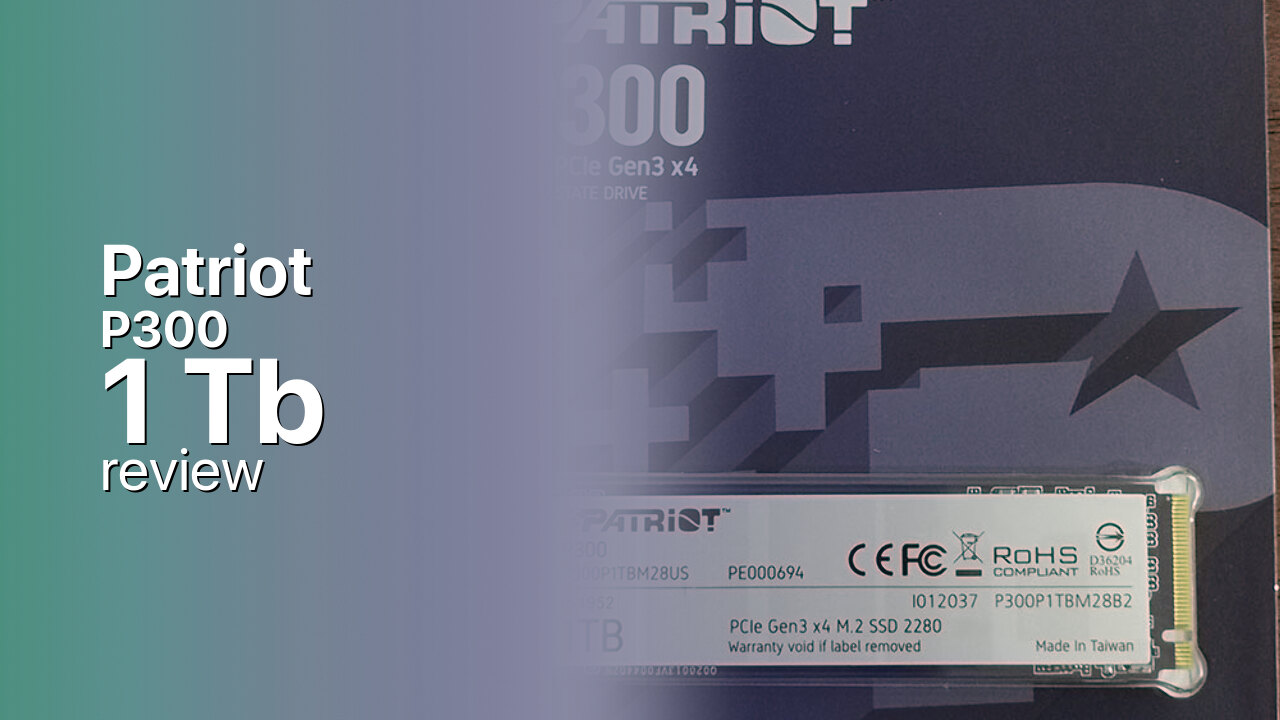
The P300 ships as a bare single-sided M.2 2280 module with a thin label, no heatsink, and no software. In the budget DRAM-less segment, the P300 1 TB competes with the Kingston NV2 1 TB, Crucial P3 1 TB, and WD Blue SN580 1 TB. All four offer similar performance characteristics, making price the primary differentiator.
Storage Comparisons:
P300 Performance & Benchmarks
Patriot rates the P300 1 TB at up to 2,100 MB/s sequential reads and up to 1,650 MB/s sequential writes, with up to 290,000 random read IOPS and 260,000 random write IOPS. These ratings are the same across all P300 capacities since the E13T controller's four channels are the bottleneck, not the NAND quantity.
Patriot P300 1 TB vs M.2 3.0 x 4 peers
Switch between sequential throughput and random IOPS to see how this drive stacks up against other M.2 3.0 x 4 SSDs in our database. The highlighted bar is the drive on this page — click any other bar to open that drive.
- ADATA SX 8800 Pro 512 GB: 3,500 MB/s read, 2,700 MB/s write
- ADATA SX 8800 Pro 1 TB: 3,500 MB/s read, 2,700 MB/s write
- ADATA XPG Spectrix S40G RGB 256 GB: 3,500 MB/s read, 3,000 MB/s write
- ADATA XPG Spectrix S40G RGB 512 GB: 3,500 MB/s read, 3,000 MB/s write
- Patriot P300 1 TB (this drive): 2,100 MB/s read, 1,650 MB/s write
In independent testing by Legit Reviews and KitGuru, the P300 1 TB delivered on its rated speeds on AMD X570 and Intel platforms. The drive provides a clear step up from SATA SSDs in boot times, application loading, and file transfers. Compared to DRAM-equipped PCIe 3.0 drives like the Samsung 970 EVO Plus, the P300's random write performance is measurably lower, and sustained writes after the SLC cache exhaust drop to lower levels. For general desktop use, light content creation, and gaming, the P300 1 TB offers sufficient performance. Users who regularly move tens or hundreds of gigabytes of data will notice the DRAM-less design's limitations.
Patriot P300 vs Competitors
See how the P300 stacks up against other M.2 3.0 x 4 drives in our database:
Compare with rival drives:
Endurance, TBW & Warranty
The P300 1 TB carries a 240 TBW endurance rating within Patriot's warranty period. At a typical 20 GB per day write workload, the 240 TBW rating translates to roughly 32 years before reaching the rated limit. The Phison E13T platform includes LDPC error correction and end-to-end data path protection for data integrity. While 240 TBW is lower than enthusiast drives at the same capacity, it is sufficient for the light to moderate workloads the P300 is designed to handle.
Patriot P300 1 TB Specifications
| Category | Value |
|---|---|
| Capacity [?] | 1 TB |
| Interface [?] | M.2 3.0 x 4 |
| Controller [?] | Phison PS5013-E13T |
| Memory type [?] | Toshiba 3D TLC |
| DRAM [?] | HMB |
| Read speed (MB/s) [?] | 2100 |
| Write speed (MB/s) [?] | 1650 |
| Read IOPS [?] | 290000 |
| Write IOPS [?] | 260000 |
| Endurance (TBW) [?] | 240 |
| MTBF (million hours) [?] | 2 |
| Warranty (years) [?] | 5 |
Verdict: Is the P300 Worth It in 2026?
The Patriot P300 1 TB is a solid budget NVMe SSD that delivers 2,100 MB/s reads and 1 TB of storage at a competitive price. It is well-suited as a boot-and-everything drive for budget desktop builds, or as a secondary storage drive in systems that already have a faster primary NVMe. Anyone who regularly handles large file transfers, runs content creation workloads, or wants the best possible game load times should spend more on a DRAM-equipped drive. For everyday desktop and light gaming use, the P300 1 TB offers a good balance of capacity and speed at a price that makes sense.
+ Pros
- 2,100 MB/s sequential reads at a budget price
- 1 TB capacity fits OS, apps, and a game library
- Single-sided M.2 2280 fits all standard slots
- Low power draw for laptop and small-form-factor use
- More NAND dies improve sustained writes vs smaller capacities
- Cons
- DRAM-less design limits random write throughput
- 240 TBW is lower than enthusiast 1 TB NVMe drives
- SLC cache is modest for a 1 TB drive
- No heatsink, no toolbox software included
Buy this or similar SSD Storage:



Video Review
Patriot P300 M.2 SSD Test: Price to Performance Sweet Spot?