ADATA Legend 960 Max 4 TB: The Max-Capacity Gen4 Heatsink Drive (2026)
Quick answer
Buy the ADATA Legend 960 Max 4 TB when the goal is a single drive that maxes a PlayStation 5 expansion bay or holds a large game library plus a video scratch disk on one Gen4 module, since the 4 TB carries the family's largest SLC cache, the family-high 3,120 TBW, and a factory-fitted heatsink that clears Sony's expansion-slot height limit.
Read: 7400 MB/s Write: 6800 MB/s Endurance: 3120 TBW Warranty: 5 years Interface: M.2 4.0 x 4
The ADATA Legend 960 Max 4 TB is the top capacity of ADATA's heatsink-bundled SM2264 Gen4 line, carrying a family-high 3,120 TBW and the largest SLC cache of the siblings.
Controller & Memory
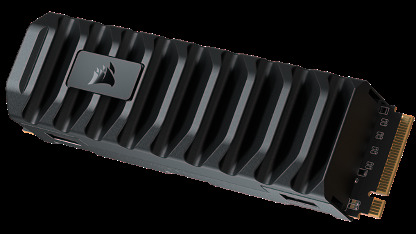
The ADATA Legend 960 Max 4 TB runs the same platform ADATA uses across the whole Legend 960 Max family: Silicon Motion's eight-channel SM2264 controller, Micron 176-layer TLC NAND, a discrete DDR4 DRAM buffer, and a bundled aluminium heatsink that is the defining 'Max' feature. Headline speeds are 7,400 MB/s sequential reads and 6,800 MB/s writes over the PCIe 4.0 x4 bus, with random performance rated up to 750,000 read IOPS and 630,000 write IOPS. Those numbers hold constant across the 1 TB, 2 TB, and 4 TB capacities; what changes between siblings is endurance, which scales with the amount of TLC NAND on board.
On the 4 TB, that endurance lands at 3,120 TBW, the family maximum and the figure johnnylucky.org records as the line's 3.1 PBW ceiling, holding roughly 780 TBW per terabyte of Micron 176-layer TLC against 1,560 TBW on the 2 TB and 780 TBW on the 1 TB. The 4 TB's full NAND complement also gives it the largest SLC cache of the three siblings, so under a long contiguous write such as a multi-hundred-gigabyte game-library move, a 4K video export, or a bulk backup, it holds the rated 6,800 MB/s burst longest before the cache fills and writes settle to the native TLC rate. That makes the 4 TB the capacity to buy when the workload is genuinely write-heavy or the library is genuinely huge, rather than the typical boot-plus-games use case. The bundled aluminium heatsink clears Sony's 11.25 millimetre height limit for the PlayStation 5 expansion bay, so the drive drops straight into a console as well as a Gen4 desktop.
Direct rivals at this capacity and tier include the Samsung 990 Pro 4 TB, which trades blows on real-world responsiveness while shipping bare, and the WD Black SN850X 4 TB, sold both bare and in a heatsink SKU that is the closest like-for-like match to the Max. The Seagate FireCuda 530 4 TB runs the same SM2264-plus-Micron recipe with similar headline numbers, and the Solidigm P44 Pro 4 TB rounds out the Gen4 enthusiast bracket. None of those ship a heatsink in the base box the way the Max does, which is the convenience case for paying the Max premium over the bare Legend 960 4 TB on the same platform.
Storage Comparisons:
Legend 960 Max Performance & Benchmarks
On the 4 TB Legend 960 Max, ADATA rates sequential reads at 7,400 MB/s and writes at 6,800 MB/s over a PCIe 4.0 x4 link, with random performance quoted up to 750,000 read IOPS and 630,000 write IOPS. Those figures match the 1 TB and 2 TB exactly, since ADATA publishes a single speed grade across the whole Legend 960 Max family; the 4 TB neither gives up nor gains anything on sequential throughput versus its siblings. The numbers sit just below the Samsung 990 Pro and WD Black SN850X ceiling of roughly 7,450 MB/s reads and match the Seagate FireCuda 530 on the same SM2264-plus-Micron platform.
ADATA Legend 960 Max 4 TB vs M.2 4.0 x 4 peers
Switch between sequential throughput and random IOPS to see how this drive stacks up against other M.2 4.0 x 4 SSDs in our database. The highlighted bar is the drive on this page — click any other bar to open that drive.
- Patriot Viper PV593 1 TB: 14,500 MB/s read, 14,000 MB/s write
- Patriot Viper PV593 2 TB: 14,500 MB/s read, 14,000 MB/s write
- Patriot Viper PV593 4 TB: 14,500 MB/s read, 14,000 MB/s write
- Patriot Viper PV573 2 TB: 14,000 MB/s read, 12,000 MB/s write
- ADATA Legend 960 Max 4 TB (this drive): 7,400 MB/s read, 6,800 MB/s write
Where the 4 TB pulls ahead of the smaller capacities in real use is sustained writes and headroom. The full TLC complement gives the 4 TB the largest SLC cache in the family, so a long contiguous transfer such as a 500 GB video export, a full game-library copy, or a bulk archive holds the rated 6,800 MB/s burst longest before the cache fills and writes settle to the native Micron TLC rate. Once that cache exhausts, the drive still writes faster than a SATA SSD or a QLC bulk drive, but the gap to the rated figure widens. For game load times, OS responsiveness, and DirectStorage-enabled titles, the 4 TB feels identical to any other upper-tier Gen4 drive; the bandwidth advantage only shows on large sequential workloads. The bundled aluminium heatsink keeps the SM2264 controller out of thermal throttle under sustained load, which is the practical reason to buy the Max over the bare Legend 960 at this capacity.
ADATA Legend 960 Max vs Competitors
See how the Legend 960 Max stacks up against other M.2 4.0 x 4 drives in our database:
Compare with rival drives:
Endurance, TBW & Warranty
ADATA covers the Legend 960 Max 4 TB with a five-year limited warranty, ending early only if the 3,120 TBW endurance rating is exceeded, whichever comes first. That 3,120 TBW figure is the family maximum, four times the 780 TBW of the 1 TB and double the 1,560 TBW of the 2 TB, holding about 780 TBW per terabyte of Micron 176-layer TLC. At a typical consumer workload of around 20 GB of writes per day, the drive would need more than four centuries to exhaust the NAND, so the flash outlasts the warranty term by a wide margin; a heavier 100 GB-per-day routine still clears eight decades. ADATA rates the drive at up to two million hours MTBF, a figure best read as a population-reliability statistic describing expected failures across a large fleet rather than a lifespan guarantee for any single unit. RMA is handled via the retailer or ADATA's regional service centres depending on the market.
ADATA Legend 960 Max 4 TB Specifications
| Category | Value |
|---|---|
| Capacity [?] | 4 TB |
| Interface [?] | M.2 4.0 x 4 |
| Controller [?] | Silicon Motion SM2264 8 Channel |
| Memory type [?] | Micron 176-L TLC |
| DRAM [?] | Yes |
| Read speed (MB/s) [?] | 7400 |
| Write speed (MB/s) [?] | 6800 |
| Read IOPS [?] | 750000 |
| Write IOPS [?] | 630000 |
| Endurance (TBW) [?] | 3120 |
| MTBF (million hours) [?] | 2000000 |
| Warranty (years) [?] | 5 |
Verdict: Is the Legend 960 Max Worth It in 2026?
Buy the ADATA Legend 960 Max 4 TB when the goal is a single drive that maxes a PlayStation 5 expansion bay or holds a large game library plus a video scratch disk on one Gen4 module, since the 4 TB carries the family's largest SLC cache, the family-high 3,120 TBW, and a factory-fitted heatsink that clears Sony's expansion-slot height limit. Skip it on a PCIe 3.0 board, where the drive runs at half its rated bandwidth and a cheaper Gen3 SSD matches the result, and pass on the 4 TB if the workload is purely everyday gaming, where the 2 TB Max hits the same speeds at a lower outlay. The closest alternative is the Samsung 990 Pro 4 TB on raw performance, or the WD Black SN850X 4 TB heatsink SKU for a like-for-like cooled comparison. The verdict on the ADATA Legend 960 Max 4 TB is a max-capacity, PS5-friendly Gen4 drive whose real edge is the bundled heatsink and bulk-storage headroom rather than chart-topping headline speed.
+ Pros
- 7,400 MB/s sequential reads over PCIe 4.0
- 3,120 TBW endurance, family maximum
- Bundled aluminium heatsink fits PS5 slot
- Largest SLC cache in the family
- Silicon Motion SM2264 eight-channel controller
- Micron 176-layer TLC with DDR4 DRAM
- Five-year warranty, TBW-limited
- Cons
- Heatsink adds height, may foul some ITX slots
- Bundled heatsink rules out most laptop slots
- 4 TB carries a price premium per gigabyte
- Real-world speed slightly trails Samsung 990 Pro
- Only matches, not beats, the bare Legend 960
Buy this or similar SSD Storage:



Video Review
LEGEND 960 MAX SSD heatsink installation tutorial