Sabrent Rocket 5 1TB Review — PCIe 5.0 NVMe SSD (2026)
Quick answer
The Sabrent Rocket 5 1TB is a solid choice for builders who have a PCIe 5.0 M.2 slot and want to populate it with a brand-name Phison E26 drive at the entry capacity.
Read: 13000 MB/s Write: 9500 MB/s Endurance: 1200 TBW Warranty: 5 years Interface: M.2 5.0 x 4
The Sabrent Rocket 5 1TB is the entry capacity in Sabrent's first PCIe 5.0 NVMe lineup, built on the Phison E26 controller with Micron 232-layer TLC NAND and rated for up to 13,000 MB/s sequential reads in the standard M.2 2280 form factor.

Controller & Memory
Inside the Rocket 5 sits Phison's PS5026-E26 controller — the most widely deployed PCIe 5.0 NVMe controller in the consumer market, built on a 12nm process with eight NAND channels. The NAND is Micron 232-layer TLC (B58R), paired with an LPDDR4 DRAM cache that stores the controller's logical-to-physical address mapping table in dedicated on-board memory. The drive connects via PCIe 5.0 x4 (NVMe 2.0) and ships in the standard M.2 2280 form factor, compatible with any motherboard that exposes a PCIe Gen5 M.2 slot.
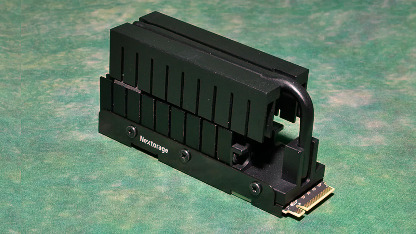
The 1TB model is the entry point in a three-capacity lineup that also includes 2TB and 4TB SKUs. As with most TLC SSDs, the 1TB carries lower sequential write speeds than the higher-capacity variants: 9,500 MB/s versus 12,000 MB/s on the 2TB and 4TB. Sequential reads are also lower at 13,000 MB/s versus 14,000 MB/s on the denser models. This performance gap is a direct consequence of NAND die parallelism — the 1TB has fewer dies available for simultaneous read and write operations. The Rocket 5 ships without a heatsink in its standard retail packaging, though Sabrent offers a custom heatsink variant (the same drive with a factory-attached cooler using dual heatpipes). Buyers running a Gen5 motherboard with a built-in M.2 thermal pad may not need the heatsink option, but sustained write workloads on the Phison E26 controller do generate significant heat.
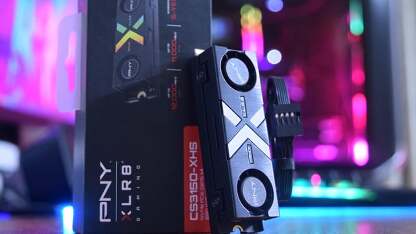
At the PCIe 5.0 tier, the Sabrent Rocket 5 1TB competes directly with the Crucial T705 1TB, the Corsair MP700 Pro 1TB, the Seagate FireCuda 540 1TB, and the PNY XLR8 CS3250 1TB. All four use the Phison E26 platform (or its newer E28 derivative in the case of the CS3250) and target the same enthusiast builder running a Ryzen 7000/9000 or Intel 12th-gen-or-later platform. The Crucial T705 is the most reviewed and broadly benchmarked of the group; the Rocket 5 differentiates itself with Sabrent's optional factory heatsink, a TAA-compliant build for government procurement, and a 5-year warranty with registration.
Storage Comparisons:
Rocket 5 Performance & Benchmarks
The Sabrent Rocket 5 1TB is rated by the manufacturer at up to 13,000 MB/s sequential reads and 9,500 MB/s sequential writes on the PCIe 5.0 x4 interface. These figures place it below the 2TB and 4TB models (14,000/12,000 MB/s) but well above any PCIe 4.0 NVMe drive, which tops out around 7,400 MB/s on the same interface. The Phison E26 platform has been widely benchmarked across multiple drive brands, and the Rocket 5 shares the same controller and NAND combination as many of its competitors — the real-world performance envelope is therefore consistent with the broader E26 ecosystem.
Sabrent Rocket 5 1 TB vs M.2 5.0 x 4 peers
Switch between sequential throughput and random IOPS to see how this drive stacks up against other M.2 5.0 x 4 SSDs in our database. The highlighted bar is the drive on this page — click any other bar to open that drive.
- Kioxia Exceria Pro G2 2 TB: 14,900 MB/s read, 13,400 MB/s write
- Kioxia Exceria Pro G2 4 TB: 14,900 MB/s read, 13,700 MB/s write
- PNY XLR8 CS3250 1 TB: 14,900 MB/s read, 13,500 MB/s write
- PNY XLR8 CS3250 2 TB: 14,900 MB/s read, 14,000 MB/s write
- Sabrent Rocket 5 1 TB (this drive): 13,000 MB/s read, 9,500 MB/s write
In practice, the 13,000 MB/s read speed translates to meaningful gains over PCIe 4.0 in large-file sequential workloads: video editors moving uncompressed 4K/8K footage, game library bulk copies, and DirectStorage-enabled titles that stream compressed assets from the SSD to the GPU. For OS boot, application launch, and general desktop responsiveness, the improvement over a fast PCIe 4.0 drive like the Samsung 990 Pro or WD Black SN850X is modest — the bottleneck in those scenarios is random 4K latency and software overhead, not sequential throughput. Like all TLC SSDs, the Rocket 5 uses an SLC write cache for burst performance; once the cache saturates during prolonged writes, sustained throughput drops to the native TLC write speed. The LPDDR4 DRAM buffer helps minimise the impact by keeping the mapping table lookups fast. The Phison E26 controller is known to run warm under sustained load — a characteristic shared by all first-generation PCIe 5.0 controllers — so airflow or a heatsink is advisable for workloads that involve extended sequential writes.
Sabrent Rocket 5 vs Competitors
See how the Rocket 5 stacks up against other M.2 5.0 x 4 drives in our database:
Compare with rival drives:
Endurance, TBW & Warranty
Sabrent covers the Rocket 5 with a conditional warranty structure: 2 years of coverage out of the box without any registration, extendable to 5 years by registering the product on Sabrent's website within 90 days of purchase. The 5-year term is the more commonly advertised figure and is what Sabrent lists in its product tags. The warranty is subject to TBW limits — the 1TB model is rated at 1,200 TBW (terabytes written), meaning the warranty expires at whichever comes first: the time limit or the total write endurance budget. At a typical consumer write workload of 20 to 40 GB per day, 1,200 TBW represents over 80 years of use before the endurance threshold is reached, so the 5-year time limit will expire well before TBW becomes a factor for most users. Content creators and workstation users writing several hundred gigabytes daily will have a shorter effective endurance horizon, but even at 200 GB per day the drive would take roughly 16 years to exhaust its rated writes. Warranty service is handled through Sabrent's standard RMA process, and the company provides a product registration portal on its website.
Sabrent Rocket 5 1 TB Specifications
| Category | Value |
|---|---|
| Capacity [?] | 1 TB |
| Interface [?] | M.2 5.0 x 4 |
| Controller [?] | Phison PS5026-E26 8 Channel |
| Memory type [?] | Micron 232-Layer TLC |
| DRAM [?] | Yes |
| Read speed (MB/s) [?] | 13000 |
| Write speed (MB/s) [?] | 9500 |
| Read IOPS [?] | 1400000 |
| Write IOPS [?] | 1800000 |
| Endurance (TBW) [?] | 1200 |
| MTBF (million hours) [?] | 2000000 |
| Warranty (years) [?] | 5 |
Verdict: Is the Rocket 5 Worth It in 2026?
The Sabrent Rocket 5 1TB is a solid choice for builders who have a PCIe 5.0 M.2 slot and want to populate it with a brand-name Phison E26 drive at the entry capacity. The 1TB SKU is the slowest in the Rocket 5 lineup — 9,500 MB/s writes trail the 2TB by 2,500 MB/s — so buyers whose workloads involve heavy sustained writes (4K video export, large backup cycles) should consider stepping up to the 2TB for the performance bump and double the storage. For gaming and general desktop use, the 1TB covers the PCIe 5.0 bandwidth requirement comfortably, and the 1,200 TBW endurance is generous for the capacity. Buyers on a PCIe 4.0 platform gain nothing from the Rocket 5 over a well-priced PCIe 4.0 drive like the Samsung 990 Pro or WD Black SN850X. The Crucial T705 1TB is the closest competitor on specs and has broader independent review coverage; the Rocket 5 differentiates with its optional factory heatsink and TAA compliance. Either drive is a sound pick in this tier.
+ Pros
- 13,000 MB/s sequential reads on PCIe 5.0 x4
- Phison E26 controller — mature, widely benchmarked platform
- LPDDR4 DRAM cache for consistent sustained performance
- M.2 2280 form factor — compatible with any Gen5 M.2 slot
- 1,200 TBW endurance rated for the 1TB capacity
- 5-year warranty with product registration
- Optional factory heatsink with dual heatpipes available
- TAA-compliant for government procurement
- Cons
- 1TB write speed (9,500 MB/s) significantly trails the 2TB model (12,000 MB/s)
- Requires PCIe 5.0 slot — no meaningful gain on PCIe 4.0 or 3.0 platforms
- Phison E26 controller runs hot under sustained load
- No bundled heatsink in the standard retail package
- 5-year warranty requires registration within 90 days; only 2 years out of the box
Buy this or similar SSD Storage:
Video Review
INSANE SPEED 🚀 - Sabrent Rocket 4 Plus NVME