Acer FA200 2 TB: The Flagship PCIe 4.0 QLC NVMe (2026)
Quick answer
Buy the Acer FA200 2 TB as a budget game-library or bulk secondary drive in a PCIe 4.0 desktop or laptop where the low cost-per-gigabyte and full flagship read bandwidth matter more than sustained write behaviour.
Read: 7200 MB/s Write: 6200 MB/s Endurance: 1000 TBW Warranty: 5 years Interface: M.2 4.0 x 4
The Acer FA200 2 TB is the flagship capacity of Acer's budget PCIe 4.0 QLC line, carrying the family's headline 7,200 MB/s reads, 6,200 MB/s writes and a 1,000 TBW endurance rating.
Controller & Memory
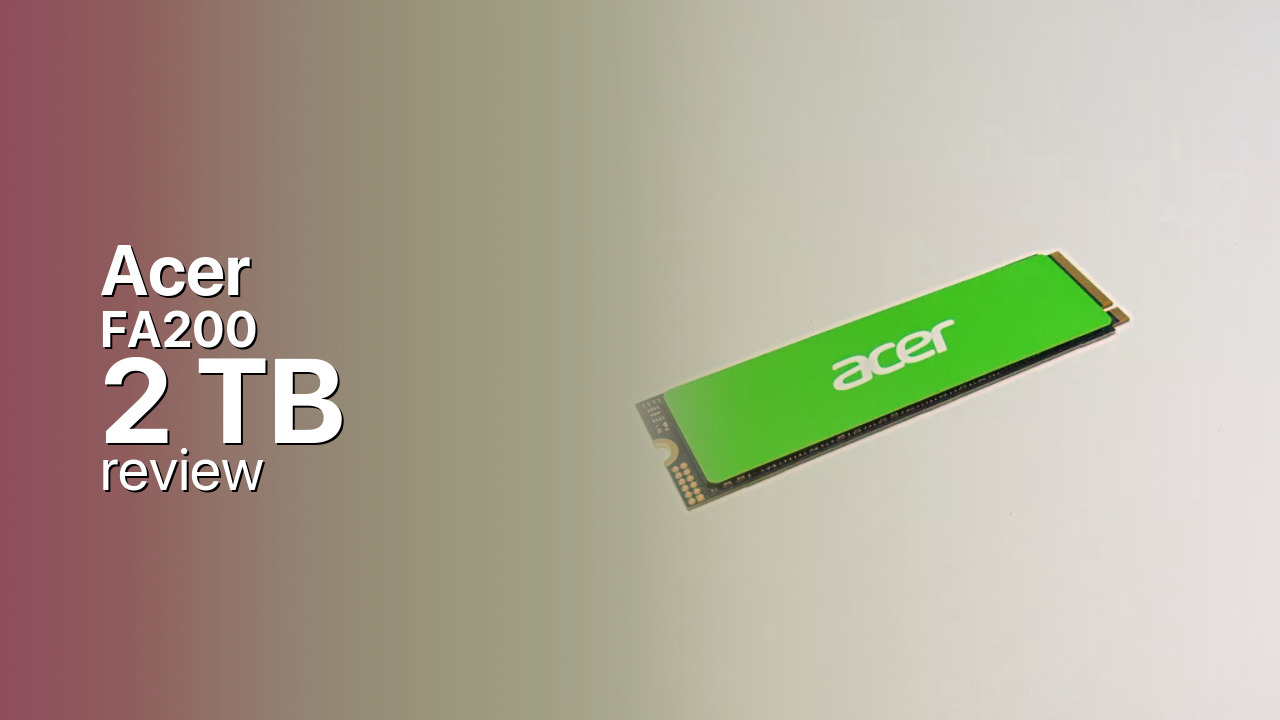
The Acer FA200 2 TB is a budget PCIe 4.0 NVMe built on a DRAM-less platform from BIWIN, the OEM that actually manufactures the drive under the Acer brand. Inside, Maxiotech's MAP1602A four-channel controller pairs with YMTC's 232-layer QLC NAND over a PCIe 4.0 x4 link on a standard single-sided M.2 2280 module, and because there is no discrete DRAM the drive leans on the host system's memory through the HMB protocol for its mapping tables. A graphene thermal pad handles cooling rather than a metal heatsink, and the single-sided layout keeps the 2 TB thin enough to fit slim laptops and a PlayStation 5 expansion slot without height-clearance issues.
Within the FA200 family, which also spans 500 GB, 1 TB and 4 TB siblings, the 2 TB is the capacity Acer's marketing numbers are drawn from: johnnylucky.org's family headline of 7,200 MB/s reads, 6,200 MB/s writes, 1,000K random read IOPS and 800K random write IOPS maps exactly onto the 2 TB's rated spec, and its 1,000 TBW endurance is double the 500 TBW of the 1 TB. The 2 TB also posts the family's strongest random write IOPS this side of the 4 TB, at 800K against the 1 TB's 586K, which is the main performance reason to step up from the smaller flagship. This is the capacity where the QLC value argument is strongest: 2 TB is enough real estate for a large game library or a bulk secondary drive, and the cost-per-gigabyte of QLC NAND pays off here in a way it does not on the 500 GB.
Compatibility is straightforward: the drive runs at full speed in any PCIe 4.0 desktop or laptop and drops to PCIe 3.0 rates in older slots, and it clears Sony's published PlayStation 5 requirement of an M.2 NVMe with at least 5,500 MB/s reads. The direct rivals are the same tier of budget DRAM-less PCIe 4.0 drives at 2 TB, including the Kingston NV2, Crucial P3, WD Blue SN580 and Team Group MP44L, with the TLC-based SN580 and MP44L the stronger picks for sustained writes. The FA200's real distinction is the Maxiotech-plus-YMTC QLC recipe at aggressive density-per-dollar rather than anything in its feature set, which makes the 2 TB a sensible game-library and secondary drive rather than a primary scratch disk.
Storage Comparisons:
FA200 Performance & Benchmarks
On the 2 TB FA200, Acer rates sequential reads at 7,200 MB/s and sequential writes at 6,200 MB/s over a PCIe 4.0 x4 link, with random performance up to 1,000K IOPS on reads and 800K IOPS on writes. Those are the family's headline numbers, and the 2 TB is the capacity they are actually drawn from: the 800K random write figure is well above the 1 TB's 586K and is the main reason the 2 TB pulls ahead of its smaller flagship sibling on paper.
Acer FA200 2 TB vs M.2 4.0 x 4 peers
Switch between sequential throughput and random IOPS to see how this drive stacks up against other M.2 4.0 x 4 SSDs in our database. The highlighted bar is the drive on this page — click any other bar to open that drive.
- Patriot Viper PV593 1 TB: 14,500 MB/s read, 14,000 MB/s write
- Patriot Viper PV593 2 TB: 14,500 MB/s read, 14,000 MB/s write
- Patriot Viper PV593 4 TB: 14,500 MB/s read, 14,000 MB/s write
- Patriot Viper PV573 2 TB: 14,000 MB/s read, 12,000 MB/s write
- Acer FA200 2 TB (this drive): 7,200 MB/s read, 6,200 MB/s write
For everyday desktop use, boot times, application launches and game loading, the drive feels responsive and the read bandwidth is more than enough; game load times are typically bounded by the CPU and asset decompression rather than storage, so the gap to a faster PCIe 4.0 drive is small in practice. The honest caveat is QLC behaviour under sustained writes: once the SLC cache fills, writes settle to the native YMTC QLC rate, which can drop well below 1,000 MB/s, and the 2 TB's larger cache than the 1 TB and 500 GB pushes that cliff further out but does not remove it. That makes the 2 TB a strong game-library and bulk-storage drive, but still a poor fit for a video scratch disk or constant large-file ingest, where a TLC drive such as the WD Blue SN580 or Team Group MP44L holds its writes far better. Independent reviews of the FA200 family confirm the platform behaves as described.
Acer FA200 vs Competitors
See how the FA200 stacks up against other M.2 4.0 x 4 drives in our database:
Compare with rival drives:
Endurance, TBW & Warranty
Acer covers the FA200 2 TB with a five-year limited warranty, ending early if the 1,000 TBW endurance rating is exceeded, whichever comes first. The 1,000 TBW figure sits near the top of a family that climbs from 250 TBW on the 500 GB through 500 TBW on the 1 TB and 1,000 TBW on the 2 TB up to 2,000 TBW on the 4 TB, scaling with capacity under the YMTC QLC endurance profile. At a typical consumer workload of around 20 GB of writes per day, the 2 TB would need more than 136 years to wear out the NAND, so in practice the warranty term expires long before the flash does; even a heavier 50 GB-per-day routine still clears 54 years. Acer rates the drive at up to 1.5 million hours MTBF, but that figure is a population-reliability statistic describing expected failures across a large fleet, not a lifespan guarantee for any single unit.
Acer FA200 2 TB Specifications
| Category | Value |
|---|---|
| Capacity [?] | 2 TB |
| Interface [?] | M.2 4.0 x 4 |
| Controller [?] | Maxiotech MAP1602A 4 channel |
| Memory type [?] | YMTC 232-L, QLC |
| DRAM [?] | HMB |
| Read speed (MB/s) [?] | 7200 |
| Write speed (MB/s) [?] | 6200 |
| Read IOPS [?] | 1000000 |
| Write IOPS [?] | 800000 |
| Endurance (TBW) [?] | 1000 |
| MTBF (million hours) [?] | 1500000 |
| Warranty (years) [?] | 5 |
Verdict: Is the FA200 Worth It in 2026?
Buy the Acer FA200 2 TB as a budget game-library or bulk secondary drive in a PCIe 4.0 desktop or laptop where the low cost-per-gigabyte and full flagship read bandwidth matter more than sustained write behaviour. Skip it for a primary video editing scratch disk, a DirectStorage-focused gaming build pushing the limits, or any workload with long sustained writes, where the QLC NAND's drop past the SLC cache will be felt. The stronger alternative in the same tier is a TLC drive like the WD Blue SN580 or Team Group MP44L 2 TB, which holds sustained writes better for similar money, or stepping down to the 1 TB FA200, which matches the 2 TB on sequential bandwidth for less outlay but halves endurance to 500 TBW. The verdict on the FA200 2 TB is a competent, no-frills QLC drive whose main draw is flagship speed and 1,000 TBW at the capacity where QLC bulk-storage value peaks.
+ Pros
- 7,200 MB/s sequential reads on PCIe 4.0
- Up to 800K random write IOPS
- 1,000 TBW endurance at 2 TB
- Single-sided M.2 2280 fits laptops and PS5
- Maxiotech MAP1602A with YMTC 232-layer NAND
- Graphene thermal pad for cooling
- Five-year warranty, TBW-limited
- Cons
- QLC NAND slows sharply past the SLC cache
- DRAM-less, relies on host HMB
- Endurance per GB trails TLC rivals
- No metal heatsink, graphene pad only
Buy this or similar SSD Storage:



Video Review
ACER FA200 2TB GEN4 NVMe