Seagate FireCuda 510 2TB Review — A Phison E12 Rebrand with Extra Endurance (2026)
Quick answer
The Seagate FireCuda 510 2 TB is the endurance champion of the PCIe 3.0 Phison E12 family — if you are building or upgrading a PCIe 3.0 system and want a single large drive that will outlast the rest of the build, the 510's 2,600 TBW rating and included data recovery warranty make a compelling case.
Read: 3450 MB/s Write: 3200 MB/s Endurance: 2600 TBW Warranty: 5 years Interface: M.2 3.0 x 4
The Seagate FireCuda 510 2 TB is a rebadged Phison E12 reference drive with Seagate firmware customizations and a 2,600 TBW endurance rating that outlasted nearly every PCIe 3.0 competitor — plus a 5-year warranty that included data recovery, which no other E12 drive offered.
Controller & Memory
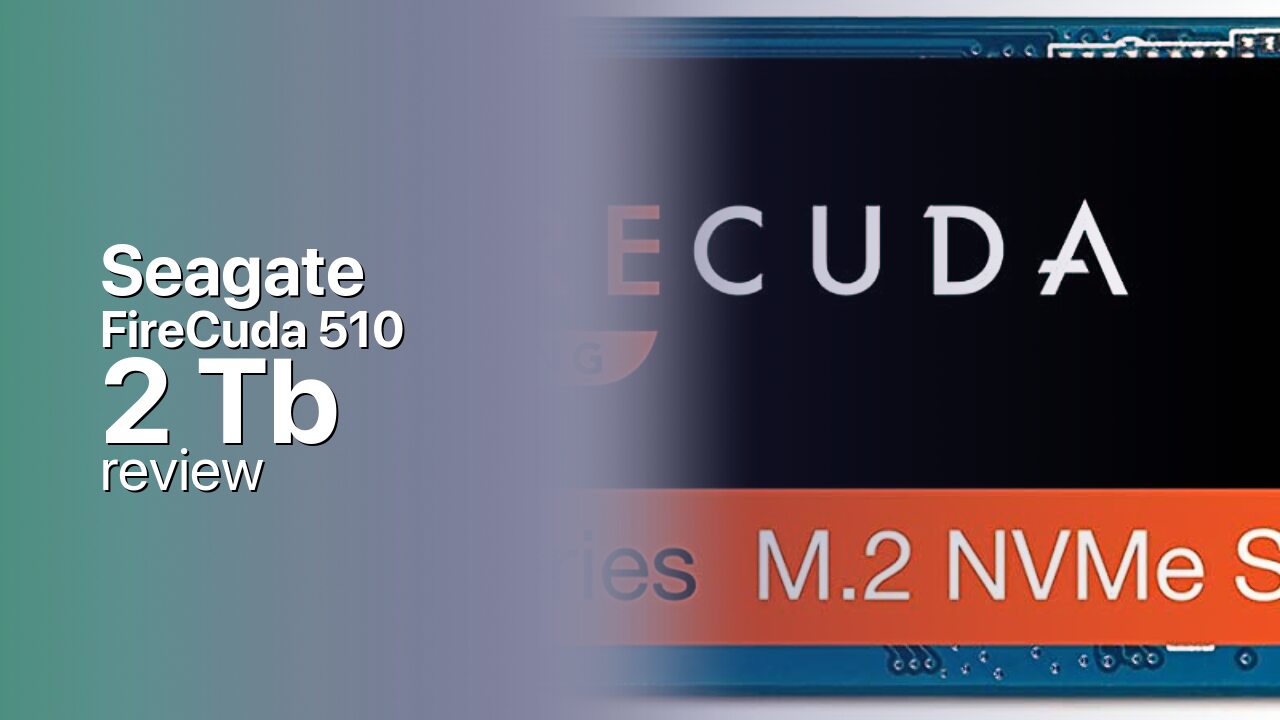
The Seagate FireCuda 510 is Seagate's first consumer NVMe SSD, and it is built on the Phison PS5012-E12 platform — the same eight-channel, TSMC 28nm controller that powered the Corsair MP510, Sabrent Rocket, and Team Group Cardea II. Seagate brands the controller as the "STXYPO," which is an internal part number for a customized E12 with Seagate-specific firmware tweaks. The NAND is Toshiba 64-layer BiCS3 3D TLC, and the 2 TB variant includes 1 GB of SK Hynix DDR4-2400 DRAM split across two 512 MB chips. The drive uses a standard M.2 2280 single-sided PCB with no included heatsink, making it compatible with laptops and ultrabooks.
Seagate's firmware customizations focused on endurance and sustained write consistency rather than peak throughput, and the numbers bear this out. The 2 TB FireCuda 510 is rated for 2,600 TBW — significantly higher than the Corsair MP510 2 TB (approximately 1,700 TBW) or the Sabrent Rocket 2 TB (approximately 1,400 TBW) on the same silicon. This was achieved through more conservative over-provisioning and firmware-level write amplification management, not different hardware. The trade-off is slightly lower peak performance: the FireCuda 510's 485,000 random read IOPS on the 2 TB variant trails the 620,000 IOPS that the 1 TB model achieves, which is the inverse of the usual capacity-versus-IOPS relationship and reflects Seagate prioritizing endurance over peak numbers on the larger drive.
Seagate positioned the FireCuda 510 as a gaming and creative-professional drive, and the 2 TB variant was the flagship of the lineup at launch in 2019. It also included Seagate's Rescue Data Recovery Services — a rare value-add for an SSD warranty that covers physical data recovery attempts if the drive fails. The FireCuda 510 has been superseded by the FireCuda 520 (PCIe 4.0, Phison E16) and later the FireCuda 530 (Phison E18, much faster), but the 510 remains relevant on the used market for PCIe 3.0 systems where endurance and the data recovery warranty are valued over raw speed.
Storage Comparisons:
FireCuda 510 Performance & Benchmarks
The Seagate FireCuda 510 2 TB is rated for 3,450 MB/s sequential reads and 3,200 MB/s sequential writes, with random performance of up to 485,000 IOPS reads and 600,000 IOPS writes. The read IOPS figure is notably lower than the 1 TB variant's 620,000 — an unusual inversion where the smaller capacity outperforms the larger one on random reads, attributable to Seagate's firmware prioritizing write consistency and endurance on the 2 TB SKU. Independent reviewers at TechPowerUp and StorageReview measured sequential throughput consistent with the rated figures, though the FireCuda 510 typically placed third or fourth in benchmark comparisons against other E12 drives due to the conservative firmware tuning.
Seagate FireCuda 510 2 TB vs M.2 3.0 x 4 peers
Switch between sequential throughput and random IOPS to see how this drive stacks up against other M.2 3.0 x 4 SSDs in our database. The highlighted bar is the drive on this page — click any other bar to open that drive.
- ADATA SX 8800 Pro 512 GB: 3,500 MB/s read, 2,700 MB/s write
- ADATA SX 8800 Pro 1 TB: 3,500 MB/s read, 2,700 MB/s write
- ADATA XPG Spectrix S40G RGB 256 GB: 3,500 MB/s read, 3,000 MB/s write
- ADATA XPG Spectrix S40G RGB 512 GB: 3,500 MB/s read, 3,000 MB/s write
- Seagate FireCuda 510 2 TB (this drive): 3,450 MB/s read, 3,200 MB/s write
The 2 TB variant's dynamic SLC cache is generously sized — roughly 28 GB of fixed SLC plus additional dynamic cache proportional to free space — and sustains full write speed for transfers well beyond typical consumer workloads. Once the cache exhausts, direct-to-TLC writes settle at approximately 800 to 1,000 MB/s, consistent with the Phison E12 platform. The drive's strength is in mixed and sustained workloads: the high endurance rating and Seagate's firmware optimizations mean the 510 maintains more consistent performance under heavy sustained writes than many E12 competitors that push peak numbers at the expense of consistency.
Thermally, the FireCuda 510 behaves like any other E12 drive — the controller reaches the mid-70s Celsius under sustained load, and a motherboard M.2 cover or modest airflow is recommended. For gaming, the 510 loads titles within a second of any other PCIe 3.0 NVMe SSD, and the DRAM cache ensures responsive multitasking. The 2 TB capacity makes it a strong single-drive solution for a gaming library plus OS without resorting to a secondary SATA SSD. The PCIe 3.0 interface precludes PS5 use, but that was never the target market.
Seagate FireCuda 510 vs Competitors
See how the FireCuda 510 stacks up against other M.2 3.0 x 4 drives in our database:
Compare with rival drives:
Endurance, TBW & Warranty
Seagate backs the FireCuda 510 2 TB with a 5-year limited warranty that includes Rescue Data Recovery Services — a meaningful differentiator in the SSD market where data recovery is almost never covered. If the drive fails within the warranty period, Seagate will attempt to recover the data at a cleanroom facility as part of the warranty service, not as an extra-cost add-on. The endurance rating is 2,600 TBW, equivalent to approximately 1.4 TB of writes per day for the warranty period. This is among the highest endurance figures for any PCIe 3.0 consumer SSD and significantly exceeds competing Phison E12 drives at the 2 TB capacity. At a typical 30 GB/day pace, the endurance extends beyond 230 years. The TBW scales across the lineup: 650 TBW for 500 GB, 1,300 TBW for 1 TB, and 2,600 TBW for 2 TB. The MTBF is rated at 1.8 million hours. Seagate provides the SeaTools SSD utility for drive health monitoring and firmware updates.
Seagate FireCuda 510 2 TB Specifications
| Category | Value |
|---|---|
| Capacity [?] | 2 TB |
| Interface [?] | M.2 3.0 x 4 |
| Controller [?] | Seagate STXYPO |
| Memory type [?] | Toshiba TLC |
| DRAM [?] | SK Hynix 1GB DDR4 |
| Read speed (MB/s) [?] | 3450 |
| Write speed (MB/s) [?] | 3200 |
| Read IOPS [?] | 485000 |
| Write IOPS [?] | 600000 |
| Endurance (TBW) [?] | 2600 |
| MTBF (million hours) [?] | 1.8 |
| Warranty (years) [?] | 5 |
Verdict: Is the FireCuda 510 Worth It in 2026?
The Seagate FireCuda 510 2 TB is the endurance champion of the PCIe 3.0 Phison E12 family — if you are building or upgrading a PCIe 3.0 system and want a single large drive that will outlast the rest of the build, the 510's 2,600 TBW rating and included data recovery warranty make a compelling case. The performance is standard E12 fare, which means it is fast enough for gaming, creative work, and general desktop use but will not win any benchmark races against the Samsung 970 EVO Plus or WD Black SN750. Buy it on the used market for a high-capacity, high-endurance PCIe 3.0 drive with a warranty that covers more than just replacement. Skip it if you can use PCIe 4.0 — the FireCuda 530 offers dramatically better performance with similar endurance and the same data recovery services.
+ Pros
- 2,600 TBW endurance — highest among PCIe 3.0 Phison E12 drives
- 5-year warranty with Rescue Data Recovery Services included
- 3,200 MB/s sequential writes — near the PCIe 3.0 ceiling
- Standard Phison E12 reliability with Seagate firmware optimizations
- 2 TB capacity suitable for OS plus large game or media library
- Single-sided PCB fits laptops and ultrabooks
- Cons
- 485K read IOPS on 2 TB is lower than 1 TB variant's 620K — unusual inversion
- Benchmarks typically place behind other E12 competitors
- PCIe 3.0 only — superseded by FireCuda 520 and 530
- Seagate firmware lacks the peak burst tuning of Corsair or Sabrent E12 drives
- No included heatsink — aftermarket cooling recommended for sustained workloads
Buy this or similar SSD Storage:
Video Review
Seagate FireCuda 510 NVMe 2TB Review | Best SSD for Video Editors?