Seagate FireCuda 520 2TB PCIe 4.0 NVMe SSD Review (2026)
Quick answer
The Seagate FireCuda 520 2TB is the logical choice within the FireCuda 520 range for anyone who needs high-capacity PCIe 4.0 storage.
Read: 5000 MB/s Write: 4400 MB/s Endurance: 3600 TBW Warranty: 5 years Interface: M.2 4.0 x 4
The Seagate FireCuda 520 2TB is the range-topping capacity of Seagate's first PCIe 4.0 NVMe line, combining 5,000 MB/s reads, 4,400 MB/s writes, and a generous 3,600 TBW endurance rating for heavy-write environments.
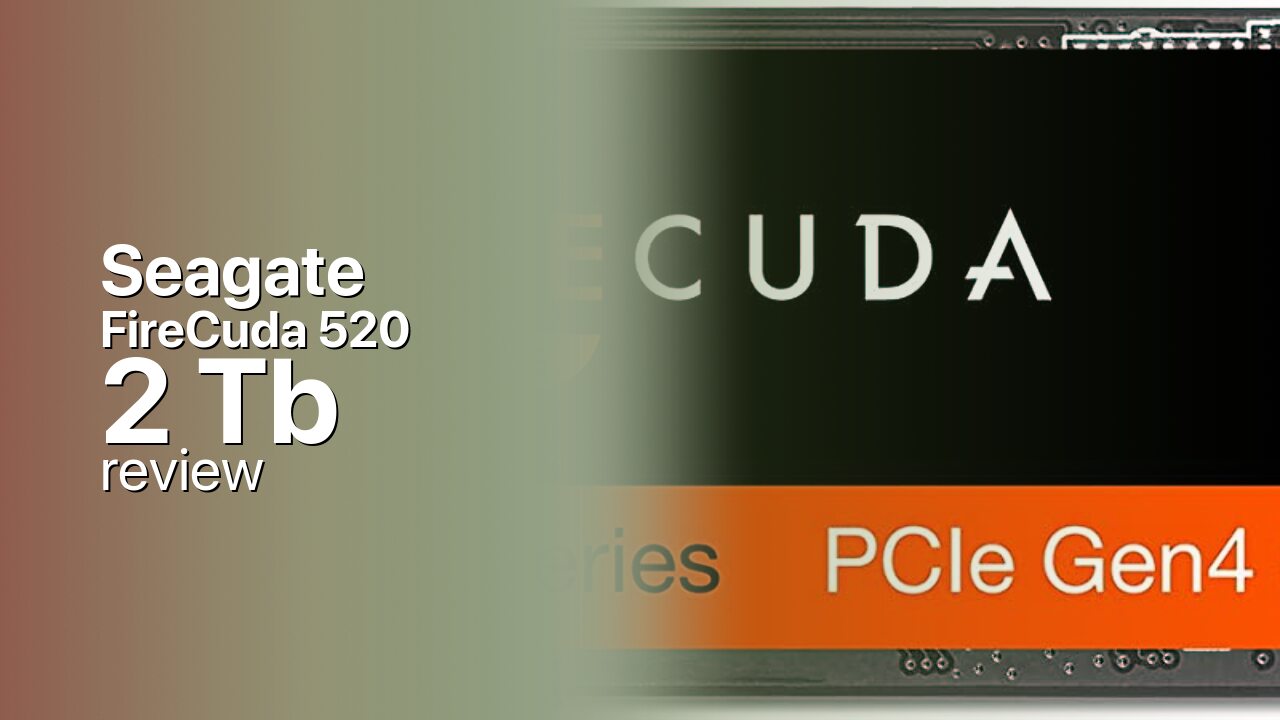
Controller & Memory
Built on the Phison PS5016-E16 eight-channel controller with Toshiba BiCS4 96-layer 3D TLC NAND, the 2TB FireCuda 520 matches the 1TB model's sequential read and write speeds at 5,000 MB/s and 4,400 MB/s respectively. Random performance is rated at 750K read IOPS and 700K write IOPS. The 2TB model doubles the endurance to 3,600 TBW, making it suitable for workstations and content creators who move large volumes of data.
The drive is double-sided with NAND packages on both faces of the M.2 2280 PCB, alongside the controller and a DDR4 DRAM cache chip. No heatsink ships in the box — Seagate expects users to rely on the M.2 thermal guards that ship with most modern motherboards. The black PCB is a significant aesthetic improvement over the FireCuda 510's blue board and blends into most builds.
At 2TB, this drive targets users who need bulk NVMe storage on a PCIe 4.0 platform: game libraries with 30+ AAA titles, video editing scratch disks, or a combined OS-and-data partition. Competing 2TB Gen4 drives from the same era include the Corsair MP600 2TB and the Sabrent Rocket NVMe 4.0 2TB, both using the same Phison E16 reference design.
Storage Comparisons:
FireCuda 520 Performance & Benchmarks
The FireCuda 520 2TB is rated for 5,000 MB/s sequential reads and 4,400 MB/s sequential writes, with 750K random read IOPS and 700K random write IOPS. Independent reviews confirm the drive consistently hits within 5 percent of these numbers in synthetic benchmarks. The 2TB model's larger SLC cache absorbs a substantial write burst before dropping to native TLC speeds around 1,500–2,000 MB/s — typically after 200–300 GB of sustained writing.
Seagate FireCuda 520 2 TB vs M.2 4.0 x 4 peers
Switch between sequential throughput and random IOPS to see how this drive stacks up against other M.2 4.0 x 4 SSDs in our database. The highlighted bar is the drive on this page — click any other bar to open that drive.
- Patriot Viper PV593 1 TB: 14,500 MB/s read, 14,000 MB/s write
- Patriot Viper PV593 2 TB: 14,500 MB/s read, 14,000 MB/s write
- Patriot Viper PV593 4 TB: 14,500 MB/s read, 14,000 MB/s write
- Patriot Viper PV573 2 TB: 14,000 MB/s read, 12,000 MB/s write
- Seagate FireCuda 520 2 TB (this drive): 5,000 MB/s read, 4,400 MB/s write
In real-world workloads, the 2TB capacity provides more die for parallel writes, which helps sustain higher throughput under mixed read/write loads compared to smaller capacities. Gaming load times are indistinguishable from other PCIe 4.0 drives in this class. Content creators working with 4K video files will see meaningful gains over PCIe 3.0 drives when importing and scrubbing footage, though the actual ceiling is still well below what newer Phison E18 or PCIe 5.0 drives can achieve.
Seagate FireCuda 520 vs Competitors
See how the FireCuda 520 stacks up against other M.2 4.0 x 4 drives in our database:
Compare with rival drives:
Endurance, TBW & Warranty
Seagate rates the FireCuda 520 2TB at 3,600 TBW, covered by a five-year limited warranty that expires when either the TBW allowance or the warranty period is reached. At 50 GB of writes per day — a heavy content-creator workload — the 3,600 TBW budget lasts roughly 197 years. Even at 200 GB per day, endurance covers 49 years. The 1.8 million hour MTBF is a population-level statistic, not a per-drive guarantee. Seagate's SeaTools utility provides health monitoring and firmware updates. Warranty service is handled directly through Seagate's RMA portal, and the drive is backed by a well-established storage company with a mature support infrastructure.
Seagate FireCuda 520 2 TB Specifications
| Category | Value |
|---|---|
| Capacity [?] | 2 TB |
| Interface [?] | M.2 4.0 x 4 |
| Controller [?] | Phison PS5016-E16 |
| Memory type [?] | Toshiba 3D TLC |
| DRAM [?] | Nanya DDR4 |
| Read speed (MB/s) [?] | 5000 |
| Write speed (MB/s) [?] | 4400 |
| Read IOPS [?] | 750000 |
| Write IOPS [?] | 700000 |
| Endurance (TBW) [?] | 3600 |
| MTBF (million hours) [?] | 1.8 |
| Warranty (years) [?] | 5 |
Verdict: Is the FireCuda 520 Worth It in 2026?
The Seagate FireCuda 520 2TB is the logical choice within the FireCuda 520 range for anyone who needs high-capacity PCIe 4.0 storage. Its 3,600 TBW endurance and matched 5,000/4,400 MB/s speeds make it well-suited for content creators and enthusiasts with large game libraries. The trade-off is that first-gen PCIe 4.0 performance is now eclipsed by second-gen Phison E18 drives that exceed 7,000 MB/s. Builders prioritizing absolute throughput should consider the Samsung 980 Pro 2TB or WD Black SN850 2TB instead. For the price-sensitive buyer who values capacity and endurance over peak benchmark numbers, the FireCuda 520 2TB is a practical and reliable option.
+ Pros
- 5,000 MB/s reads and 4,400 MB/s writes on PCIe 4.0
- 3,600 TBW endurance — the highest in the FireCuda 520 range
- Toshiba 96-layer TLC with Phison E16 controller
- DDR4 DRAM cache for consistent IO performance
- 2TB capacity fits large game libraries or video projects
- Black PCB with clean aesthetics
- Cons
- Surpassed by Phison E18 and PCIe 5.0 drives for peak speed
- No included heatsink
- Double-sided PCB limits slim-laptop and some ITX builds
- First-gen Gen4 idle power higher than newer designs
- Requires PCIe 4.0 platform for rated throughput
Buy this or similar SSD Storage:
Video Review
Could This Be The FASTEST NVMe SSD Yet? Seagate Firecuda 520