Seagate FireCuda 540 4 TB: Max Capacity, Max Endurance Gen5 (2026)
Quick answer
The Seagate FireCuda 540 4 TB is the drive to buy if you want the maximum capacity and endurance of Seagate's Gen5 lineup without giving up the full 10,000 MB/s speed.
Read: 10000 MB/s Write: 10000 MB/s Endurance: 2000 TBW Warranty: 5 years Interface: M.2 5.0
The Seagate FireCuda 540 4 TB is the largest capacity of Seagate's PCIe 5.0 gaming line, pairing 10,000 MB/s reads with 2,000 TBW of endurance and a 5-year warranty.
Controller & Memory
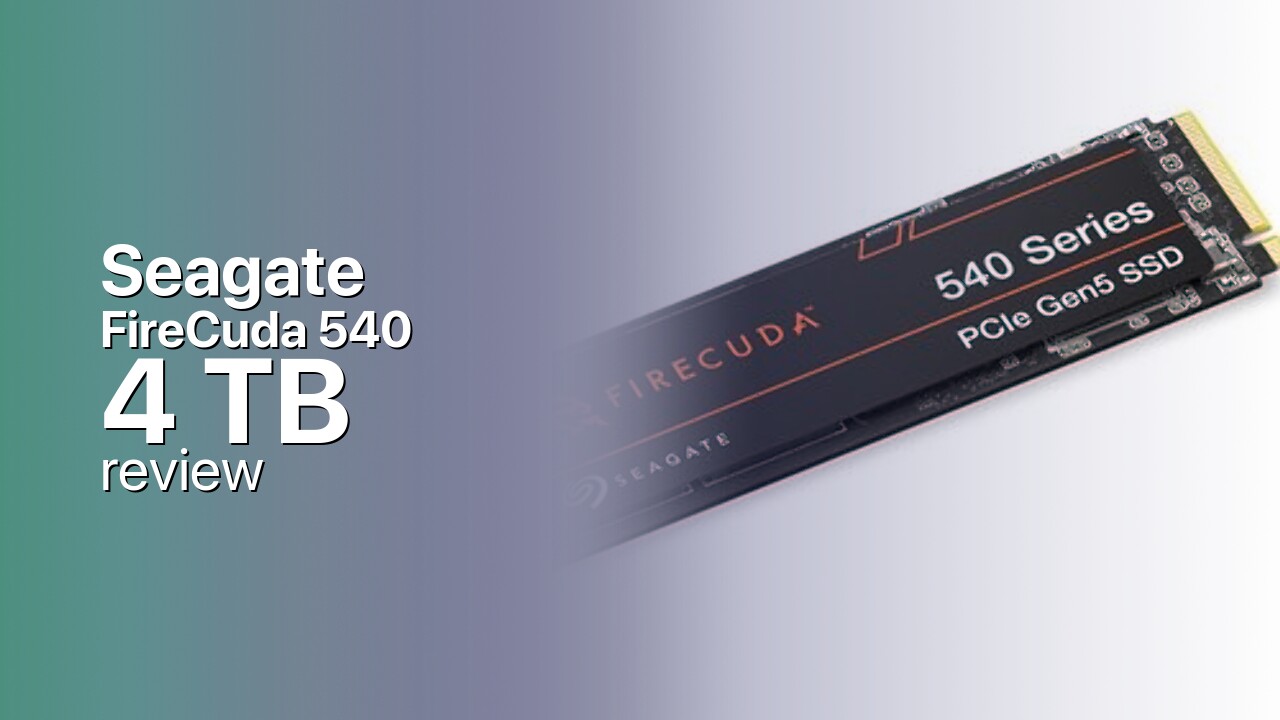
The Seagate FireCuda 540 4 TB is the largest capacity of Seagate's PCIe 5.0 NVMe drive, sold in 1 TB, 2 TB and 4 TB sizes and pitched at high-end gaming and creator builds that need both speed and space. Inside is an M.2 2280 drive built on the eight-channel Phison PS5026-E26 controller paired with Micron 232-layer 3D TLC NAND and a DRAM cache, the same platform used by the Crucial T700 and T705, the Corsair MP700 and most of the first wave of Gen5 drives. Seagate validates the controller itself, and the platform is well understood after two years on the market.
All three FireCuda 540 capacities share the same rated sequential speed of 10,000 MB/s read and 10,000 MB/s write, so the 4 TB keeps the line's full 10 GB/s rather than running slower at the top of the lineup. Where the 4 TB stands apart is endurance and write headroom: it carries 2,000 TBW against 1,200 TBW on the 2 TB and 700 TBW on the 1 TB, and its larger SLC cache holds sustained writes at full speed the longest of the three. Random performance is rated around 1.5 million IOPS, and the whole line carries a 5-year warranty backed by Seagate's rescue and data-recovery services.
The FireCuda 540 is a bare M.2 2280 drive: Seagate ships it without a bundled heatsink, so like most Gen5 drives it relies on your motherboard's M.2 cooling for sustained operation, and the hot-running Phison E26 platform makes that cooling genuinely important. It is backward compatible with PCIe 4.0 boards, where it runs at roughly half its rated bandwidth. The 4 TB is justified when the space and the 2,000 TBW endurance actually matter: a very large game and media library, a video-editing scratch disk, or a content-creator working drive. Direct rivals are the Crucial T705 and Corsair MP700 on the same platform and Samsung's PCIe 4.0 990 Pro.
Storage Comparisons:
FireCuda 540 Performance & Benchmarks
The 4 TB Seagate FireCuda 540 is rated at 10,000 MB/s sequential read and 10,000 MB/s sequential write over its PCIe 5.0 x4 interface, with around 1.5 million random IOPS. The rated sequential speed is the same across all three capacities, so the 4 TB delivers the line's full 10 GB/s rather than a capacity-specific figure. Reviewers place the FireCuda 540 in the competent first-wave Gen5 tier: fast on paper, with real-world results around the top end of PCIe 4.0 in many traces and clear Gen5 headroom in sustained transfers.
Seagate FireCuda 540 4 TB vs M.2 5.0 peers
Switch between sequential throughput and random IOPS to see how this drive stacks up against other M.2 5.0 SSDs in our database. The highlighted bar is the drive on this page — click any other bar to open that drive.
- Corsair MP700 Pro XT 1 TB: 14,900 MB/s read, 14,200 MB/s write
- Corsair MP700 Pro XT 2 TB: 14,900 MB/s read, 14,500 MB/s write
- Corsair MP700 Pro XT 4 TB: 14,900 MB/s read, 14,400 MB/s write
- Crucial T710 1 TB: 14,900 MB/s read, 13,800 MB/s write
- Seagate FireCuda 540 4 TB (this drive): 10,000 MB/s read, 10,000 MB/s write
For real-world use, 10,000 MB/s is deep into PCIe 5.0 territory and well beyond any PCIe 4.0 drive, so the bandwidth shows up in the workflows that actually saturate a Gen5 link: fast in-game asset streaming and DirectStorage titles, large file transfers, and OS responsiveness. Slightly faster Phison E26 designs like the Crucial T705 post higher peak numbers, but the gap is invisible in most real use.
The 4 TB's particular strength is sustained writes. Like all TLC NVMe drives the FireCuda 540 writes into a fast SLC cache first, then drops to a lower direct-TLC rate once the cache fills, and the 4 TB carries the largest cache in the lineup. Under a long contiguous write such as a 4K or 8K video render it therefore holds full speed the longest before slowing to the direct-TLC rate, which is exactly the workload that justifies a 4 TB Gen5 drive over the cheaper 2 TB. The remaining caveat is thermals: the hot Phison E26 platform needs a good motherboard heatsink to avoid throttling under sustained load.
Seagate FireCuda 540 vs Competitors
See how the FireCuda 540 stacks up against other M.2 5.0 drives in our database:
Compare with rival drives:
Endurance, TBW & Warranty
The 4 TB Seagate FireCuda 540 carries a rated endurance of 2,000 TBW (terabytes written), the highest in a lineup that scales from 700 TBW on the 1 TB through 1,200 TBW on the 2 TB. Seagate covers the drive for 5 years, with coverage ending at whichever threshold comes first, the 5-year term or 2,000 TBW of cumulative writes. A 5-year term is the standard retail coverage for this tier.
For a 4 TB drive the endurance limit is more relevant than on the smaller capacities, because a drive this size is more likely to be used for write-heavy work such as video capture or scratch-disk use. Even so, the time limit binds first for most buyers: at a typical 20 GB of writes per day, exhausting 2,000 TBW would take around 274 years; at a heavy 100 GB per day it is still roughly 55 years. The drive is rated for around 2 million hours MTBF. Seagate's longer-term differentiator is its rescue and data-recovery service ecosystem, which pairs naturally with a high-capacity drive holding a lot of data.
Seagate FireCuda 540 4 TB Specifications
| Category | Value |
|---|---|
| Capacity [?] | 4 TB |
| Interface [?] | M.2 5.0 |
| Controller [?] | Phison PS52056-E26 8 Channel |
| Memory type [?] | Micron 232-L TLC |
| DRAM [?] | Yes |
| Read speed (MB/s) [?] | 10000 |
| Write speed (MB/s) [?] | 10000 |
| Read IOPS [?] | 1500000 |
| Write IOPS [?] | 1700000 |
| Endurance (TBW) [?] | 2000 |
| MTBF (million hours) [?] | 2000000 |
| Warranty (years) [?] | 5 |
Verdict: Is the FireCuda 540 Worth It in 2026?
The Seagate FireCuda 540 4 TB is the drive to buy if you want the maximum capacity and endurance of Seagate's Gen5 lineup without giving up the full 10,000 MB/s speed. It pairs proven Phison E26 plus Micron TLC hardware with 2,000 TBW of endurance, the line's largest SLC cache, and a 5-year warranty backed by Seagate's data-recovery services.
Step down to the 2 TB if you do not need 4 TB of space, since it delivers the same 10 GB/s speed for much less money and is the value sweet spot of the line. Skip the FireCuda 540 if you will not provide adequate M.2 cooling, since the hot Phison E26 platform throttles without it, or if you want the single fastest peak numbers, where the Crucial T705 edges it. For a gaming or creator desktop with a free, cooled PCIe 5.0 slot and a genuinely large library or video workload, the 4 TB FireCuda 540 pairs Gen5 speed with the endurance and headroom to match.
+ Pros
- PCIe 5.0 with 10,000 MB/s sequential reads and writes
- 2,000 TBW endurance, highest in the FireCuda 540 line
- Largest SLC cache sustains writes longest
- Phison E26 with Micron 232-L TLC and DRAM cache
- 5-year warranty with Seagate rescue services
- Cons
- 4 TB PCIe 5.0 carries a steep capacity premium
- Bare drive, no heatsink included in the box
- Hot-running Phison E26 needs motherboard cooling
- Peak Gen5 speed is wasted on most current games
- Crucial T705 posts slightly higher peak numbers
Buy this or similar SSD Storage:



Video Review
Seagate FireCuda 540 SSD Review | Gen 5 PCIe NVMe M.2