KINGBANK KP260 2TB: an ultra-budget PCIe 4.0 NVMe SSD (2026)
Quick answer
The KINGBANK KP260 2TB suits budget builders who want a large game or media library on TLC NAND and PCIe 4.0 speed without paying brand-name prices.
Read: 5000 MB/s Write: 4000 MB/s Endurance: 600 TBW Warranty: 1 years Interface: M.2 4.0 x 4
The KINGBANK KP260 2TB is an ultra-budget, DRAM-less PCIe 4.0 NVMe drive that sticks with TLC NAND instead of cheaper QLC, giving buyers a large game library at a rock-bottom price.
Controller & Memory
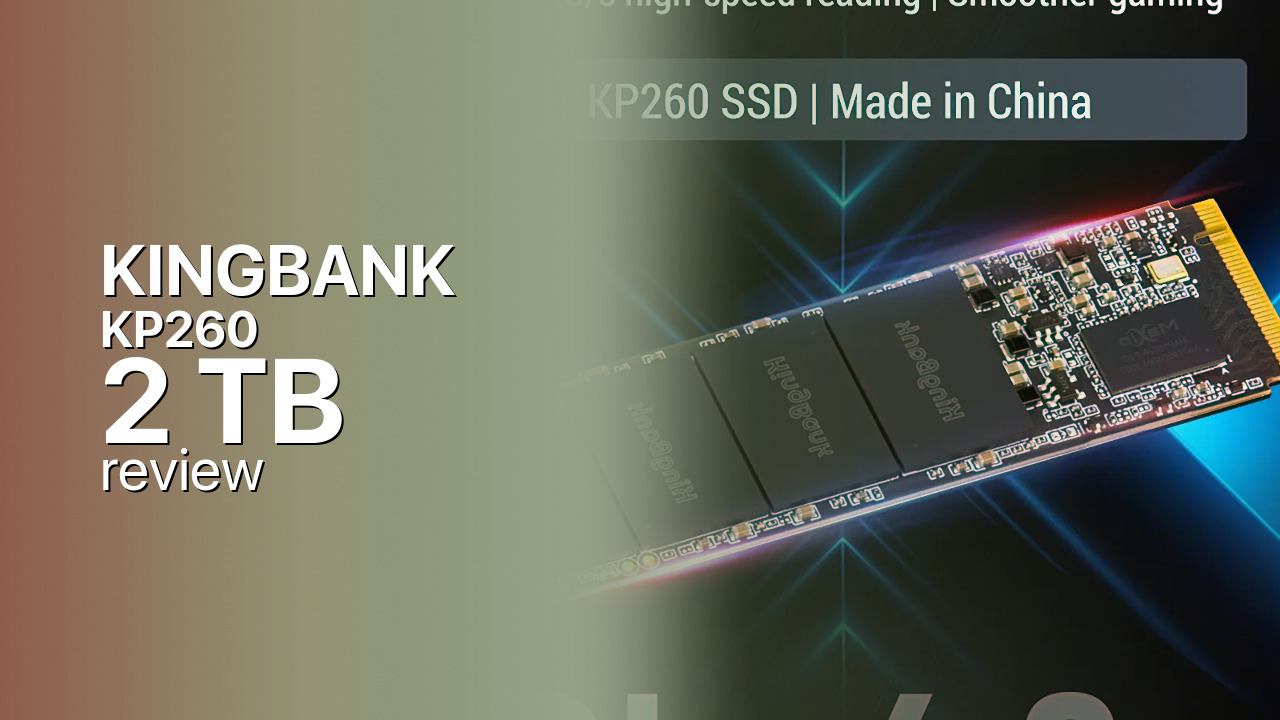
KINGBANK pairs a Maxio controller with YMTC TLC NAND on the KP260, skipping a dedicated DRAM chip in favor of Host Memory Buffer - firmware data from the same drive family confirms a 32 MiB HMB allocation and NVMe 1.4 support. It connects over PCIe 4.0 x4 in the standard M.2 2280 form factor, and choosing TLC over QLC at this price point is a genuine point of difference from many similarly-priced budget rivals.
The 2 TB KP260 sits at the top of the base line, which also ships in 512 GB and 1 TB, and below KINGBANK's separate KP260 Plus series for buyers who want extra speed at a higher price. Rated speed, endurance, and MTBF stay flat across the base KP260's capacities rather than scaling up, so the main reason to pick 2 TB over the smaller sizes is simply the extra room for a large game or media library. KINGBANK sells primarily direct-to-consumer through online marketplaces rather than major Western retail chains, which is how it keeps prices well under most brand-name PCIe 4.0 drives.
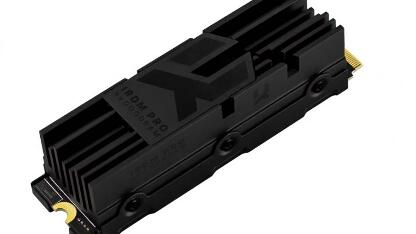
Without a heatsink in the box, the KP260 fits laptops, thin desktops, and the PS5's internal M.2 slot without clearance issues, though a desktop build under sustained heavy writes may benefit from an aftermarket M.2 heatsink. On price it undercuts established budget picks like the WD Blue SN580 and Crucial P3 Plus, both of which carry a longer independent review history and more consistent retail warranty support overall.
Storage Comparisons:
KP260 Performance & Benchmarks
KINGBANK rates the KP260 2TB at up to 5,000 MB/s sequential reads and 4,000 MB/s sequential writes over PCIe 4.0 x4, well ahead of any SATA drive and in line with many budget TLC competitors. Random IOPS figures for this capacity aren't independently confirmed, so treat any specific number seen elsewhere with caution.
KINGBANK KP260 2 TB vs M.2 4.0 x 4 peers
Switch between sequential throughput and random IOPS to see how this drive stacks up against other M.2 4.0 x 4 SSDs in our database. The highlighted bar is the drive on this page — click any other bar to open that drive.
- Patriot Viper PV593 1 TB: 14,500 MB/s read, 14,000 MB/s write
- Patriot Viper PV593 2 TB: 14,500 MB/s read, 14,000 MB/s write
- Patriot Viper PV593 4 TB: 14,500 MB/s read, 14,000 MB/s write
- Patriot Viper PV573 2 TB: 14,000 MB/s read, 12,000 MB/s write
- KINGBANK KP260 2 TB (this drive): 5,000 MB/s read, 4,000 MB/s write
As a DRAM-less design relying on Host Memory Buffer, the KP260 leans on an SLC write cache to hit its rated sequential numbers; once a large sustained transfer exhausts that cache, write speeds drop toward the native TLC ceiling, a pattern common to every drive in this class. At 2 TB, that cache has more absolute headroom in gigabytes than on the smaller KP260 capacities, so it takes a larger transfer to exhaust it. For everyday use - booting an OS, loading games, general file management - that cache limit is rarely a practical issue. Buyers planning frequent, large sustained writes will find more consistent performance on a DRAM-equipped drive.
KINGBANK KP260 vs Competitors
See how the KP260 stacks up against other M.2 4.0 x 4 drives in our database:
Compare with rival drives:
Endurance, TBW & Warranty
KINGBANK rates the KP260 2TB at 600 TBW of total write endurance, the same figure used across the base KP260 line regardless of capacity. At a typical 20-50 GB of writes per day, that budget lasts roughly 33 to 82 years before hitting the rated limit, well beyond the drive's realistic service life, so endurance is not a practical concern for normal use, even though this figure doesn't scale up the way some 2TB rivals' endurance ratings do. The MTBF rating is 2,000,000 hours, a statistical reliability figure describing failure rates across a large population of drives rather than a promise for any individual unit.
Warranty coverage on this listing is 1 year, shorter than the 3-to-5-year terms common among established brands like WD or Crucial. That's consistent with KINGBANK's position as a newer, direct-to-consumer budget brand.
KINGBANK KP260 2 TB Specifications
| Category | Value |
|---|---|
| Capacity [?] | 2 TB |
| Interface [?] | M.2 4.0 x 4 |
| Controller [?] | Maxio |
| Memory type [?] | YMTC TLC |
| DRAM [?] | No |
| Read speed (MB/s) [?] | 5000 |
| Write speed (MB/s) [?] | 4000 |
| Read IOPS [?] | 5000000 |
| Write IOPS [?] | 4000000 |
| Endurance (TBW) [?] | 600 |
| MTBF (million hours) [?] | 2000000 |
| Warranty (years) [?] | 1 |
Verdict: Is the KP260 Worth It in 2026?
The KINGBANK KP260 2TB suits budget builders who want a large game or media library on TLC NAND and PCIe 4.0 speed without paying brand-name prices. It's a weaker choice for buyers who prioritize long warranty coverage, scaled endurance, or an established independent review track record, since KINGBANK's 1-year warranty, flat 600 TBW rating, and limited third-party testing all trail bigger names. Buyers who want more warranty security and endurance that scales with capacity should look at the WD Blue SN580. Overall, the KP260 2TB is a reasonable low-cost pick for anyone comfortable trading brand recognition and warranty length for a lower price at a useful capacity.
+ Pros
- 5,000 MB/s sequential reads on PCIe 4.0
- TLC NAND instead of cheaper QLC
- 2TB capacity for a large game library
- 2,000,000-hour MTBF rating
- Low price via direct-to-consumer sales
- Cons
- Only a 1-year warranty, shorter than major-brand rivals
- 600 TBW endurance doesn't scale up with capacity
- No included heatsink for sustained desktop loads
- Limited independent long-term review coverage
Buy this or similar SSD Storage:



Video Review
KingBank KP260 NVMe M.2 2280 SSD