Silicon Power UD70 1TB QLC NVMe SSD Review (2026)
Quick answer
The Silicon Power UD70 1TB is a budget QLC NVMe drive that reads fast (3,400 MB/s) and includes a DRAM cache, which are strong features at its price point.
Read: 3400 MB/s Write: 3000 MB/s Endurance: 260 TBW Warranty: 5 years Interface: M.2 3.0 x 4
The Silicon Power UD70 1TB is a budget PCIe 3.0 NVMe SSD built on Micron QLC NAND, offering 3,400 MB/s reads and a DRAM cache at a price point that undercuts most TLC alternatives.
Controller & Memory
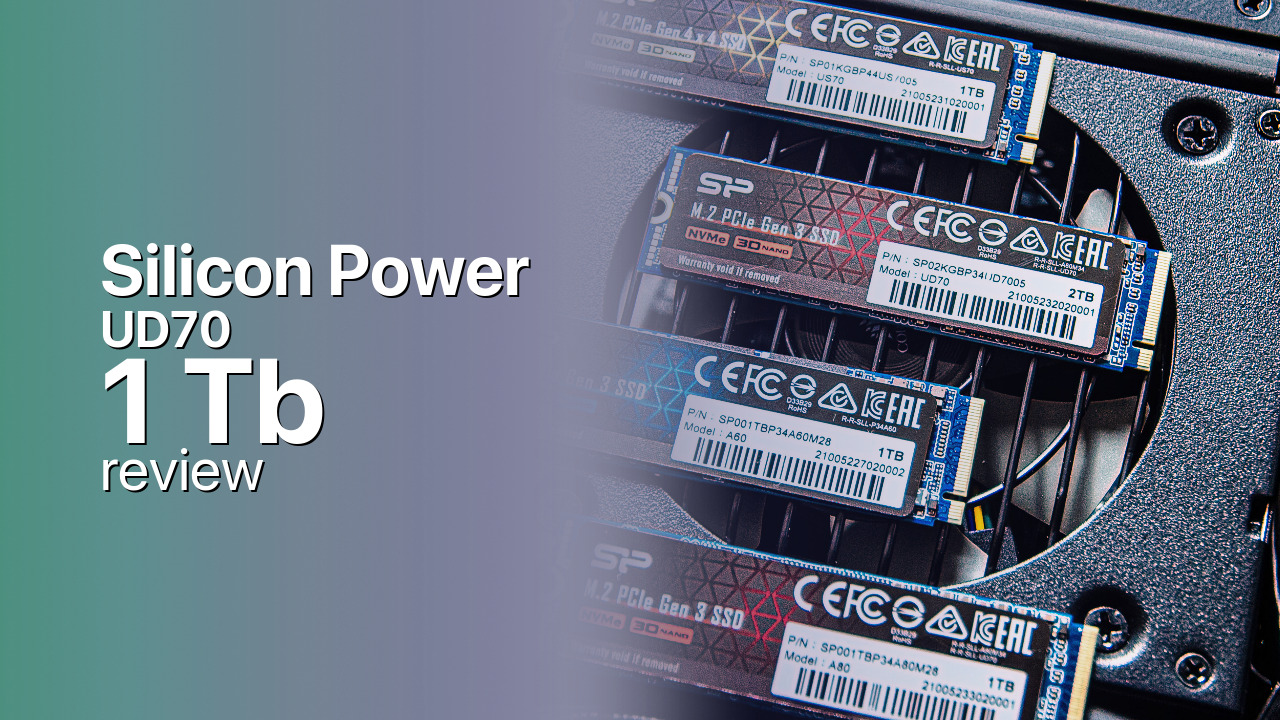
The UD70 1TB is built around the Phison PS5012-E12S-32 controller and Micron 3D QLC NAND. QLC (quad-level cell) flash stores four bits per cell — one more than TLC — which increases density and lowers cost at the expense of write endurance and sustained write speed. The drive includes a DRAM cache buffer to manage the flash translation layer, an important feature for QLC drives where the mapping table is larger than on TLC.
Rated at 3,400 MB/s sequential reads and 3,000 MB/s sequential writes, the 1TB UD70 matches many TLC-based PCIe 3.0 drives on paper. The catch is that these peak speeds only apply within the dynamic SLC cache. Once the cache fills — typically after 40–80 GB of sustained writing on the 1TB model — writes drop to native QLC rates around 100–200 MB/s. The 1TB model has more NAND die than the 500GB variant, so its sustained QLC write speed is higher and its SLC cache is larger.
The UD70 range also includes 500GB and 2TB capacities. The drive uses a single-sided M.2 2280 form factor, fitting most desktop motherboards and many laptops. No heatsink is included. The UD70 competes with other QLC NVMe drives like the Crucial P1 and Intel 660p, as well as budget TLC drives like the Kingston NV2 and Team MP33.
Storage Comparisons:
UD70 Performance & Benchmarks
The UD70 1TB is rated for 3,400 MB/s sequential reads and 3,000 MB/s sequential writes. In synthetic benchmarks that test within the SLC cache, the drive hits these numbers consistently. Real-world performance depends heavily on write pattern: short burst writes (OS operations, application saves, small file copies) complete at full speed within the cache. Sustained writes that exceed the 40–80 GB SLC cache expose native QLC write speeds of roughly 100–200 MB/s on the 1TB model.
Silicon Power UD70 1 TB vs M.2 3.0 x 4 peers
Switch between sequential throughput and random IOPS to see how this drive stacks up against other M.2 3.0 x 4 SSDs in our database. The highlighted bar is the drive on this page — click any other bar to open that drive.
- ADATA SX 8800 Pro 512 GB: 3,500 MB/s read, 2,700 MB/s write
- ADATA SX 8800 Pro 1 TB: 3,500 MB/s read, 2,700 MB/s write
- ADATA XPG Spectrix S40G RGB 256 GB: 3,500 MB/s read, 3,000 MB/s write
- ADATA XPG Spectrix S40G RGB 512 GB: 3,500 MB/s read, 3,000 MB/s write
- Silicon Power UD70 1 TB (this drive): 3,400 MB/s read, 3,000 MB/s write
Random read performance is adequate for a boot drive and handles OS and application loads without issue. Random write performance is lower than TLC alternatives, particularly as the drive fills and the SLC cache shrinks. For gaming, the UD70 loads titles at speeds comparable to other PCIe 3.0 NVMe drives because gaming is dominated by reads. Content creators who regularly move multi-gigabyte files should consider a TLC drive like the Silicon Power P34A80, which maintains consistent write speeds regardless of cache state.
Silicon Power UD70 vs Competitors
See how the UD70 stacks up against other M.2 3.0 x 4 drives in our database:
Compare with rival drives:
Endurance, TBW & Warranty
Silicon Power covers the UD70 1TB with a five-year limited warranty. Silicon Power does not publish a specific TBW rating for the UD70 series in most documentation — a common omission for QLC drives. QLC NAND typically has approximately 1,000 program-erase cycles per cell, compared to 3,000 for TLC. For a read-heavy desktop workload, the drive should last well beyond the warranty period. Heavy sustained-write workloads will consume the write budget faster than on TLC drives. The warranty is processed through the retailer or Silicon Power's direct RMA portal.
Silicon Power UD70 1 TB Specifications
| Category | Value |
|---|---|
| Capacity [?] | 1 TB |
| Interface [?] | M.2 3.0 x 4 |
| Controller [?] | Phison PS5012-E12S-32 |
| Memory type [?] | Micron 3D QLC |
| DRAM [?] | SLC Caching DRAM Buffer |
| Read speed (MB/s) [?] | 3400 |
| Write speed (MB/s) [?] | 3000 |
| Read IOPS [?] | 250000 |
| Write IOPS [?] | 650000 |
| Endurance (TBW) [?] | 260 |
| MTBF (million hours) [?] | 1.8 |
| Warranty (years) [?] | 5 |
Verdict: Is the UD70 Worth It in 2026?
The Silicon Power UD70 1TB is a budget QLC NVMe drive that reads fast (3,400 MB/s) and includes a DRAM cache, which are strong features at its price point. The QLC limitation is real: sustained writes after the SLC cache fills drop well below TLC levels, and overall write endurance is lower. For budget builders who primarily read from the drive — boot, application storage, game library — the UD70 1TB delivers good value. Anyone who writes large files regularly should invest in a TLC-based alternative like the Silicon Power P34A80 1TB or the Kingston A2000 1TB, which offer more consistent write performance for a modest price increase.
+ Pros
- 3,400 MB/s sequential reads on PCIe 3.0
- DRAM cache buffer at a budget price point
- Single-sided M.2 2280 fits laptops and desktops
- 1TB capacity at a competitive price per GB
- Five-year warranty coverage
- Cons
- QLC NAND — sustained writes drop after SLC cache fills
- No published TBW endurance rating
- QLC write endurance lower than TLC alternatives
- Not suitable for heavy sustained-write workloads
- SLC cache shrinks as drive fills
Buy this or similar SSD Storage:



Video Review
Silicon Power UD70 2TB Gen3x4 M.2 SSD - review