Team Group T-Force Cardea Zero Z440 256GB PCIe 4.0 Review (2026)
Quick answer
The Cardea Zero Z440 256GB is a niche product best suited as a fast boot drive for a PCIe 4.0-capable desktop.
Read: 5000 MB/s Write: 4400 MB/s Endurance: 1800 TBW Warranty: 5 years Interface: M.2 4.0 x 4
The Team Group T-Force Cardea Zero Z440 256GB is a compact PCIe 4.0 NVMe SSD using Phison's E16 controller with a thin graphene copper foil heat spreader designed to fit under motherboard M.2 coolers.
Controller & Memory
The Cardea Zero Z440 is built on the Phison PS5016-E16 PCIe 4.0 controller paired with Toshiba (Kioxia) 96-layer 3D TLC NAND and DDR4 DRAM. The E16 is a dual-core Arm Cortex-R5 design at 733 MHz with CoXProcessor technology for NAND management overhead. This is the same platform used in the Corsair MP600 and Sabrent Rocket 4.0.
At 256GB, the Z440 is the smallest capacity in the lineup. Team Group rates it at 5,000 MB/s sequential read and 4,400 MB/s sequential write with 750K random read/write IOPS — the same headline numbers as the larger capacities. In practice, small-capacity E16 drives typically see reduced write speeds compared to 1TB+ models because fewer NAND dies limit parallelism, but Team Group publishes uniform ratings across the range.
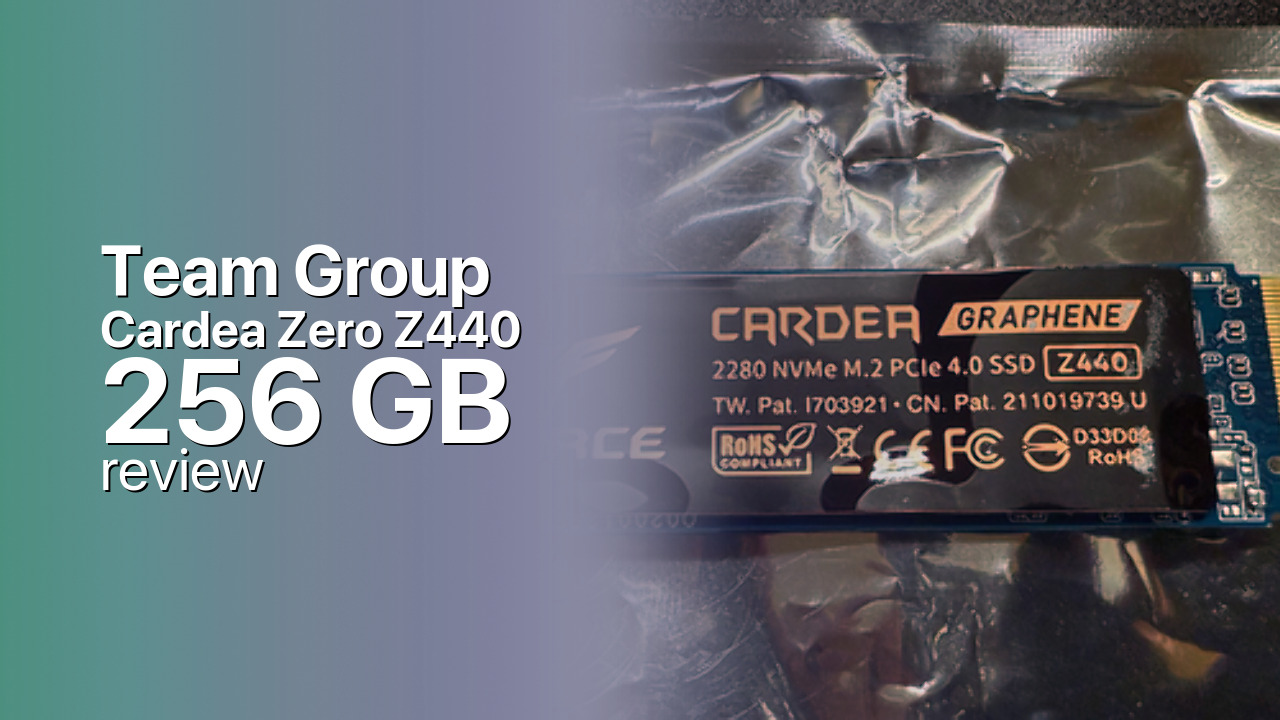
The defining feature compared to the ceramic C440 sibling is the cooling approach: instead of a ceramic heat spreader, the Z440 uses a thin graphene copper foil strip applied to the NAND and controller. This keeps the drive slim enough to fit under most motherboard-integrated M.2 heatsinks — a practical advantage over bulkier finned designs. The drive is double-sided with components on both PCB faces.
Storage Comparisons:
Cardea Zero Z440 Performance & Benchmarks
Team Group rates the Z440 256GB at 5,000 MB/s sequential read and 4,400 MB/s sequential write with 750K random IOPS. These are manufacturer-rated figures for the platform; independent reviews primarily tested the 1TB model and confirmed the E16 hits its 5 GB/s read ceiling. At 256GB, fewer NAND dies may reduce real-world sustained write speeds below the rated 4,400 MB/s, particularly once the SLC cache fills.
Team Group Cardea Zero Z440 256 GB vs M.2 4.0 x 4 peers
Switch between sequential throughput and random IOPS to see how this drive stacks up against other M.2 4.0 x 4 SSDs in our database. The highlighted bar is the drive on this page — click any other bar to open that drive.
- Patriot Viper PV593 1 TB: 14,500 MB/s read, 14,000 MB/s write
- Patriot Viper PV593 2 TB: 14,500 MB/s read, 14,000 MB/s write
- Patriot Viper PV593 4 TB: 14,500 MB/s read, 14,000 MB/s write
- Patriot Viper PV573 2 TB: 14,000 MB/s read, 12,000 MB/s write
- Team Group Cardea Zero Z440 256 GB (this drive): 5,000 MB/s read, 4,400 MB/s write
The SLC cache at 256GB is necessarily small, likely around 80 GB. Once exhausted, sustained writes transition to TLC direct mode at reduced speeds. For an OS boot drive with mostly read traffic, this is largely irrelevant. Gaming and desktop responsiveness at this capacity are limited more by the 256GB space than by the drive's speed capability. At low queue depths relevant to desktop use, random performance is competitive with other PCIe 3.0 and Gen4 drives.
Team Group Cardea Zero Z440 vs Competitors
See how the Cardea Zero Z440 stacks up against other M.2 4.0 x 4 drives in our database:
Compare with rival drives:
Endurance, TBW & Warranty
The 256GB model carries a 1,800 TBW endurance rating with a 5-year warranty. While this seems high for a 256GB drive, it aligns with the endurance levels seen on E16 drives using Kioxia 96L TLC. At 20 GB of writes per day — typical for a boot drive — the endurance would last roughly 246 years. The MTBF is rated at 1.7 million hours. The warranty is limited by whichever comes first: the 5-year period or the TBW threshold.
Team Group Cardea Zero Z440 256 GB Specifications
| Category | Value |
|---|---|
| Capacity [?] | 256 GB |
| Interface [?] | M.2 4.0 x 4 |
| Controller [?] | Phison PS5016-E16 |
| Memory type [?] | Toshiba 3D TLC |
| DRAM [?] | DDR4, SLC Cache |
| Read speed (MB/s) [?] | 5000 |
| Write speed (MB/s) [?] | 4400 |
| Read IOPS [?] | 750000 |
| Write IOPS [?] | 750000 |
| Endurance (TBW) [?] | 1800 |
| MTBF (million hours) [?] | 1.7 |
| Warranty (years) [?] | 5 |
Verdict: Is the Cardea Zero Z440 Worth It in 2026?
The Cardea Zero Z440 256GB is a niche product best suited as a fast boot drive for a PCIe 4.0-capable desktop. The thin graphene cooling and slim profile are genuine advantages for builds where motherboard M.2 heatsinks are already in place. The 256GB capacity is too small for more than an OS and a handful of applications or games. For a primary drive, stepping up to the 512GB or 1TB model provides meaningful capacity gains with the same rated speeds. For a dedicated boot drive, the ADATA XPG SX8200 Pro 256GB or WD Blue SN570 250GB offer similar PCIe 3.0 performance at a lower price.
+ Pros
- 5,000 MB/s read on PCIe 4.0
- Thin graphene foil fits under motherboard heatsinks
- 1,800 TBW endurance at 256GB
- Phison E16 with DRAM cache
- 5-year warranty
- Cons
- 256GB capacity too small for gaming libraries
- Small SLC cache fills quickly during writes
- Double-sided PCB may not fit all laptop slots
- Overkill PCIe 4.0 for a boot-only drive
Buy this or similar SSD Storage:



Video Review
Best Bang for Buck PCIe 3.0 NVMe SSD? ⏩ T-Force Cardea z340 SSD Review