Samsung 980 Pro 250GB PCIe 4.0 NVMe SSD (2026)
Quick answer
The Samsung 980 Pro 250GB makes sense as a compact OS or boot drive for a system that already has bulk storage elsewhere.
Read: 6400 MB/s Write: 2700 MB/s Endurance: 150 TBW Warranty: 5 years Interface: M.2 4.0 x 4
The Samsung 980 Pro 250GB is the entry point into Samsung's PCIe 4.0 flagship line, trading peak throughput for a lower cost of admission that still outpaces any SATA or PCIe 3.0 drive.
Controller & Memory
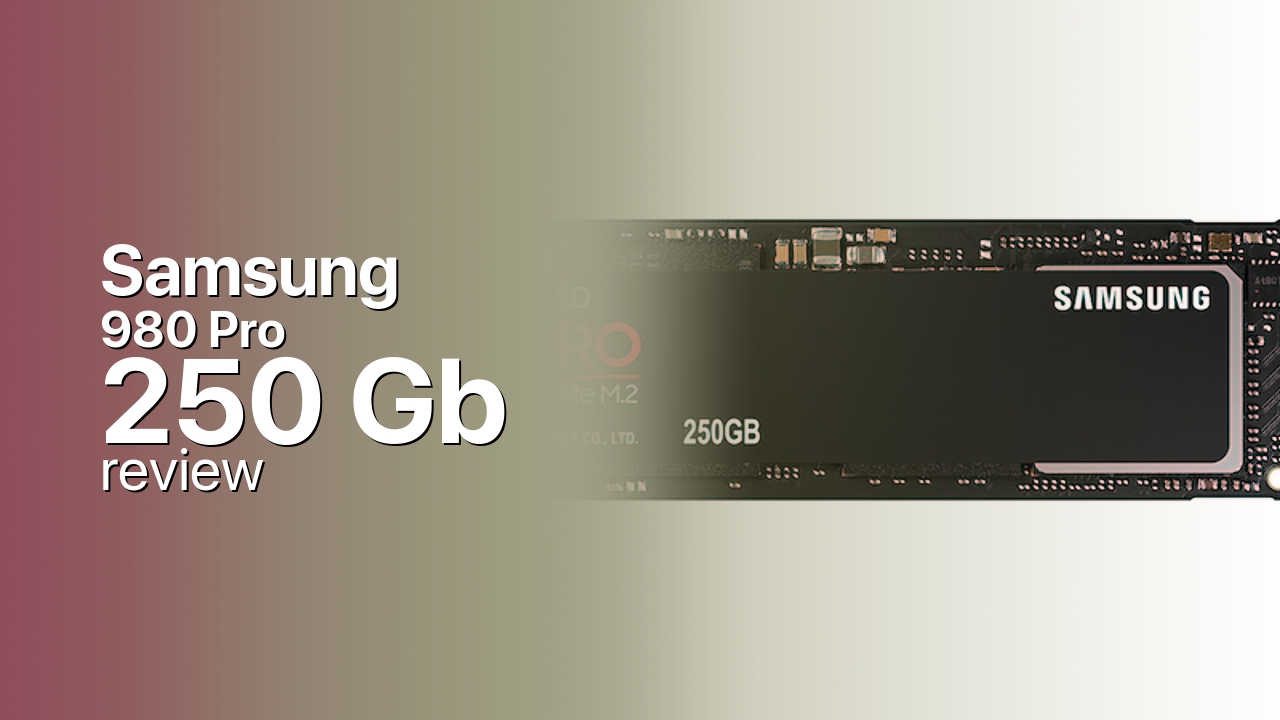
Under the label sits Samsung\'s Elpis controller, an 8 nm ARM-based design supporting 128 concurrent I/O queues and an eight-channel NAND interface. Paired with 512 MB of LPDDR4 DRAM for the flash translation layer, the 250 GB variant uses Samsung\'s sixth-generation V-NAND TLC in a single-sided M.2 2280 layout. The single-sided PCB keeps the drive thin enough for laptops and the PS5 expansion slot alike.
The catch is that the smallest capacity gives up a lot of headline speed compared to its larger siblings. Where the 1 TB and 2 TB models hit 7,000 MB/s reads and 5,000 MB/s writes, the 250 GB variant is rated at 6,400 MB/s sequential reads and just 2,700 MB/s sequential writes. Random performance drops as well: 500 K read IOPS and 600 K write IOPS versus the 1 M IOPS both ways on the 1 TB model. After the Intelligent TurboWrite 2.0 buffer fills, direct-to-TLC writes fall to roughly 500 MB/s on this capacity. The 250 GB also ships with only 150 TBW of write endurance, the lowest in the 980 Pro family.
Direct rivals at this capacity are thin on the ground. The WD Black SN850 250 GB and the Seagate FireCuda 520 500 GB occupy the same PCIe 4.0 tier, though most buyers shopping a 250 GB NVMe in 2026 should consider whether the 500 GB or 1 TB variant of the 980 Pro offers better long-term value per gigabyte.
Storage Comparisons:
980 Pro Performance & Benchmarks
Samsung rates the 980 Pro 250GB at up to 6,400 MB/s sequential reads and 2,700 MB/s sequential writes over the PCIe 4.0 x4 bus. Random performance peaks at 500,000 read IOPS and 600,000 write IOPS at queue depth 32. Low-latency queue-depth-one performance is rated at 22,000 read IOPS and 60,000 write IOPS, which is competitive with other high-end NVMe drives at this capacity.
Samsung 980 Pro 250 GB vs M.2 4.0 x 4 peers
Switch between sequential throughput and random IOPS to see how this drive stacks up against other M.2 4.0 x 4 SSDs in our database. The highlighted bar is the drive on this page — click any other bar to open that drive.
- Patriot Viper PV593 1 TB: 14,500 MB/s read, 14,000 MB/s write
- Patriot Viper PV593 2 TB: 14,500 MB/s read, 14,000 MB/s write
- Patriot Viper PV593 4 TB: 14,500 MB/s read, 14,000 MB/s write
- Patriot Viper PV573 2 TB: 14,000 MB/s read, 12,000 MB/s write
- Samsung 980 Pro 250 GB (this drive): 6,400 MB/s read, 2,700 MB/s write
The drive uses Samsung's Intelligent TurboWrite 2.0 SLC caching, with a 4 GB static cache that can expand up to 49 GB dynamically from unused capacity. Once the cache is exhausted, writes drop to native TLC speed, which hovers around 500 MB/s on the 250 GB model. For a boot drive handling OS-level writes and application installs, the cache rarely fills under normal use. Sustained large-file transfers will feel the drop, though. Independent reviewers consistently place the 980 Pro family near the top of PCIe 4.0 drives in real-world game-load and application-latency tests, but note that the 250 GB trails the 1 TB and 2 TB by a wide margin in sequential write benchmarks.
Samsung 980 Pro vs Competitors
See how the 980 Pro stacks up against other M.2 4.0 x 4 drives in our database:
Compare with rival drives:
Endurance, TBW & Warranty
Samsung rates the 980 Pro 250GB at 150 TBW (terabytes written) over a five-year warranty period. That works out to roughly 0.3 drive writes per day, or about 82 GB of writes per day for five years straight. For a boot-drive workload dominated by reads and small writes, endurance is unlikely to be a practical concern. Samsung cites internal data from over 660,000 field SSDs showing that 99% of users write fewer than 156 TB over five years, well within the 150 TBW envelope. The drive also carries an MTBF rating of 1.5 million hours, a population-level reliability metric rather than a per-drive guarantee. If the drive fails within warranty, Samsung handles replacement directly through its RMA process.
Samsung 980 Pro 250 GB Specifications
| Category | Value |
|---|---|
| Capacity [?] | 250 GB |
| Interface [?] | M.2 4.0 x 4 |
| Controller [?] | Samsung Elpis |
| Memory type [?] | Samsung 3D TLC |
| DRAM [?] | Samsung LPDDR4 DRAM |
| Read speed (MB/s) [?] | 6400 |
| Write speed (MB/s) [?] | 2700 |
| Read IOPS [?] | 500000 |
| Write IOPS [?] | 600000 |
| Endurance (TBW) [?] | 150 |
| MTBF (million hours) [?] | 1.5 |
| Warranty (years) [?] | 5 |
Verdict: Is the 980 Pro Worth It in 2026?
The Samsung 980 Pro 250GB makes sense as a compact OS or boot drive for a system that already has bulk storage elsewhere. Its PCIe 4.0 interface delivers responsive load times and snappy day-to-day performance that no SATA drive can match. Buyers planning to install large game libraries or work with big media files on this drive alone should step up to the 500 GB or 1 TB variant, which doubles or triples the TurboWrite cache and nearly doubles the sustained write speed. At the 250 GB capacity specifically, the WD Black SN850X 250 GB is a credible alternative with similar PCIe 4.0 throughput. The 980 Pro 250GB remains a competent entry in Samsung's flagship line, but its value proposition is weaker than the larger capacities in the same family.
+ Pros
- 6,400 MB/s sequential reads on PCIe 4.0
- 512 MB LPDDR4 DRAM for FTL mapping
- Single-sided M.2 2280 fits laptops and PS5
- AES 256-bit hardware encryption
- Samsung Magician software suite
- 5-year warranty with direct RMA
- Cons
- 2,700 MB/s writes, lowest in the 980 Pro range
- Native TLC writes drop to roughly 500 MB/s
- Only 150 TBW endurance
- 250 GB fills up fast as a modern game drive
- Better value per GB at 500 GB and 1 TB
Buy this or similar SSD Storage:
Video Review
Samsung 980 PRO Review - Samsung's First PCIe Gen4 SSD