Team Group T-Force Cardea Zero Z440 512GB SSD Review (2026)
Quick answer
The Cardea Zero Z440 512GB is a practical mid-capacity PCIe 4.0 SSD that fits where bulkier drives cannot.
Read: 5000 MB/s Write: 4400 MB/s Endurance: 2400 TBW Warranty: 5 years Interface: M.2 4.0 x 4
The Team Group T-Force Cardea Zero Z440 512GB sits in the middle of the Z440 PCIe 4.0 lineup, offering Phison E16 performance with a slim graphene foil cooler and 2,400 TBW endurance.
Controller & Memory
The Z440 512GB shares the Phison PS5016-E16 controller and Kioxia (Toshiba) 96-layer 3D TLC platform with the rest of the Cardea Zero family. The E16 is a dual-core Arm Cortex-R5 design at 733 MHz with CoXProcessor offload for NAND management, backed by DDR4 DRAM for the FTL mapping table.
At 512GB, the drive is rated for the same 5,000 MB/s sequential read and 4,400 MB/s sequential write as the 1TB and 2TB models, with 750,000 random read/write IOPS. The E16 controller is the performance ceiling, not the NAND density. The 512GB capacity provides enough space for an OS installation plus 5 to 8 modern games or a working set of creative project files.
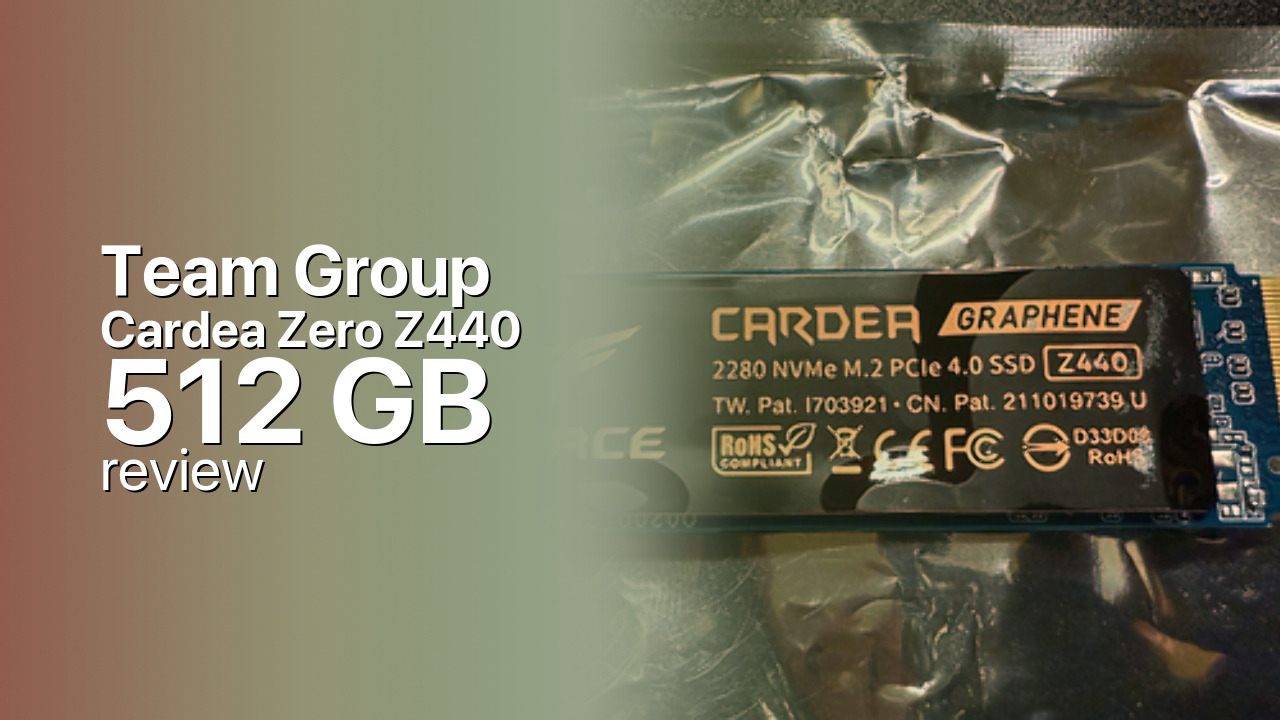
The graphene copper foil heat spreader is the Z440's practical differentiator. Unlike the Ceramic C440's thicker ceramic plate, the graphene foil adds negligible height, allowing the drive to fit under most motherboard-integrated M.2 heatsinks. This makes the Z440 a better choice than the C440 for boards that already have their own M.2 thermal solutions. The drive is double-sided.
Storage Comparisons:
Cardea Zero Z440 Performance & Benchmarks
The Z440 512GB is rated at 5,000 MB/s sequential read and 4,400 MB/s sequential write. Independent reviews (Guru3D, HotHardware, KitGuru) tested the 1TB model and confirmed the E16 platform delivers on these numbers. The 512GB model's fewer NAND dies may result in slightly lower sustained write speeds compared to the 1TB after the SLC cache fills, but within the cache, rated speeds should be achievable.
Team Group Cardea Zero Z440 512 GB vs M.2 4.0 x 4 peers
Switch between sequential throughput and random IOPS to see how this drive stacks up against other M.2 4.0 x 4 SSDs in our database. The highlighted bar is the drive on this page — click any other bar to open that drive.
- Patriot Viper PV593 1 TB: 14,500 MB/s read, 14,000 MB/s write
- Patriot Viper PV593 2 TB: 14,500 MB/s read, 14,000 MB/s write
- Patriot Viper PV593 4 TB: 14,500 MB/s read, 14,000 MB/s write
- Patriot Viper PV573 2 TB: 14,000 MB/s read, 12,000 MB/s write
- Team Group Cardea Zero Z440 512 GB (this drive): 5,000 MB/s read, 4,400 MB/s write
The SLC cache at 512GB is estimated at roughly 170 GB — enough for most burst write scenarios like game installs and file copies. Post-cache sustained writes settle to approximately 1,500 MB/s in TLC mode. Random 4K performance at QD1 is comparable to other E16 drives and more than sufficient for gaming, OS boot, and general desktop use. The graphene foil keeps the controller at manageable temperatures, though sustained heavy workloads benefit from motherboard heatsink contact.
Team Group Cardea Zero Z440 vs Competitors
See how the Cardea Zero Z440 stacks up against other M.2 4.0 x 4 drives in our database:
Compare with rival drives:
Endurance, TBW & Warranty
The 512GB model carries a 2,400 TBW endurance rating with a 5-year warranty. At 30 GB of daily writes, this translates to roughly 219 years of use. The MTBF is rated at 1.7 million hours. Team Group provides a SMART Tool utility for health monitoring. The warranty is limited by whichever threshold is reached first: the 5-year period or the TBW rating. For a drive serving as a combined OS and game library, the endurance is far beyond any realistic consumer workload.
Team Group Cardea Zero Z440 512 GB Specifications
| Category | Value |
|---|---|
| Capacity [?] | 512 GB |
| Interface [?] | M.2 4.0 x 4 |
| Controller [?] | Phison PS5016-E16 |
| Memory type [?] | Toshiba 3D TLC |
| DRAM [?] | DDR4, SLC Cache |
| Read speed (MB/s) [?] | 5000 |
| Write speed (MB/s) [?] | 4400 |
| Read IOPS [?] | 750000 |
| Write IOPS [?] | 750000 |
| Endurance (TBW) [?] | 2400 |
| MTBF (million hours) [?] | 1.7 |
| Warranty (years) [?] | 5 |
Verdict: Is the Cardea Zero Z440 Worth It in 2026?
The Cardea Zero Z440 512GB is a practical mid-capacity PCIe 4.0 SSD that fits where bulkier drives cannot. The graphene foil cooling is an honest solution — it does not claim to replace a proper heatsink but makes the drive compatible with motherboard cooling that taller drives would block. The 512GB capacity hits a workable sweet spot for an OS plus several games or creative applications. For users who need more space, the 1TB model at the same rated speeds is the logical step up. Competitors on the same E16 platform, like the Corsair MP600 500GB, offer near-identical performance.
+ Pros
- 5,000 MB/s read, 4,400 MB/s write
- Thin graphene foil fits under motherboard heatsinks
- 2,400 TBW endurance with 5-year warranty
- Phison E16 with DRAM cache
- 512GB usable for OS plus games
- Cons
- 512GB fills up with modern game sizes
- E16 surpassed by newer E18 generation
- Double-sided PCB may limit laptop compatibility
- Graphene foil alone insufficient for sustained heavy loads
Buy this or similar SSD Storage:



Video Review
Best Bang for Buck PCIe 3.0 NVMe SSD? ⏩ T-Force Cardea z340 SSD Review