Team Group MP33 512GB — Budget PCIe 3.0 NVMe SSD Review (2026)
Quick answer
The 512 GB MP33 is the MP33 to buy if you are shopping this family.
Read: 1700 MB/s Write: 1400 MB/s Endurance: 120 TBW Warranty: 5 years Interface: M.2 3.0 x 4
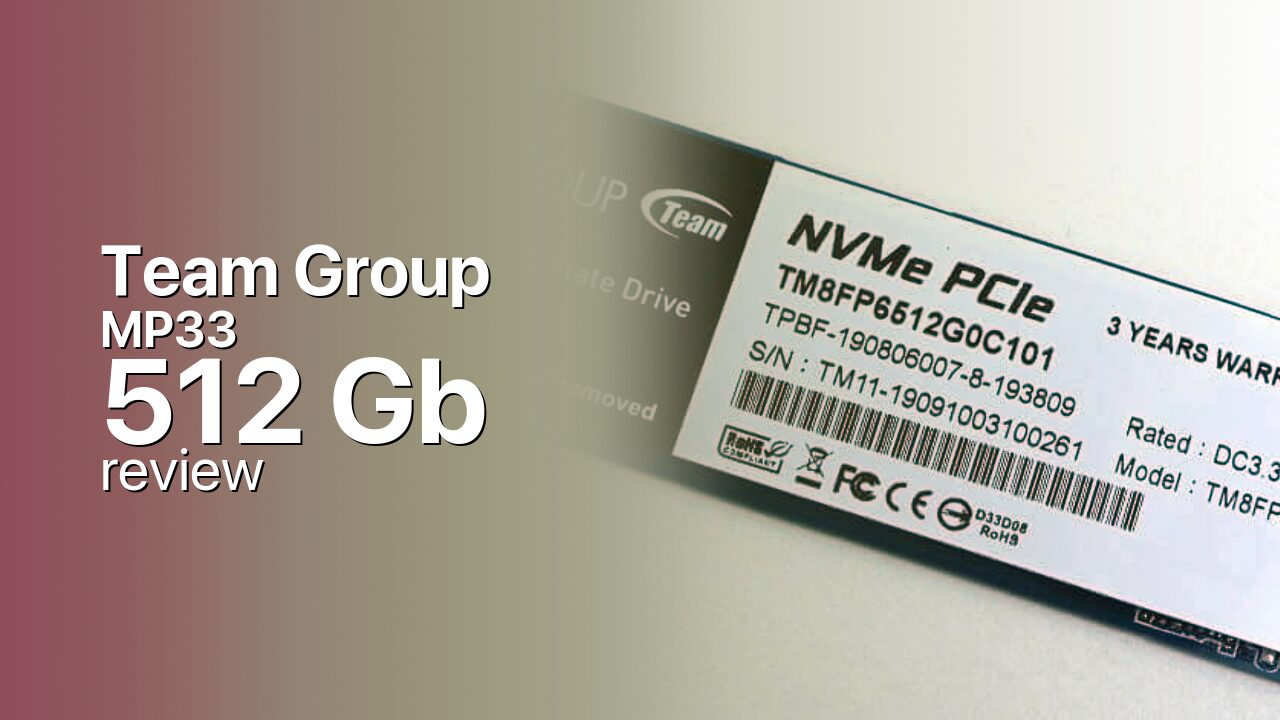
The Team Group MP33 512 GB takes the Phison E13T DRAM-less platform to a more practical capacity, nearly doubling the 256 GB variant's endurance while delivering modestly higher throughput for an OS-plus-applications workload.
Controller & Memory
The 512 GB MP33 shares the same Phison PS5013-E13T foundation as its 256 GB sibling: a four-channel DRAM-less PCIe 3.0 x4 controller paired with 3D TLC NAND, relying on HMB to borrow system RAM for the flash translation layer. The step up to 512 GB populates more of the E13T's channels with additional NAND dies, bumping rated sequential throughput from 1,600/1,000 MB/s to 1,700/1,400 MB/s read/write and lifting endurance from 65 TBW to 120 TBW. The drive remains a single-sided M.2 2280 design with no factory heatsink, keeping it compatible with thin laptops and compact desktop builds.
The 512 GB capacity is the practical sweet spot in the MP33 lineup. It is large enough to hold Windows, a suite of productivity applications, and a modest game or media library without the constant storage management that the 256 GB model demands. Performance gains over the 256 GB variant are real but incremental — the extra NAND parallelism primarily helps sustained write throughput and SLC cache size rather than peak reads, which are already limited by the E13T's four-channel design more than the NAND count. The 1 TB MP33 pushes further to 2,000/1,700 MB/s and 325 TBW, making it the strongest performer in the family for users who can stretch the budget.
Against the broader budget NVMe market, the 512 GB MP33 competes with the Kingston NV2, WD Green SN350, and Silicon Power P34A60. The MP33's TLC NAND gives it a durability and sustained-write edge over QLC alternatives like the Crucial P3 Plus at similar capacities, though DRAM-equipped Gen3 drives from the previous generation — discounted Samsung 970 EVO Plus or WD Black SN750 stock — offer materially better random I/O consistency if found at clearance pricing. For a new-build office PC, a laptop OS-upgrade, or a secondary game storage drive, the MP33 512 GB is a competent budget pick that does not cut the TLC corner.
Storage Comparisons:
MP33 Performance & Benchmarks
Team Group rates the 512 GB MP33 at 1,700 MB/s sequential reads and 1,400 MB/s sequential writes, with random IOPS in the 220,000 read and 200,000 write range. These figures translate to roughly triple SATA read speeds and roughly double-to-triple SATA write speeds, making the MP33 a meaningful upgrade for anyone coming from a 2.5-inch SSD. The E13T's HMB-based FTL introduces a small latency penalty versus DRAM-equipped drives under mixed read-write loads, but for the predominantly read-heavy workload of an OS and application drive, this penalty is invisible.
Team Group MP33 512 GB vs M.2 3.0 x 4 peers
Switch between sequential throughput and random IOPS to see how this drive stacks up against other M.2 3.0 x 4 SSDs in our database. The highlighted bar is the drive on this page — click any other bar to open that drive.
- ADATA SX 8800 Pro 512 GB: 3,500 MB/s read, 2,700 MB/s write
- ADATA SX 8800 Pro 1 TB: 3,500 MB/s read, 2,700 MB/s write
- ADATA XPG Spectrix S40G RGB 256 GB: 3,500 MB/s read, 3,000 MB/s write
- ADATA XPG Spectrix S40G RGB 512 GB: 3,500 MB/s read, 3,000 MB/s write
- Team Group MP33 512 GB (this drive): 1,700 MB/s read, 1,400 MB/s write
The SLC cache on the 512 GB model is proportionally larger than on the 256 GB variant, absorbing roughly 12–20 GB of burst writes at full speed before the drive transitions to native TLC write speeds around 300–400 MB/s. This is enough headroom for most consumer write bursts — Windows updates, Steam game installs, file copies from a USB drive — without the user ever hitting the post-cache write cliff. Sustained TLC writes in the 300–400 MB/s range are still roughly on par with a high-end SATA SSD, so even when the cache is exhausted the MP33 does not regress to hard-drive territory. Gaming load times are indistinguishable from any other PCIe 3.0 NVMe drive and noticeably faster than SATA.
Team Group MP33 vs Competitors
See how the MP33 stacks up against other M.2 3.0 x 4 drives in our database:
Compare with rival drives:
Endurance, TBW & Warranty
Team Group backs the 512 GB MP33 with a five-year warranty, capped at 120 TBW. At a consumer write rate of 20 GB/day, this endurance budget lasts roughly 16 years. The 256 GB model carries 65 TBW, the 1 TB model 325 TBW, and the 2 TB reaches 650 TBW. While 120 TBW is lower than the 300–600 TBW typical of DRAM-equipped TLC drives at this capacity, it reflects the E13T platform's budget firmware tuning rather than a reliability concern — the NAND itself is standard 3D TLC from Toshiba or Micron, and the TBW ceiling is set conservatively to match the expected service life of a value-tier drive. The five-year warranty length is competitive for the price segment and exceeds what most SATA SSD competitors offer at similar cost.
Team Group MP33 512 GB Specifications
| Category | Value |
|---|---|
| Capacity [?] | 512 GB |
| Interface [?] | M.2 3.0 x 4 |
| Controller [?] | Phison PS5013-E13-31 |
| Memory type [?] | Toshiba 3D TLC |
| DRAM [?] | HMB |
| Read speed (MB/s) [?] | 1700 |
| Write speed (MB/s) [?] | 1400 |
| Read IOPS [?] | 220000 |
| Write IOPS [?] | 200000 |
| Endurance (TBW) [?] | 120 |
| MTBF (million hours) [?] | 1.5 |
| Warranty (years) [?] | 5 |
Verdict: Is the MP33 Worth It in 2026?
The 512 GB MP33 is the MP33 to buy if you are shopping this family. It fixes the 256 GB model's most painful constraints — the 65 TBW endurance floor and the capacity squeeze — while adding a small but welcome bump to write throughput and SLC cache size. It remains a thoroughly budget-oriented drive: the DRAM-less E13T platform will never match a Samsung 970 EVO Plus or WD Black SN750 on sustained mixed I/O, and the 1,700 MB/s read ceiling is modest by 2026 standards. But for a basic OS drive in an office PC, a laptop boot-drive upgrade, or a secondary game library disk, the MP33 512 GB delivers TLC reliability and NVMe responsiveness at a price that undercuts SATA alternatives. Buyers with PCIe 4.0-capable slots should cross-shop the MP44L, which offers Gen4 peak reads for a modest premium, but for PCIe 3.0-only builds the MP33 512 GB is a sensible, well-warrantied entry point.
+ Pros
- 1,700 MB/s reads — triple SATA throughput at a budget price
- 120 TBW endurance — doubled from the 256 GB model
- TLC NAND — no QLC write cliff or endurance penalty
- 5-year warranty — generous for the budget NVMe segment
- Single-sided M.2 2280 — fits thin laptops without clearance issues
- Cons
- DRAM-less HMB design limits sustained mixed-I/O consistency
- 1,400 MB/s writes — adequate but trails DRAM-equipped Gen3 drives
- PCIe 3.0 ceiling — Gen4 budget drives offer higher peak reads
- No factory heatsink — bare PCB with no thermal mitigation
Buy this or similar SSD Storage:



Video Review
TeamGroup MP33 M.2 NVMe SSD Review