Team Group Cardea Liquid 512GB Review — The Water-Cooled PCIe 3.0 NVMe SSD (2026)
Quick answer
The Team Group T-Force Cardea Liquid 512 GB is more interesting as a piece of PC hardware history than as a practical purchase in 2026.
Read: 3400 MB/s Write: 2000 MB/s Endurance: 800 TBW Warranty: 3 years Interface: M.2 3.0 x 4
The Team Group T-Force Cardea Liquid 512 GB is the only M.2 NVMe SSD ever shipped with a factory liquid cooling module — a translucent heatsink with a refill port and spare coolant vial that drops NAND temperatures by roughly ten degrees while making the drive incompatible with a surprising number of motherboards.
Controller & Memory
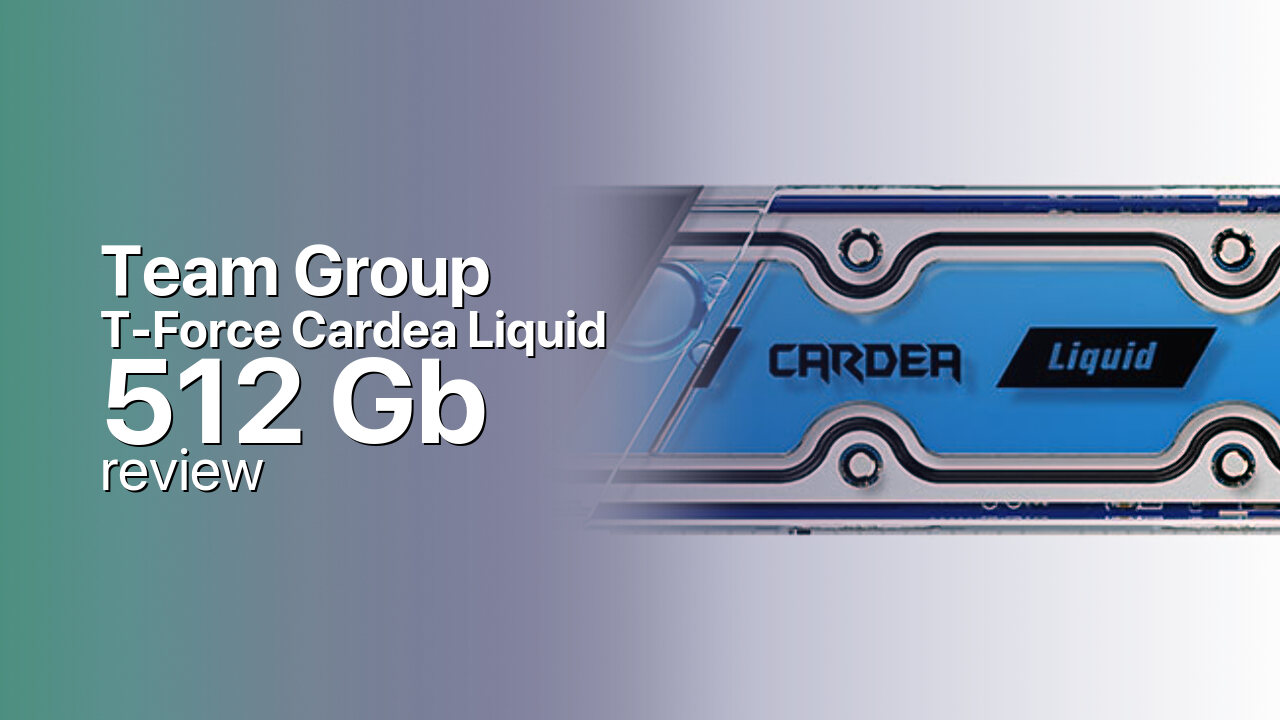
The Team Group T-Force Cardea Liquid pairs the Phison PS5012-E12 controller — an eight-channel, dual-core PCIe 3.0 design on TSMC 28nm — with Toshiba 64-layer BiCS3 3D TLC NAND and 512 MB of DDR4 DRAM. The E12 was the workhorse reference platform for late-era PCIe 3.0 NVMe drives, also powering the Corsair MP510, Sabrent Rocket, and Seagate FireCuda 510. Team Group's differentiating move was the liquid cooling module: a sealed acrylic chamber machined into the heatsink, filled with a non-conductive coolant, complete with a refill port and a small vial of spare liquid in the box. It is not an active pump or loop — the cooling relies on natural convection within the chamber and airflow from case fans passing over the heatsink fins. The result is a roughly 10-degree Celsius reduction in NAND temperatures under sustained load compared to a standard passive heatsink.
The cooling module is also the Cardea Liquid's biggest practical liability. The total z-height is roughly 14 mm, which exceeds the clearance under many motherboard GPU slots — several X570 boards, for example, place the primary M.2 slot directly beneath the PCIe x16 slot, where a 14 mm drive simply does not fit. The cooling pad contacts only the NAND packages; the Phison E12 controller and DRAM chip are bypassed by the thermal assembly, which undermines the value of the liquid cooling for the components that generate the most heat. The securing clips that hold the heatsink to the PCB are fragile, and multiple reviewers noted they felt likely to snap if removed more than once.
Under the heatsink, the Cardea Liquid is a standard Phison E12 drive, and performance reflects that. The 512 GB variant delivers 3,400 MB/s sequential reads and 2,000 MB/s sequential writes, with the write speed taking a notable hit compared to the 1 TB variant's 3,000 MB/s due to reduced NAND parallelism. The drive was available in 512 GB and 1 TB capacities. It has been discontinued — Team Group moved on to the Cardea II (also E12, no liquid) and later the Cardea Z44Q and A440 series — and surviving units are novelties more than practical purchases.
Storage Comparisons:
T-Force Cardea Liquid Performance & Benchmarks
The Team Group Cardea Liquid 512 GB is rated for 3,400 MB/s sequential reads and 2,000 MB/s sequential writes, with random performance of up to 350,000 IOPS reads and 300,000 IOPS writes. These are standard Phison E12 numbers for the 512 GB capacity tier — the 1 TB variant pushes writes to 3,000 MB/s by populating all eight NAND channels more fully. Independent reviewers at Hexus and Tweaktown confirmed the drive hitting its rated sequential figures, with real-world CrystalDiskMark results within a few percent of the rated specifications.
Team Group T-Force Cardea Liquid 512 GB vs M.2 3.0 x 4 peers
Switch between sequential throughput and random IOPS to see how this drive stacks up against other M.2 3.0 x 4 SSDs in our database. The highlighted bar is the drive on this page — click any other bar to open that drive.
- ADATA SX 8800 Pro 512 GB: 3,500 MB/s read, 2,700 MB/s write
- ADATA SX 8800 Pro 1 TB: 3,500 MB/s read, 2,700 MB/s write
- ADATA XPG Spectrix S40G RGB 256 GB: 3,500 MB/s read, 3,000 MB/s write
- ADATA XPG Spectrix S40G RGB 512 GB: 3,500 MB/s read, 3,000 MB/s write
- Team Group T-Force Cardea Liquid 512 GB (this drive): 3,400 MB/s read, 2,000 MB/s write
The Phison E12's pSLC cache on the 512 GB variant handles roughly 50 to 60 GB of sustained writes at full speed before exhausting to direct-to-TLC mode, where writes settle at approximately 800 to 1,000 MB/s. This is adequate for typical consumer use but noticeably less headroom than the 1 TB variant's larger cache. Thermally, the liquid cooling module does what it claims — Hexus measured a roughly 10-degree reduction in NAND temperature under sustained load compared to the same drive with a standard heatsink. However, this benefit is limited to the NAND: the E12 controller, which typically runs hotter than the NAND under load, is not contacted by the cooling assembly and reaches normal E12 operating temperatures in the mid-to-high 70s Celsius. The cooling is real but narrowly applied.
For gaming, the Cardea Liquid performs identically to any other Phison E12 drive — game load times are within a second of other PCIe 3.0 NVMe SSDs, and the DRAM cache ensures responsive multitasking. The liquid cooling provides no gaming performance benefit; it matters only for sustained write workloads where NAND temperature could otherwise approach throttle thresholds. The drive's PCIe 3.0 ceiling is a hard limit — it cannot match PCIe 4.0 drives in DirectStorage scenarios or the PS5, though neither of those is relevant to the era of hardware this drive shipped into.
Team Group T-Force Cardea Liquid vs Competitors
See how the T-Force Cardea Liquid stacks up against other M.2 3.0 x 4 drives in our database:
Compare with rival drives:
Endurance, TBW & Warranty
Team Group backs the Cardea Liquid 512 GB with a 3-year limited warranty and an endurance rating of 800 TBW. The 3-year warranty is shorter than the 5-year coverage offered by many Phison E12 competitors at the time, and it is worth noting that Team Group's warranty process is less globally established than Samsung, WD, or Crucial. At 800 TBW, the 512 GB Cardea Liquid can absorb roughly 730 GB of writes per day for the warranty period — an endurance envelope that exceeds even heavy consumer workloads. At a typical 30 GB/day pace, the drive would last over 70 years before reaching the TBW limit. The endurance rating is generous for a 512 GB drive and reflects Team Group's conservative over-provisioning on the Phison E12 platform. The 1 TB variant carries 1,600 TBW. The MTBF is rated at 2 million hours. Team Group provides no dedicated SSD management software, so firmware updates and health monitoring rely on third-party tools or the Phison NVMe driver.
Team Group T-Force Cardea Liquid 512 GB Specifications
| Category | Value |
|---|---|
| Capacity [?] | 512 GB |
| Interface [?] | M.2 3.0 x 4 |
| Controller [?] | Phison PS5012-E12 |
| Memory type [?] | Toshiba 3D TLC |
| DRAM [?] | 512MB DDR4 |
| Read speed (MB/s) [?] | 3400 |
| Write speed (MB/s) [?] | 2000 |
| Read IOPS [?] | 350000 |
| Write IOPS [?] | 300000 |
| Endurance (TBW) [?] | 800 |
| MTBF (million hours) [?] | 2 |
| Warranty (years) [?] | 3 |
Verdict: Is the T-Force Cardea Liquid Worth It in 2026?
The Team Group T-Force Cardea Liquid 512 GB is more interesting as a piece of PC hardware history than as a practical purchase in 2026. The liquid cooling module is genuinely novel and measurably reduces NAND temperatures, but the 14 mm z-height excludes it from many builds, the cooling misses the controller entirely, and the PCIe 3.0 performance is identical to any other Phison E12 drive that costs less and fits everywhere. Buy one if you are a collector of unusual PC hardware or want a conversation piece for a showcase build with generous M.2 clearance. For actual use, literally any other Phison E12 drive — or better yet, a modern PCIe 4.0 budget option like the WD Blue SN580 — will serve you better at a lower price with fewer fitment headaches.
+ Pros
- Unique factory liquid cooling module — the only one ever shipped on M.2
- Roughly 10-degree NAND temperature reduction under sustained load
- Standard Phison E12 performance — 3,400 MB/s reads, DRAM cache
- 800 TBW endurance is generous for a 512 GB drive
- Includes spare coolant vial and refill port for long-term maintenance
- Cons
- 14 mm z-height incompatible with many M.2 slots — especially under GPU
- Cooling assembly contacts only NAND, bypasses controller and DRAM
- Write speed limited to 2,000 MB/s on 512 GB vs 3,000 MB/s on 1 TB
- Fragile securing clips risk breaking during installation or removal
- Only a 3-year warranty — shorter than 5-year Phison E12 competitors
- Discontinued — limited to used and NOS stock
Buy this or similar SSD Storage:



Video Review
World's First Liquid M.2 NVMe ! The TEAM GROUP T-FORCE Cardea Liquid SSD