WD Black SN770 500GB PCIe 4.0 NVMe SSD Review (2026)
Quick answer
The WD Black SN770 500GB is the right pick for buyers who want a clean Gen4 boot drive and a second-tier game volume without paying for a flagship controller or DRAM.
Read: 5000 MB/s Write: 4000 MB/s Endurance: 300 TBW Warranty: 5 years Interface: M.2 4.0 x 4
The WD Black SN770 500GB is the sweet spot of WD's budget Gen4 lineup, trading flagship features for a 5,000 MB/s read rating and a 5-year warranty.
Controller & Memory
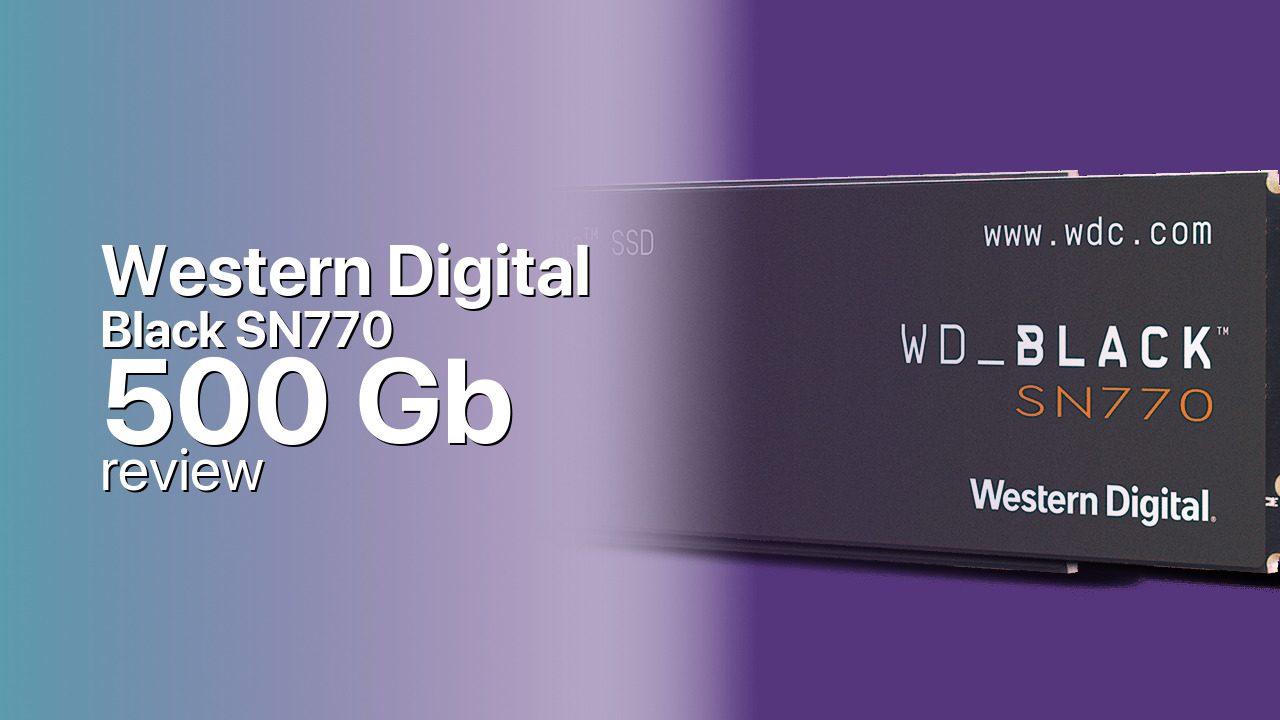
Western Digital builds the SN770 around an in-house SanDisk-designed four-channel NVMe controller paired with BiCS5 112-layer Kioxia 3D TLC NAND. There is no onboard DRAM cache; the drive uses the NVMe Host Memory Buffer (HMB) feature to borrow a small slice of system RAM for its mapping table. The PCB is single-sided M.2 2280, which fits cleanly into thin-and-light laptops, mini PCs, and PS5-style heatsink carriers where bottom-side components would foul the slot. No heatsink is included in the retail box, and WD did not need to include one — the SN770 runs cool enough that motherboard-supplied cooling is plenty in nearly every install.
The SN770 is sold in 250 GB, 500 GB, 1 TB, and 2 TB capacities. The 500 GB tier sits a notch below the headline 1 TB and 2 TB ratings: WD spec sheets it at 5,000 MB/s sequential reads and 4,000 MB/s sequential writes, with 460,000 random read IOPS and 800,000 random write IOPS. Compared to the 250 GB sheet (4,000/2,000 MB/s) it is a substantial jump; compared to the 1 TB sheet (5,150/4,900 MB/s) it is a small step back, because there are fewer NAND dies to interleave. This is the smallest capacity that meaningfully feels like a Gen4 drive.
In this tier the SN770 500GB lines up directly against the WD Blue SN580 500GB, the Crucial P3 Plus 500GB, the Kingston NV2 500GB, and the Samsung 980 (PCIe 3.0). Among the DRAM-less Gen4 cohort, the SN770 has the most polished firmware, the longest warranty, and the most consistent random performance — the in-house controller is genuinely competitive. PS5 owners can use this drive in the console, but the 5,000 MB/s read rating sits a touch below Sony's 5,500 MB/s recommendation, so a 1 TB or 2 TB SN770 (5,150 MB/s) is a tidier match for that role.
Storage Comparisons:
Black SN770 Performance & Benchmarks
WD rates the 500 GB SN770 at up to 5,000 MB/s sequential reads and 4,000 MB/s sequential writes, with 460,000 random read IOPS and 800,000 random write IOPS. Those numbers comfortably outclass any SATA drive and roughly match a strong PCIe 3.0 NVMe on writes while delivering true Gen4 speeds on reads. Game loads, application launches, OS boot, and most DirectStorage workloads all feel sharp on this drive. Compared to a flagship like the WD Black SN850X, the gap shows up in queued mixed workloads and long sustained transfers, not in everyday desktop tasks.
Western Digital Black SN770 500 GB vs M.2 4.0 x 4 peers
Switch between sequential throughput and random IOPS to see how this drive stacks up against other M.2 4.0 x 4 SSDs in our database. The highlighted bar is the drive on this page — click any other bar to open that drive.
- Patriot Viper PV593 1 TB: 14,500 MB/s read, 14,000 MB/s write
- Patriot Viper PV593 2 TB: 14,500 MB/s read, 14,000 MB/s write
- Patriot Viper PV593 4 TB: 14,500 MB/s read, 14,000 MB/s write
- Patriot Viper PV573 2 TB: 14,000 MB/s read, 12,000 MB/s write
- Western Digital Black SN770 500 GB (this drive): 5,000 MB/s read, 4,000 MB/s write
Like most TLC NVMe drives, the SN770 uses a dynamic SLC cache to absorb burst writes. Independent reviewers consistently find that the SLC cache on the 500 GB SN770 handles tens of gigabytes of writes at full speed before exhaustion, after which sustained writes drop into native TLC territory in the low gigabyte-per-second range. For users who copy a movie, install a game, or move a project folder, this transition is invisible. For users who routinely write 100 GB or more in one shot — large video archives, scratch disks, big game library migrations — the cache wall is something to plan around. The DRAM-less HMB design is the other practical trade-off: under deep mixed random workloads it lags DRAM-equipped drives like the Samsung 990 Pro, but for the buyer profile this drive is aimed at, the difference is academic.
Western Digital Black SN770 vs Competitors
See how the Black SN770 stacks up against other M.2 4.0 x 4 drives in our database:
Compare with rival drives:
Endurance, TBW & Warranty
Western Digital backs the SN770 with a 5-year limited warranty, and on the 500 GB capacity the endurance allowance is 300 TBW — half of the 1 TB model and double the 250 GB. That works out to roughly 165 GB of writes per day, every day, for five straight years before the rating is exhausted. A typical desktop or laptop user writes well under 50 GB per day, so the warranty time limit will expire long before any normal workload approaches the TBW ceiling. Power users running constant Steam reinstalls or video work should still keep an eye on SMART write counters, but for the target buyer this is a non-issue.
WD lists an MTBF of 1,750,000 hours for the SN770 family. MTBF is a population statistic, not a per-drive guarantee, so treat it as a sign of design confidence rather than a forecast. Warranty coverage is handled directly through Western Digital's support portal, which usually moves faster than a retailer return once the original purchase window has closed. As with every consumer SSD, the warranty ends at whichever boundary is reached first: five calendar years or 300 TBW.
Western Digital Black SN770 500 GB Specifications
| Category | Value |
|---|---|
| Capacity [?] | 500 GB |
| Interface [?] | M.2 4.0 x 4 |
| Controller [?] | SanDisk |
| Memory type [?] | Kioxia 112-L TLC |
| DRAM [?] | No (HMB) |
| Read speed (MB/s) [?] | 5000 |
| Write speed (MB/s) [?] | 4000 |
| Read IOPS [?] | 460000 |
| Write IOPS [?] | 800000 |
| Endurance (TBW) [?] | 300 |
| MTBF (million hours) [?] | 1.75 |
| Warranty (years) [?] | 5 |
Verdict: Is the Black SN770 Worth It in 2026?
The WD Black SN770 500GB is the right pick for buyers who want a clean Gen4 boot drive and a second-tier game volume without paying for a flagship controller or DRAM. It is best suited to mainstream desktops, gaming laptops, mini PCs, and PCIe 3.0 upgrades that simply want to step into Gen4 territory. Heavy creators, PS5 owners chasing Sony's 5,500 MB/s read recommendation, and anyone planning sustained large-file workloads should look at the SN770 1 TB or 2 TB instead, where read speeds climb to 5,150 MB/s and endurance scales sharply. Among DRAM-less Gen4 rivals — Kingston NV2, Crucial P3 Plus, WD Blue SN580 — the SN770 500GB is the most consistent option backed by the longest warranty.
+ Pros
- 5,000 MB/s sequential reads on PCIe 4.0
- 300 TBW endurance with 5-year warranty
- Single-sided M.2 2280 fits laptops and carriers
- In-house SanDisk controller, BiCS5 Kioxia TLC
- Strong 800,000 random write IOPS rating
- Runs cool without an added heatsink
- Cons
- 4,000 MB/s writes trail the 1 TB SKU sharply
- No DRAM hurts deep mixed random workloads
- Just under PS5 5,500 MB/s read recommendation
- Small SLC cache on the 500 GB die layout
- No included heatsink in the retail box
Buy this or similar SSD Storage:



Video Review
WD Black SN770 SSD Review – Mid Range Gaming Greatness?