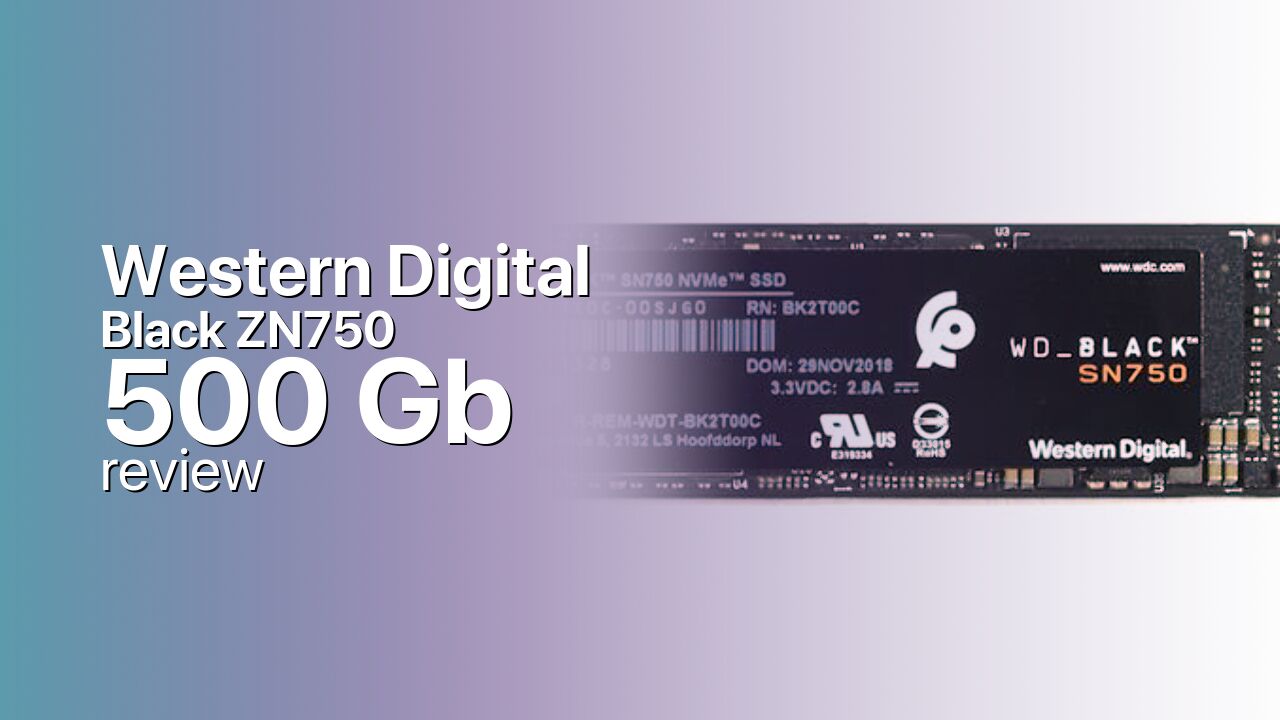
WD Black SN750 500GB Review — PCIe 3.0 NVMe SSD (2026)
Quick answer
The WD Black SN750 500GB is an excellent choice for gamers upgrading from SATA SSDs who don't want to pay the PCIe 4.0 premium.
Read: 3470 MB/s Write: 2600 MB/s Endurance: 300 TBW Warranty: 5 years Interface: M.2 3.0 x 4
The WD Black SN750 500GB remains one of the strongest PCIe 3.0 NVMe values even as PCIe 4.0 drives have pushed the ceiling higher.
Controller & Memory
Western Digital released the Black SN750 as a gaming-focused refresh of the earlier SN720, keeping the same SanDisk 64-layer TLC NAND and WD-designed NVMe controller but tuning the firmware for better sustained performance. The 500GB capacity sits in the sweet spot between the entry-level 250GB model, which drops to 3,100 MB/s reads and 1,600 MB/s writes, and the 1TB version with its full 3,470/3,000 MB/s ratings. Like the rest of the series, this 500GB model includes 1GB of SK Hynix DDR4 DRAM cache for consistent random I/O performance.
Inside, the SN750 uses Western Digital's in-house controller (SanDisk 20-82-007011) paired with 64-layer BiCS3 TLC NAND. The drive ships in the standard M.2 2280 form factor and is single-sided, which means it fits in thin laptops and the PS5 expansion slot, though the PS5's PCIe 4.0 interface won't let this Gen3 drive hit its full potential. WD offered a variant with an EKWB heatsink for better thermal performance under sustained loads, but most retail kits ship bare—you may want to add your own heatsink if you're pushing the drive with large file transfers.
The SN750 competes directly with Samsung's 970 EVO Plus and the Sabrent Rocket. Samsung's drive edges ahead in pure sequential writes, while the SN750 holds its own in gaming workloads where queue depths stay low. For pure gaming loads, the difference between this Gen3 drive and a Gen4 alternative like the WD SN850X is imperceptible—game load times are bound by CPU decompression and API overhead long before storage bandwidth becomes the bottleneck.
Storage Comparisons:
Black ZN750 Performance & Benchmarks
The WD Black SN750 500GB is rated at 3,470 MB/s sequential reads and 2,600 MB/s sequential writes. These are capacity-specific ratings—the 250GB model drops significantly to 3,100/1,600 MB/s, while the 1TB variant gains faster writes at 3,000 MB/s. Random 4K performance is rated at up to 420,000 IOPS reads and 380,000 IOPS writes.
Western Digital Black ZN750 500 GB vs M.2 3.0 x 4 peers
Switch between sequential throughput and random IOPS to see how this drive stacks up against other M.2 3.0 x 4 SSDs in our database. The highlighted bar is the drive on this page — click any other bar to open that drive.
- ADATA SX 8800 Pro 512 GB: 3,500 MB/s read, 2,700 MB/s write
- ADATA SX 8800 Pro 1 TB: 3,500 MB/s read, 2,700 MB/s write
- ADATA XPG Spectrix S40G RGB 256 GB: 3,500 MB/s read, 3,000 MB/s write
- ADATA XPG Spectrix S40G RGB 512 GB: 3,500 MB/s read, 3,000 MB/s write
- Western Digital Black ZN750 500 GB (this drive): 3,470 MB/s read, 2,600 MB/s write
In real-world testing, independent reviewers found the SN750 consistently hits its rated sequential speeds in CrystalDiskMark and similar synthetic benchmarks. More importantly, the drive maintains strong sustained write performance after its SLC cache exhausts. The SLC cache implementation uses a portion of the TLC NAND in SLC mode for burst writes, typically handling the first several gigabytes at full speed before dropping to native TLC write speeds. For gaming and typical desktop use, you won't notice the transition—gaming installs and level loads are read-heavy workloads that don't stress the cache.
Versus SATA SSDs, the SN750 500GB delivers 5–6x faster sequential throughput. The practical difference is most apparent in large file transfers—moving a 50GB game installation from a SATA SSD takes roughly 10–12 minutes, but the SN750 finishes in under 2 minutes. For OS boot times and application launches, the jump from SATA to NVMe is measurable but less dramatic; most of the perceived speed comes from the NVMe driver's lower overhead rather than raw bandwidth.
Western Digital Black ZN750 vs Competitors
See how the Black ZN750 stacks up against other M.2 3.0 x 4 drives in our database:
Compare with rival drives:
Endurance, TBW & Warranty
Western Digital rates the SN750 500GB at 300 TBW endurance over a 5-year warranty period. This means you can write 300 terabytes of data before the warranty expires—at 50 GB per day, that would take over 16 years to exhaust. The 250GB model offers only 200 TBW, while the 1TB doubles to 600 TBW, so the 500GB sits at a reasonable middle ground for most users.
The MTBF rating is 1.75 million hours, though as with any SSD, this is a population statistic rather than a guarantee for any individual drive. WD handles warranty claims directly; the drive is RMA-eligible through WD's support portal if the TBW limit hasn't been exceeded or the 5-year period hasn't passed. Unlike some competitors, WD does not include recovery software or data migration tools with the SN750—you'll need to provide your own cloning solution if upgrading an existing boot drive.
Western Digital Black ZN750 500 GB Specifications
| Category | Value |
|---|---|
| Capacity [?] | 500 GB |
| Interface [?] | M.2 3.0 x 4 |
| Controller [?] | SanDisk 20-82-007011 |
| Memory type [?] | SanDisk 64L TLC |
| DRAM [?] | SK Hynix 1GB DDR4 SDRAM |
| Read speed (MB/s) [?] | 3470 |
| Write speed (MB/s) [?] | 2600 |
| Read IOPS [?] | 420000 |
| Write IOPS [?] | 380000 |
| Endurance (TBW) [?] | 300 |
| MTBF (million hours) [?] | 1.75 |
| Warranty (years) [?] | 5 |
Verdict: Is the Black ZN750 Worth It in 2026?
The WD Black SN750 500GB is an excellent choice for gamers upgrading from SATA SSDs who don't want to pay the PCIe 4.0 premium. It delivers the full Gen3 experience with DRAM cache, strong sustained writes, and a firmware-optimized "Gaming Mode" in the WD SSD Dashboard that disables low-power states to maintain responsiveness during long sessions. Buy it if you want a proven, reliable boot drive for a gaming PC and don't need cutting-edge Gen4 speeds.
Skip it if you're building a new high-end system and want to future-proof with PCIe 4.0 or 5.0—those drives have fallen in price enough that the SN750's value argument has weakened. Consider the Samsung 970 EVO Plus for slightly better sustained write performance, or step up to the WD Black SN850X if your motherboard supports PCIe 4.0 and you want more headroom for large file workloads. The SN750 500GB hits the right balance for most mid-range gaming builds in 2026.
+ Pros
- 3,470 MB/s sequential reads, 2,600 MB/s writes
- DRAM cache with 1GB SK Hynix DDR4 for consistent random I/O
- 300 TBW endurance with 5-year warranty
- Single-sided M.2 2280 form factor fits laptops and PS5
- Firmware-optimized Gaming Mode disables aggressive power saving
- Strong sustained write performance after SLC cache exhausts
- Cons
- No hardware encryption support
- PCIe 3.0 limited—cannot match Gen4 drives in large file transfers
- Heatsink variant sold separately and adds cost
- Write speed drops significantly versus the 1TB model (2,600 vs 3,000 MB/s)
Buy this or similar SSD Storage:



Video Review
STEP-BY-STEP Boot drive setup: WESTERN DIGITAL BLACK SN750 M.2 NVMe SSD vs Samsung 970 EVO Plus