Addlink S93 4 TB: The Capacity Flagship of Addlink's DRAM-less Line (2026)
Quick answer
The Addlink S93 4 TB is the capacity that makes the strongest case for this drive and the one to buy when a single SSD has to hold everything.
Read: 7400 MB/s Write: 6500 MB/s Endurance: 2400 TBW Warranty: 5 years Interface: M.2 4.0 x 4
The Addlink S93 4 TB tops Addlink's ultra-slim PCIe 4.0 line with 7,400 MB/s reads, a class-leading 2,400 TBW rating, and a single-sided 2.25 mm card.
Controller & Memory
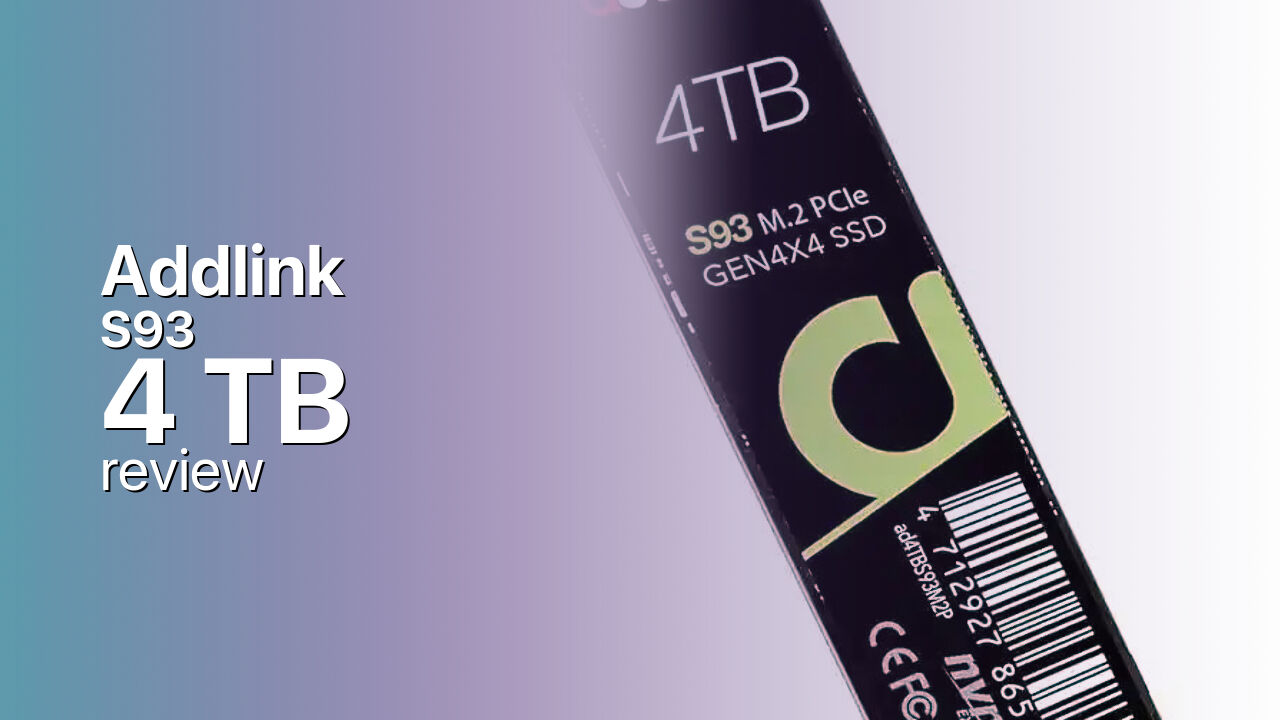
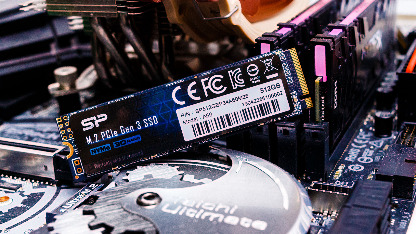
The Addlink S93 4 TB pairs a Maxio MAP1602-C four-channel DRAM-less controller with YMTC 232-layer 3D TLC NAND, borrowing system RAM through Host Memory Buffer for the flash translation layer instead of fitting a discrete DRAM chip. The defining physical trait is the 2.25 mm single-sided M.2 2280 PCB, one of the thinnest Gen4 drives on the market and notably slim for a 4 TB capacity, where many competitors switch to a double-sided board to fit enough NAND packages. Addlink ships the drive bare, with no heatsink, no graphene sticker, and no thermal pad, positioning it for laptops and compact desktops that already provide cooling through the chassis.
The S93 spans three capacities, 1 TB, 2 TB, and 4 TB, all sharing the same MAP1602 controller, YMTC 232L TLC, HMB architecture, and five-year warranty. Sequential throughput scales with NAND parallelism: the 1 TB runs at 7,200 MB/s reads and 6,100 MB/s writes, while both the 2 TB and 4 TB hit the platform's full 7,400 MB/s read and 6,500 MB/s write ceiling because they already populate enough of the controller's four channels to saturate it. Random IOPS are controller-limited and identical across the line at 1,000,000 read and 820,000 write. Endurance scales at a clean 600 TBW per terabyte, 600 TBW at 1 TB, 1,200 TBW at 2 TB, and 2,400 TBW at the 4 TB reviewed here, which is the figure that separates the flagship from the rest of the family.
The 4 TB is the capacity to buy when the drive will serve as a laptop or small-form-factor desktop's only storage, holding an operating system, a full application suite, a working media library, and a substantial game collection without the constant shuffling that a 1 TB drive demands. Its larger SLC cache, carved from a bigger NAND pool than the smaller capacities, keeps sustained writes at peak speed through larger transfers before dropping to native TLC throughput, which matters for video exports, large game installs, and backup restores. Compatibility is PCIe 4.0 x4 with NVMe 1.4 and full backward compatibility to PCIe 3.0, where throughput halves. The bare single-sided PCB also fits the PlayStation 5 expansion bay with room for a third-party heatsink under Sony's 11.25 mm ceiling, though Addlink's own AddGame A93, on the same MAP1602 platform but with a bundled aluminium heatsink, is the more convenient PS5 pick from the same brand. The closest external competitors in the DRAM-less budget tier are the WD Black SN770, the Team Group MP44, and the Crucial P3 Plus, with the S93's combination of a 2,400 TBW rating and a genuinely ultra-slim PCB being its distinguishing edge.
Storage Comparisons:
S93 Performance & Benchmarks
Addlink rates the 4 TB S93 at 7,400 MB/s sequential reads and 6,500 MB/s sequential writes over a PCIe 4.0 x4 link, the full ceiling of the Maxio MAP1602-C platform. Random performance is rated at up to 1,000,000 read IOPS and 820,000 write IOPS, figures that are controller-limited and identical across all three S93 capacities. The MAP1602-C is built on TSMC 12 nm silicon running four NAND channels at 2,400 MT/s, the same proven platform Addlink uses in the AddGame A93.
Addlink S93 4 TB vs M.2 4.0 x 4 peers
Switch between sequential throughput and random IOPS to see how this drive stacks up against other M.2 4.0 x 4 SSDs in our database. The highlighted bar is the drive on this page — click any other bar to open that drive.
- Patriot Viper PV593 1 TB: 14,500 MB/s read, 14,000 MB/s write
- Patriot Viper PV593 2 TB: 14,500 MB/s read, 14,000 MB/s write
- Patriot Viper PV593 4 TB: 14,500 MB/s read, 14,000 MB/s write
- Patriot Viper PV573 2 TB: 14,000 MB/s read, 12,000 MB/s write
- Addlink S93 4 TB (this drive): 7,400 MB/s read, 6,500 MB/s write
TweakTown's review of this exact 4 TB model recorded a 6,541 MB/s sequential write result that landed within 18 MB/s of the highest the lab had ever measured, and an 883,000 random read IOPS figure on its AMD test bench that tracks the 1,000,000 rating. The same review found the 4K QD1 random read at around 100 MB/s, a strong real-world indicator for boot and application-launch responsiveness. Guru3D's independent review of the 4 TB confirmed sequential results matching the rated speeds and observed sustained writes holding near peak through roughly the first quarter of the drive before the SLC cache exhausted and writes settled to native TLC speed; the 4 TB's proportionally larger cache extends that peak window further than on the 1 TB or 2 TB. Addlink claims over 35 percent lower power consumption than typical Gen4 x4 SSDs, credible given the 12 nm controller's efficiency, and relevant for a laptop drive where wattage under load directly affects battery life during transfers. The DRAM-less HMB design does carry higher 4K random write latency than drives with discrete DRAM such as the Samsung 990 Pro or WD Black SN850X, but those drives occupy a higher price tier entirely.
Addlink S93 vs Competitors
See how the S93 stacks up against other M.2 4.0 x 4 drives in our database:
Compare with rival drives:
Endurance, TBW & Warranty
Addlink covers the S93 4 TB with a five-year limited warranty, terminated by whichever arrives first between the term and the 2,400 TBW endurance rating. That 2,400 TBW is the highest in the S93 family, scaling at 600 TBW per terabyte from 600 TBW on the 1 TB, and it tracks the rated cycle life of the YMTC 232-layer TLC. Within the budget PCIe 4.0 segment the endurance is competitive bordering on generous: the WD Black SN770 2 TB carries 1,200 TBW, the Team Group MP44 2 TB reaches 1,300 TBW, and QLC-based rivals such as the Crucial P3 Plus manage only 440 TBW at 2 TB. At a typical consumer write load of 20 GB per day, a 2,400 TBW rating translates to roughly 328 years before the write budget is exhausted, so the five-year term expires long before the NAND approaches its limit. The headroom matters most if the 4 TB is repurposed as a scratch disk or content-creation volume where daily writes reach hundreds of gigabytes, scenarios in which the doubled-over-doubled-again endurance over the smaller capacities is a genuine practical advantage. Addlink rates the drive at 2.0 million hours MTBF, a population-reliability statistic describing expected failure rates across a fleet rather than a lifespan promise for any single unit. Warranty claims route through the retailer or distributor, as Addlink does not operate a direct end-user RMA portal in most regions.
Addlink S93 4 TB Specifications
| Category | Value |
|---|---|
| Capacity [?] | 4 TB |
| Interface [?] | M.2 4.0 x 4 |
| Controller [?] | Maxio Tech MAP1602-C |
| Memory type [?] | YMTC 232-L TLC |
| DRAM [?] | HMB |
| Read speed (MB/s) [?] | 7400 |
| Write speed (MB/s) [?] | 6500 |
| Read IOPS [?] | 1000000 |
| Write IOPS [?] | 820000 |
| Endurance (TBW) [?] | 2400 |
| MTBF (million hours) [?] | 2000000 |
| Warranty (years) [?] | 5 |
Verdict: Is the S93 Worth It in 2026?
The Addlink S93 4 TB is the capacity that makes the strongest case for this drive and the one to buy when a single SSD has to hold everything. It delivers the full 7,400 MB/s sequential read ceiling of the MAP1602-C platform, the family's full 1,000,000 random read IOPS, and a class-leading 2,400 TBW endurance rating with the largest SLC cache for sustained-write headroom, all while staying single-sided at 2.25 mm in a market where most 4 TB Gen4 drives use thicker or double-sided boards. The five-year warranty is standard for the segment, the 12 nm controller's efficiency claims are credible, and the YMTC 232-layer TLC buries QLC competitors on endurance. Buyers who do not need 4 TB save meaningfully with the 1 TB or 2 TB siblings and still get a capable drive, but the 4 TB is the S93 to choose when the budget allows, because it is the only capacity that makes a single-drive laptop or compact desktop feel genuinely spacious for years. Look past the S93 only if the system lacks integrated M.2 cooling, in which case Addlink's AddGame A93 4 TB ships with an aluminium heatsink on the same platform. For a thin laptop or a PS5 where clearance and capacity are the binding constraints together, the S93 4 TB is one of the very few drives that solves both at once.
+ Pros
- 7,400 MB/s sequential reads, full MAP1602-C platform ceiling
- 2,400 TBW endurance, highest in the S93 family
- Largest SLC cache in the line for sustained writes
- Ultra-slim 2.25 mm single-sided PCB fits tight laptop slots
- Five-year warranty competitive in the budget Gen4 segment
- YMTC 232-layer TLC buries QLC rivals on endurance
- Over 35% lower power draw than typical Gen4 drives
- Cons
- DRAM-less HMB design raises sustained random write latency
- No heatsink included, bare drive only
- No AES 256-bit hardware encryption
- 4 TB carries a capacity price premium over 1 TB and 2 TB
- AddGame A93 sibling offers included heatsink and higher endurance
Buy this or similar SSD Storage:
Video Review
REVIEW (2026): Addlink S93 4TB SSD Expansion. ESSENTIAL details.