Micron 4600 1 TB Review: The PCIe 5.0 Sweet Spot (2026)
Quick answer
The Micron 4600 1 TB is the capacity we would point most buyers to.
Read: 14500 MB/s Write: 12000 MB/s Endurance: 600 TBW Warranty: 3 years Interface: M.2 5.0
The Micron 4600 1 TB is the sweet-spot capacity of Micron's PCIe 5.0 client SSD, pairing an efficient Silicon Motion SM2508 controller with Micron G9 TLC for up to 14,500 MB/s reads.
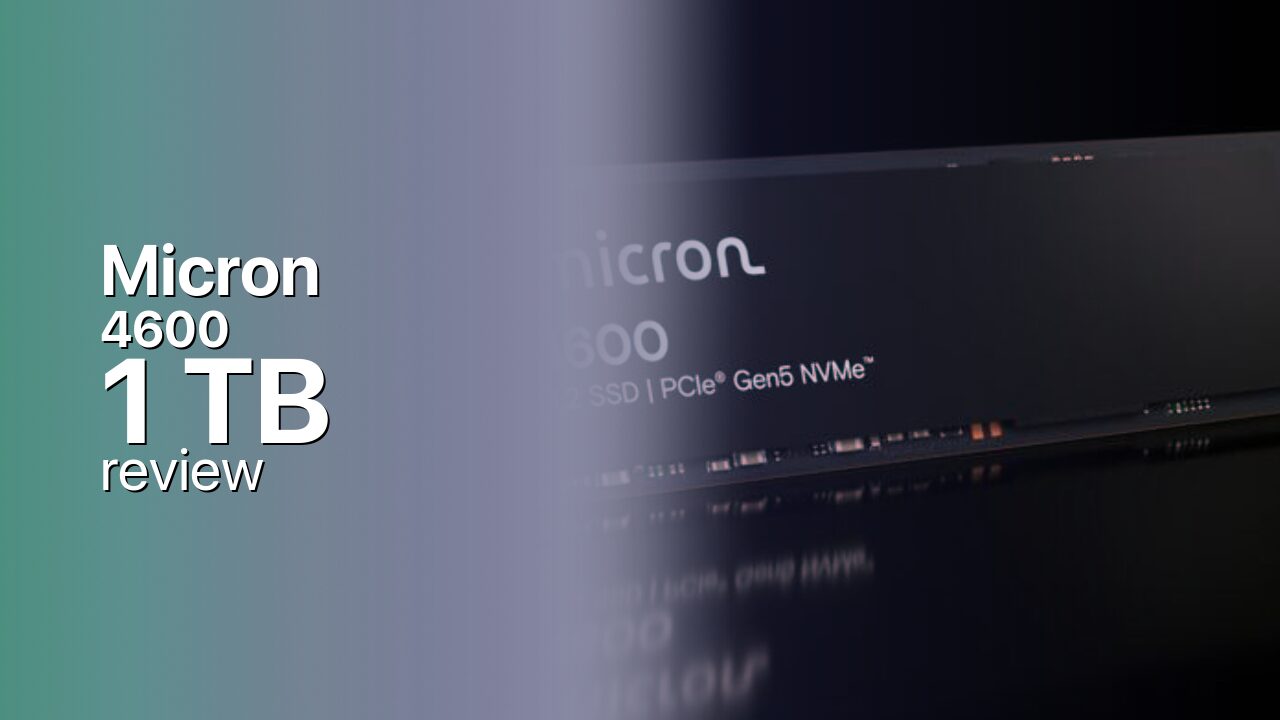
Controller & Memory
The Micron 4600 1 TB sits in the middle of a four-capacity PCIe 5.0 lineup (512 GB, 1 TB, 2 TB, 4 TB), and it is the capacity most buyers should actually pick. Inside is a Silicon Motion SM2508 Gen5 controller rather than the Phison E26 that dominates the first wave of PCIe 5.0 drives, paired with Micron's own G9 276-layer TLC NAND, dynamic SLC caching and an on-board DRAM cache for the address map. That SM2508 choice is the defining detail: independent reviewers single the 4600 out as efficient for a Gen5 drive, reaching flagship-class bandwidth without the heat and power penalty that made early E26 designs demanding to cool.
Where the 1 TB earns its sweet-spot label is the balance of endurance, cache and price. It carries 600 TBW, double the 300 TBW of the 512 GB model, and its larger SLC write cache holds sustained writes at full speed for longer before dropping to the direct-TLC rate. It still shares the same headline sequential rating as the rest of the lineup, up to 14,500 MB/s read and 12,000 MB/s write, plus the same 2.1 million random read and write IOPS ceiling. For a single drive holding an operating system, working applications and a respectable game library, the 1 TB is the practical pick; the 512 GB saves money but runs out of room and cache sooner, and the 2 TB and 4 TB add headroom most users will not fill.
The 4600 is an M.2 2280 module that drops into any PCIe 5.0 M.2 slot and, like every Gen5 drive, benefits from the motherboard's M.2 heatsink or shield even though its efficiency keeps it cooler than E26 peers. It is backward compatible with PCIe 4.0 boards, where it runs at roughly half its rated bandwidth. Direct rivals are the Crucial T705 and Corsair MP700 Pro on the Phison E26 platform and Samsung's 9100 Pro; the 4600's case against them is efficiency and Micron's in-house NAND, weighed against their typically longer 5-year retail warranties.
Storage Comparisons:
4600 Performance & Benchmarks
Micron rates the 4600 at up to 14,500 MB/s sequential read and 12,000 MB/s sequential write over its PCIe 5.0 x4 interface, with up to 2.1 million random read and 2.1 million random write IOPS at 4K QD128. Those are manufacturer headline figures shared across the 4600 capacities, sitting close to the ceiling of what PCIe 5.0 can deliver in 2025; only the interface, not the silicon, is the limit at this tier.
Micron 4600 1 TB vs M.2 5.0 peers
Switch between sequential throughput and random IOPS to see how this drive stacks up against other M.2 5.0 SSDs in our database. The highlighted bar is the drive on this page — click any other bar to open that drive.
- Corsair MP700 Pro XT 1 TB: 14,900 MB/s read, 14,200 MB/s write
- Corsair MP700 Pro XT 2 TB: 14,900 MB/s read, 14,500 MB/s write
- Corsair MP700 Pro XT 4 TB: 14,900 MB/s read, 14,400 MB/s write
- Crucial T710 1 TB: 14,900 MB/s read, 13,800 MB/s write
- Micron 4600 1 TB (this drive): 14,500 MB/s read, 12,000 MB/s write
For real-world use, that bandwidth shows up most in the workflows that actually saturate a Gen5 link: fast in-game asset streaming and DirectStorage titles, large file transfers, and OS responsiveness where random IOPS matter more than peak sequential. Reviewers consistently frame the 4600 as efficient rather than the single fastest Gen5 drive on the market, noting that it reaches flagship-class numbers without the high idle and load power draw that made early Phison E26 designs run hot and demand aggressive cooling.
The 1 TB capacity is a good sustained-write citizen. Its SLC cache is larger than the 512 GB model's, so under a long contiguous write such as a video render or a large database dump it holds full speed for longer before dropping to the direct-TLC rate, and it recovers faster once the write stops. For boot, applications and typical game libraries the cache is effectively never exhausted, so everyday performance is indistinguishable from the larger capacities while costing meaningfully less than the 2 TB.
Micron 4600 vs Competitors
See how the 4600 stacks up against other M.2 5.0 drives in our database:
Compare with rival drives:
Endurance, TBW & Warranty
The 1 TB Micron 4600 carries a rated endurance of 600 TBW (terabytes written), double the 300 TBW of the 512 GB model and half way to the 1,200 TBW of the 2 TB. Micron covers the drive for 3 years, with coverage ending at whichever threshold comes first, the 3-year term or 600 TBW of cumulative writes. The 3-year term is shorter than the 5-year warranty common on retail Gen5 drives from Crucial or Samsung, and reflects the 4600's OEM lineage.
For almost all buyers the time limit, not the endurance limit, is what binds. At a typical 20 GB of writes per day, exhausting 600 TBW would take around 82 years; at 50 GB per day it is roughly 33 years. Only users sustaining several hundred gigabytes of writes every single day would approach the TBW ceiling inside the warranty window, and that is not what a 1 TB client SSD is normally asked to do. The drive is also rated at 2,000,000 hours MTBF, a population-reliability statistic rather than a per-unit life expectancy.
Micron 4600 1 TB Specifications
| Category | Value |
|---|---|
| Capacity [?] | 1 TB |
| Interface [?] | M.2 5.0 |
| Controller [?] | Silicon Motion SM2508 |
| Memory type [?] | Micron 276-L TLC |
| DRAM [?] | Yes |
| Read speed (MB/s) [?] | 14500 |
| Write speed (MB/s) [?] | 12000 |
| Read IOPS [?] | 2100000 |
| Write IOPS [?] | 2100000 |
| Endurance (TBW) [?] | 600 |
| MTBF (million hours) [?] | 2000000 |
| Warranty (years) [?] | 3 |
Verdict: Is the 4600 Worth It in 2026?
The Micron 4600 1 TB is the capacity we would point most buyers to. It pairs the efficient Silicon Motion SM2508 controller and Micron G9 NAND with 600 TBW of endurance and a larger SLC cache than the 512 GB, so it delivers the headline 14,500 MB/s reads and 2.1M IOPS in a size that actually holds an operating system, applications and a real game library without forcing constant capacity management.
Step up to the 2 TB if you install many large games or work with big media files and want more headroom and a larger cache; the endurance scales to 1,200 TBW on that model. Look elsewhere, at the Crucial T705 or Samsung 9100 Pro, if a long retail warranty matters more than efficiency, since the 4600's 3-year OEM term trails their 5-year coverage. For a PCIe 5.0 platform where the goal is fast, cool and roomy enough, the 4600 1 TB is the practical sweet spot of the lineup.
+ Pros
- Up to 14,500 MB/s sequential reads on PCIe 5.0
- Efficient Silicon Motion SM2508 Gen5 controller
- 600 TBW endurance, double the 512 GB model
- Larger SLC cache holds sustained writes longer
- TCG Opal 2.02 hardware encryption support
- Lower power draw than Phison E26 Gen5 rivals
- Cons
- 3-year OEM warranty trails the 5-year retail norm
- PCIe 5.0 speed wasted on a PCIe 4.0 platform
- No heatsink included
- OEM lineage means thinner retail support channels
Buy this or similar SSD Storage:
Video Review
Micron 4600 2TB M.2 SSD PCIe Gen5 NVMe specifications