Sabrent Rocket Nano 1 TB — Compact M.2 2242 NVMe SSD (2026)
Quick answer
The Sabrent Rocket Nano 1 TB solves a real problem: finding a competent, high-capacity retail NVMe SSD for M.2 2242-only systems.
Read: 2500 MB/s Write: 2100 MB/s Endurance: 720 TBW Warranty: 5 years Interface: M.2 3.0 x 4
Sabrent's Rocket Nano 1 TB delivers a full terabyte of NVMe storage in an M.2 2242 package — half the length of standard drives — making it a rare high-capacity retail option for compact systems with shorter M.2 slots.
Controller & Memory
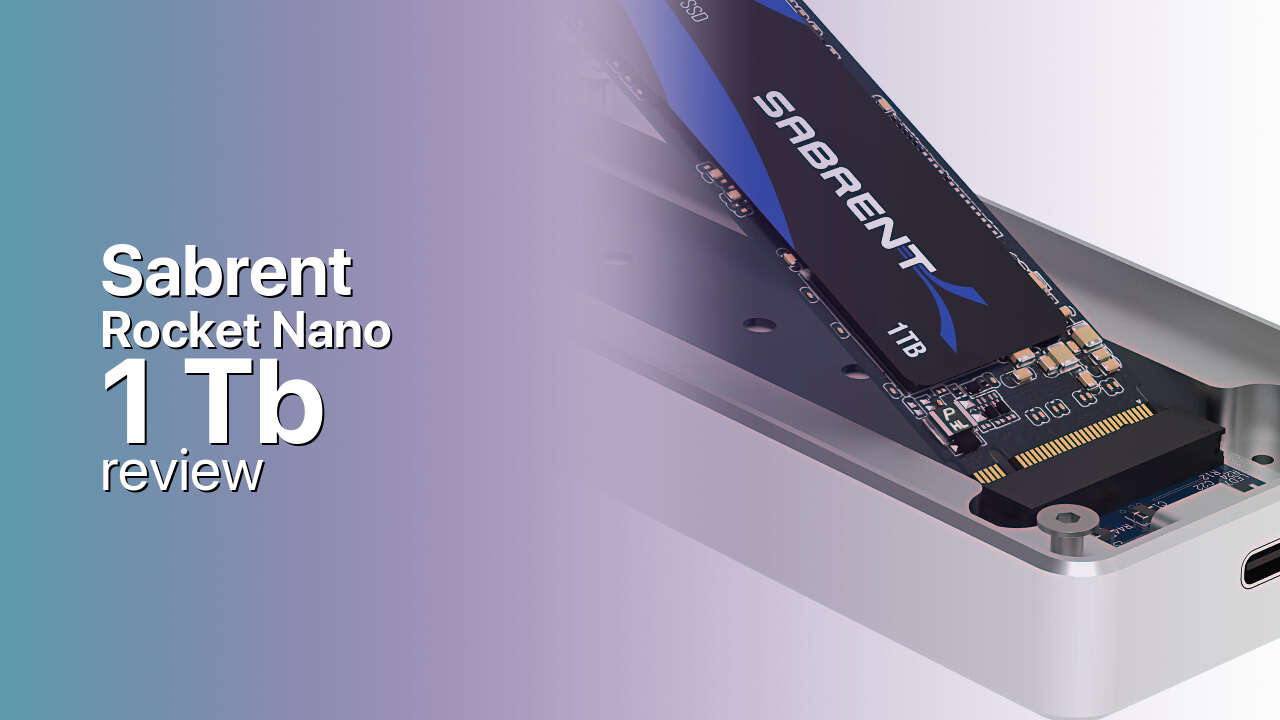
The Sabrent Rocket Nano is built on the Phison E13T, a 4-channel PCIe 3.0 x4 controller designed for compact, DRAM-less SSDs using host memory buffer (HMB) technology instead of a dedicated DRAM chip. The NAND is Kioxia (formerly Toshiba) 96-layer 3D TLC. The drive's defining feature is its M.2 2242 form factor — 22 mm wide by 42 mm long, exactly half the length of standard M.2 2280 drives. This targets a specific niche: compact business laptops (Lenovo ThinkPad, Dell Latitude), mini PCs, and some handheld gaming devices that use shorter M.2 slots and historically had very limited SSD upgrade options.
The 1 TB variant is the mid-point of the Rocket Nano lineup, sitting between the 512 GB entry model and the 2 TB flagship. At 1 TB, the Nano provides enough capacity to serve as a primary drive — fitting an OS, applications, and a reasonable game or media library without the storage anxiety of smaller capacities. The single-sided PCB is essential for the 2242 form factor, as many 2242 slots have tight vertical clearance. The DRAM-less E13T controller keeps power consumption low, benefiting battery life in mobile devices. Sabrent backs the drive with a 5-year warranty after product registration.
The key consideration with any 2242 drive is the host system's M.2 slot wiring. Many 2242 slots in older compact laptops are electrically limited to PCIe 3.0 x2 rather than x4, which would cap the Rocket Nano's throughput at roughly half its rated speed. Before purchasing, verify your system's M.2 slot supports PCIe 3.0 x4 to get full performance from the drive.
Storage Comparisons:
Rocket Nano Performance & Benchmarks
Sabrent rates the Rocket Nano 1 TB at 2,500 MB/s sequential reads and 2,100 MB/s sequential writes — figures that saturate the Phison E13T controller's 4-channel PCIe 3.0 x4 ceiling. These speeds are competitive with standard M.2 2280 mid-range drives and represent a dramatic upgrade over the low-performance OEM 2242 SSDs found in most compact systems. The 1 TB capacity ensures a healthy SLC write cache — typically 100 GB or more depending on free space — which keeps burst writes at full speed for everyday consumer workloads.
Sabrent Rocket Nano 1 TB vs M.2 3.0 x 4 peers
Switch between sequential throughput and random IOPS to see how this drive stacks up against other M.2 3.0 x 4 SSDs in our database. The highlighted bar is the drive on this page — click any other bar to open that drive.
- ADATA SX 8800 Pro 512 GB: 3,500 MB/s read, 2,700 MB/s write
- ADATA SX 8800 Pro 1 TB: 3,500 MB/s read, 2,700 MB/s write
- ADATA XPG Spectrix S40G RGB 256 GB: 3,500 MB/s read, 3,000 MB/s write
- ADATA XPG Spectrix S40G RGB 512 GB: 3,500 MB/s read, 3,000 MB/s write
- Sabrent Rocket Nano 1 TB (this drive): 2,500 MB/s read, 2,100 MB/s write
In practice, the 1 TB Nano handles OS duties, application launches, and game loads without calling attention to its compact form factor. The DRAM-less HMB design means random read latency at low queue depths is slightly higher than DRAM-equipped alternatives, but the difference is subtle in typical desktop use. Sustained sequential writes will eventually exhaust the SLC cache, at which point speeds drop to the native TLC write rate. For an OS and general-purpose drive in a compact system, this is an uncommon scenario. The single-sided design and modest power draw keep thermals within safe limits even in the confined spaces typical of 2242 installations. The 1 TB model's larger NAND pool and SLC cache give it a sustained performance edge over the 512 GB variant for users who regularly move large files.
Sabrent Rocket Nano vs Competitors
See how the Rocket Nano stacks up against other M.2 3.0 x 4 drives in our database:
Compare with rival drives:
Endurance, TBW & Warranty
Sabrent provides a 5-year limited warranty on the Rocket Nano after product registration — matching the coverage on their full-sized Rocket drives. Sabrent does not publish a specific TBW endurance rating for the Rocket Nano series. As a general guideline, 96-layer Kioxia TLC SSDs at 1 TB typically carry endurance ratings in the 400–600 TBW range, though this is an estimate. At a typical consumer workload of 30 GB per day, even a conservative 400 TBW rating translates to roughly 36 years of use. The DRAM-less design may slightly increase write amplification compared to DRAM-equipped drives, but for the light-to-moderate workloads typical of the compact systems these drives serve, endurance is unlikely to be a practical concern within or well beyond the warranty period.
Sabrent Rocket Nano 1 TB Specifications
| Category | Value |
|---|---|
| Capacity [?] | 1 TB |
| Interface [?] | M.2 3.0 x 4 |
| Controller [?] | Phison PS5013-E13 |
| Memory type [?] | Toshiba TLC |
| DRAM [?] | HMB |
| Read speed (MB/s) [?] | 2500 |
| Write speed (MB/s) [?] | 2100 |
| Read IOPS [?] | 295000 |
| Write IOPS [?] | 430000 |
| Endurance (TBW) [?] | 720 |
| MTBF (million hours) [?] | 1800000 |
| Warranty (years) [?] | 5 |
Verdict: Is the Rocket Nano Worth It in 2026?
The Sabrent Rocket Nano 1 TB solves a real problem: finding a competent, high-capacity retail NVMe SSD for M.2 2242-only systems. If you own a compact laptop or mini PC with a 2242 slot, the 1 TB Nano is arguably the sweet spot of the lineup — enough capacity for a primary drive, competitive PCIe 3.0 performance, and Sabrent's 5-year warranty. The jump from a typical 256 GB OEM 2242 drive to a 1 TB Rocket Nano transforms both capacity and speed. Skip it if your system has a standard 2280 slot — you can get PCIe 4.0 performance and more capacity for less money from a full-sized drive. Skip it also if your 2242 slot is wired for only PCIe 3.0 x2 — the Nano's extra bandwidth will be wasted. For the right compact system, the Rocket Nano 1 TB is a purpose-built upgrade that fills a niche few other retail drives address.
+ Pros
- M.2 2242 form factor — fits compact laptops and mini PCs
- 1 TB capacity viable as a primary drive
- 2,500 MB/s reads — competitive with 2280 mid-range drives
- Single-sided PCB — compatible with tight 2242 clearances
- Kioxia 96-layer 3D TLC — mature and reliable NAND
- 5-year warranty after product registration
- Cons
- DRAM-less HMB design limits sustained write performance
- Limited to PCIe 3.0 x4 — not PS5 compatible
- No published TBW endurance rating
- More expensive per GB than equivalent 2280 drives
- Older E13T controller — newer 2242 drives offer PCIe 4.0
Buy this or similar SSD Storage:



Video Review
Sabrent Rocket Nano 1TB USB 3.2 NVMe Unboxing