Addlink S68 512GB — Phison E13T PCIe 3.0 NVMe SSD (2026)
Quick answer
The Addlink S68 512 GB earns a recommendation for buyers who prioritize controller pedigree and warranty length in a budget PCIe 3.0 NVMe drive.
Read: 2100 MB/s Write: 1700 MB/s Endurance: 400 TBW Warranty: 5 years Interface: M.2 3.0 x 4
The Addlink S68 512GB separates itself from the budget pack with a Phison E13T controller, 3D TLC NAND, and a 5-year warranty — a combination that was rare in the entry-level PCIe 3.0 segment when the drive launched.
Controller & Memory
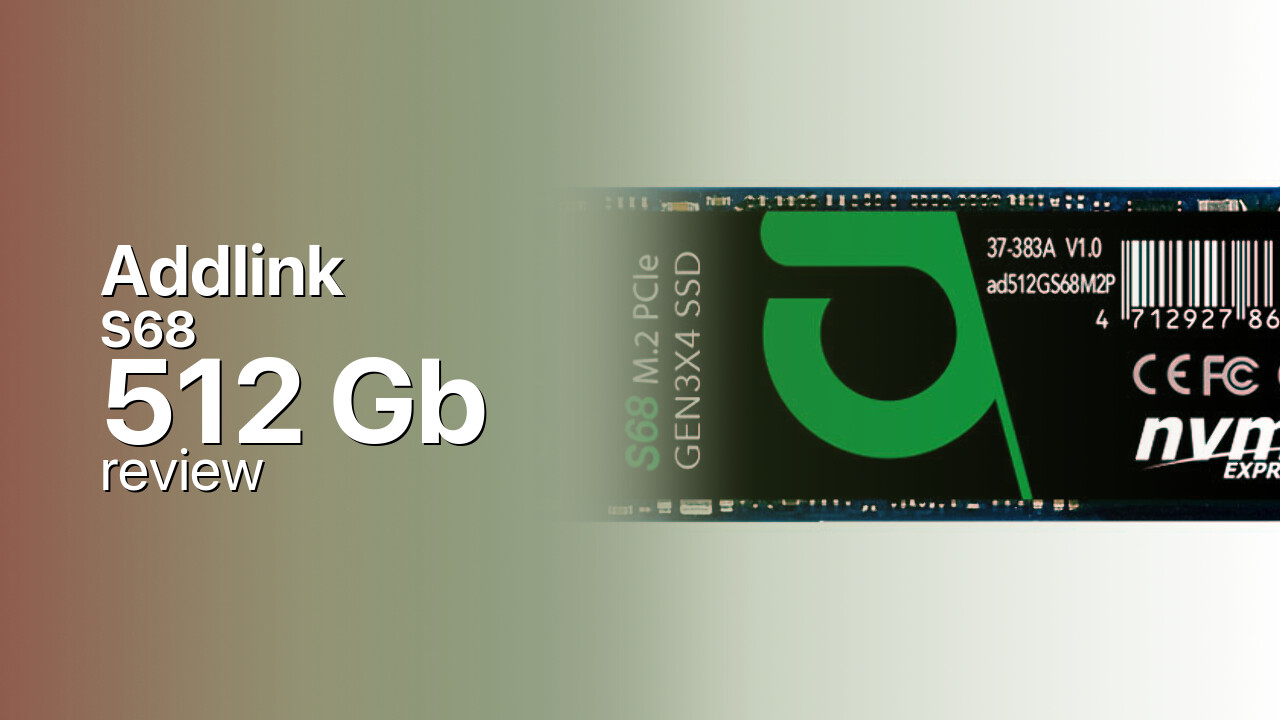
The Addlink S68 is an entry-level M.2 2280 NVMe SSD built around the Phison PS5013-E13T controller — a DRAM-less, four-channel design that leverages the Host Memory Buffer (HMB) to borrow system RAM for its mapping table. The NAND is 3D TLC, which gives the S68 a meaningful endurance and sustained-write advantage over QLC-based alternatives at similar price points. Addlink offered the S68 in three capacities — 256 GB, 512 GB, and 1 TB — with sequential speeds scaling upward through the stack. The PCB is single-sided, so it fits in thin laptops and any standard M.2 slot without clearance issues.
The 512 GB variant is rated at up to 2,100 MB/s sequential reads and 1,700 MB/s sequential writes, with the 1 TB model stepping up to 2,500 MB/s reads and 2,100 MB/s writes. The 256 GB entry point is slower still at 2,000 MB/s reads and 1,200 MB/s writes — a clear illustration of how NAND parallelism scales with capacity in DRAM-less designs. The 512 GB capacity hits a practical sweet spot: formatted to roughly 476 GB in Windows, it provides enough room for the operating system, a solid application suite, and a modest game or media library without the price premium of 1 TB.
The S68 competes in the crowded entry-level PCIe 3.0 segment against drives like the WD Blue SN550, Crucial P2, and Kingston A2000. The Phison E13T controller is the headline differentiator — it is a known quantity with mature firmware, which is more than can be said for the commodity controllers in many competing budget drives. The 5-year warranty is another standout at this price tier, matching the coverage on drives that cost significantly more. Where the S68 gives ground is peak throughput: the Blue SN550 and A2000 push reads past 2,200 MB/s on their 500 GB-class variants, and both publish detailed endurance specifications that Addlink does not prominently surface.
Storage Comparisons:
S68 Performance & Benchmarks
The 512 GB Addlink S68 is rated at up to 2,100 MB/s sequential reads and 1,700 MB/s sequential writes on the PCIe 3.0 x4 interface, with random performance of up to 295,000 IOPS read and 430,000 IOPS write. These numbers reflect the Phison E13T controller operating within its design envelope — the E13T is a capable budget platform, but it is not a flagship PCIe 3.0 controller and does not approach the 3,500 MB/s ceiling that drives like the Samsung 970 EVO Plus reach on the same interface.
Addlink S68 512 GB vs M.2 3.0 x 4 peers
Switch between sequential throughput and random IOPS to see how this drive stacks up against other M.2 3.0 x 4 SSDs in our database. The highlighted bar is the drive on this page — click any other bar to open that drive.
- ADATA SX 8800 Pro 512 GB: 3,500 MB/s read, 2,700 MB/s write
- ADATA SX 8800 Pro 1 TB: 3,500 MB/s read, 2,700 MB/s write
- ADATA XPG Spectrix S40G RGB 256 GB: 3,500 MB/s read, 3,000 MB/s write
- ADATA XPG Spectrix S40G RGB 512 GB: 3,500 MB/s read, 3,000 MB/s write
- Addlink S68 512 GB (this drive): 2,100 MB/s read, 1,700 MB/s write
The 3D TLC NAND paired with the E13T provides predictable sustained write performance once the SLC write cache fills. Unlike QLC-based budget drives that can drop below 100 MB/s after cache exhaustion, the S68 settles at TLC native speeds typically above 500 MB/s — still a meaningful step down from the cached burst rate, but fast enough to keep large file transfers and game installs moving at an acceptable pace. The DRAM-less HMB architecture adds negligible latency for boot-drive workloads, though users running heavy multitasking or database operations may notice the difference versus a DRAM-equipped alternative.
For its intended use — a system disk in a budget or mid-range desktop, or an upgrade from SATA in an older laptop — the S68 delivers the core NVMe experience without the pitfalls of QLC. Independent benchmarking of the E13T platform consistently shows it punching above its weight class in mixed real-world workloads, trading raw sequential throughput for strong consistency under sustained use.
Addlink S68 vs Competitors
See how the S68 stacks up against other M.2 3.0 x 4 drives in our database:
Compare with rival drives:
Endurance, TBW & Warranty
Addlink backs the S68 with a 5-year limited warranty, which is a genuine standout in the entry-level PCIe 3.0 segment where 3-year coverage is far more common. Third-party databases rate the 512 GB model at 400 TBW endurance, though Addlink's own product pages have not consistently published this figure. If accurate, 400 TBW for a 512 GB drive works out to roughly 800 TBW per terabyte — an above-average ratio for the price tier that reflects the 3D TLC NAND's write endurance characteristics. At a typical daily write load of 20 to 30 GB, the drive would last 36 to 55 years before approaching the TBW ceiling, well past practical relevance. The MTBF is rated at 1.5 million hours, a population-level statistic. Warranty claims are handled through Addlink's RMA process; the 5-year window runs from the original purchase date.
Addlink S68 512 GB Specifications
| Category | Value |
|---|---|
| Capacity [?] | 512 GB |
| Interface [?] | M.2 3.0 x 4 |
| Controller [?] | Phison E13T |
| Memory type [?] | 3D TLC |
| DRAM [?] | HMB |
| Read speed (MB/s) [?] | 2100 |
| Write speed (MB/s) [?] | 1700 |
| Read IOPS [?] | 295000 |
| Write IOPS [?] | 430000 |
| Endurance (TBW) [?] | 400 |
| MTBF (million hours) [?] | 1.5 |
| Warranty (years) [?] | 5 |
Verdict: Is the S68 Worth It in 2026?
The Addlink S68 512 GB earns a recommendation for buyers who prioritize controller pedigree and warranty length in a budget PCIe 3.0 NVMe drive. The Phison E13T platform is a proven quantity, the 3D TLC NAND avoids the QLC write-cliff penalty, and the 5-year warranty is unusually generous for this price bracket. It is best suited as a system drive in a budget or mid-range build, or as a secondary game-storage SSD. Skip it if peak sequential throughput is the priority — the WD Blue SN550 and Kingston A2000 both offer faster reads on their 500 GB-class variants, and both publish endurance specifications directly. The S68's main weakness is documentation: Addlink has not consistently published the TBW rating or NAND vendor details that competing manufacturers list on their product pages. For the buyer who can live with that information gap in exchange for the Phison controller and 5-year warranty, the S68 512 GB delivers a well-balanced entry-level NVMe experience.
+ Pros
- Phison E13T controller with mature, proven firmware
- 3D TLC NAND avoids QLC write-speed penalties
- 5-year warranty, uncommon at this price point
- 2,100 MB/s reads, a clear upgrade from SATA III
- Single-sided M.2 2280 PCB fits thin laptops
- Above-average endurance for an entry-level NVMe
- Cons
- Endurance TBW not prominently published by Addlink
- Peak reads trail competing WD Blue SN550 500 GB
- No dedicated DRAM cache, HMB-only architecture
- Brand support infrastructure less established than WD or Kingston
Buy this or similar SSD Storage:



Video Review
Best Budget SSD ? addlink S70 M.2 NVME SSD Test