Kioxia XG6 256GB SSD Review (2026)
Quick answer
The Kioxia XG6 256 GB is a solid choice if you are upgrading a laptop that came with this drive preinstalled, or if you find a surplus OEM unit at a compelling price.
Read: 3180 MB/s Write: 2960 MB/s Endurance: 200 TBW Warranty: 5 years Interface: M.2 3.0 x 4
The Kioxia XG6 256 GB is a capable PCIe 3.0 NVMe drive that introduced the company's 96-layer BiCS4 TLC NAND to the OEM market, offering competitive performance in a single-sided M.2 2280 package ideal for thin laptops and compact desktops.
Controller & Memory
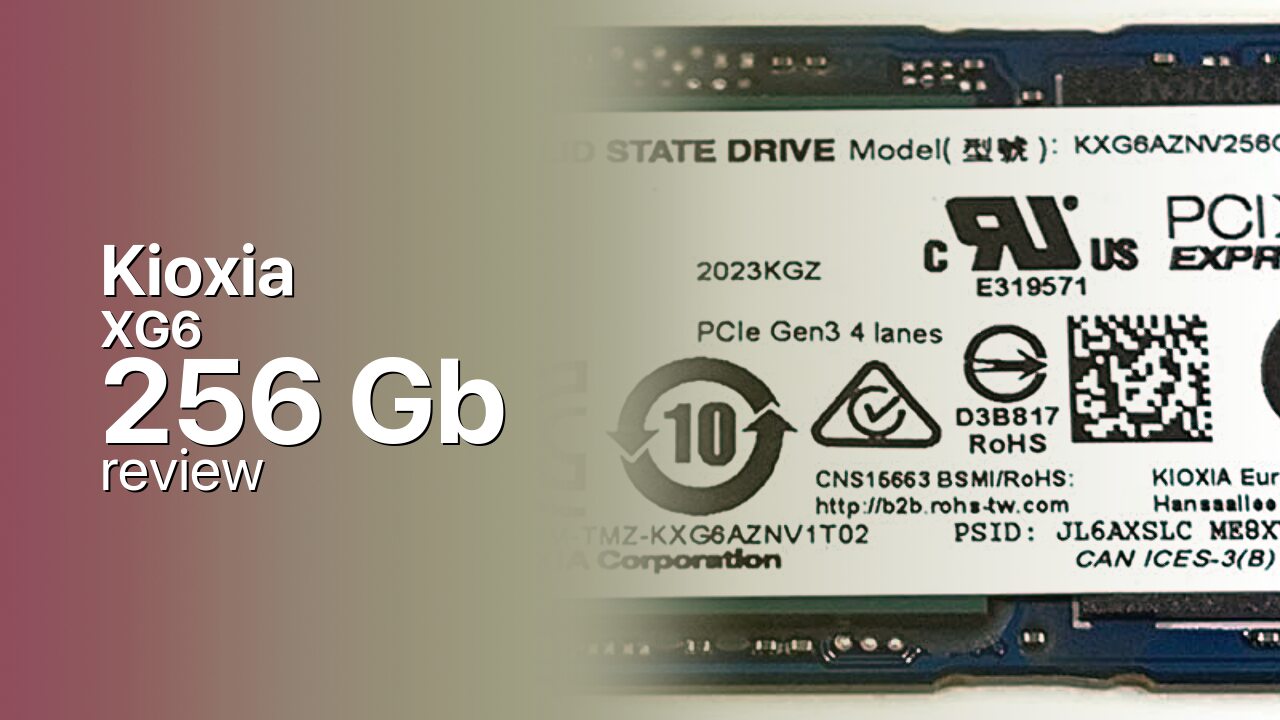
Inside the XG6 256 GB sits Kioxia's (formerly Toshiba) TC58NCP090GSB 8-channel controller, the same silicon used across the XG5 and XG5-P generations. The key upgrade is the NAND: this was the first SSD to ship with Kioxia's 96-layer BiCS4 3D TLC, offering 40% higher density per die compared to the previous 64-layer BiCS3. The 256 GB variant uses a single-sided M.2 2280 PCB with DRAM cache—a critical feature missing from many budget NVMe drives at this capacity point.
The drive targets the OEM market, so you'll typically find it preinstalled in performance laptops, all-in-one PCs, and slim desktops rather than sold at retail under the Kioxia brand. Retail equivalents like the Kingston KC2000 use the same platform. The single-sided design is particularly valuable for laptops with restricted M.2 slot heights, and the absence of a heatsink means it fits easily in cramped spaces. The 256 GB capacity point serves best as a boot and application drive rather than bulk storage.
Competitors in this PCIe 3.0 tier include the Samsung 970 EVO, WD Blue SN570, and Crucial P5. The XG6 trades blows with these drives in sequential throughput but distinguishes itself with its Toggle 3.0 NAND interface, boosting internal transfer speeds from 533 MT/s (Toggle 2.0) to up to 800 MT/s. In real-world use, the drive excels at large file transfers and boots quickly, though smaller-capacity TLC drives inevitably show weaker sustained write performance once their SLC cache exhausts.
Storage Comparisons:
XG6 Performance & Benchmarks
Kioxia rates the 256 GB XG6 at up to 3,180 MB/s sequential reads and 2,960 MB/s sequential writes over a PCIe 3.1 x4 (NVMe 1.3a) interface. Random 4K performance is listed at up to 355,000 IOPS reads and 365,000 IOPS writes. Independent testing of the 1 TB variant largely confirms these figures, with ATTO benchmarks hitting 3,255 MB/s reads and 3,026 MB/s writes. Queue depth 1 performance—a better proxy for real-world consumer workloads—shows the XG6 performing competitively against other PCIe 3.0 drives.
Kioxia XG6 256 GB vs M.2 3.0 x 4 peers
Switch between sequential throughput and random IOPS to see how this drive stacks up against other M.2 3.0 x 4 SSDs in our database. The highlighted bar is the drive on this page — click any other bar to open that drive.
- ADATA SX 8800 Pro 512 GB: 3,500 MB/s read, 2,700 MB/s write
- ADATA SX 8800 Pro 1 TB: 3,500 MB/s read, 2,700 MB/s write
- ADATA XPG Spectrix S40G RGB 256 GB: 3,500 MB/s read, 3,000 MB/s write
- ADATA XPG Spectrix S40G RGB 512 GB: 3,500 MB/s read, 3,000 MB/s write
- Kioxia XG6 256 GB (this drive): 3,180 MB/s read, 2,960 MB/s write
Like most TLC-based NVMe SSDs, the XG6 employs an SLC caching scheme to accelerate burst writes. The cache size scales with capacity, so the 256 GB model has a smaller buffer than the 512 GB and 1 TB variants. Once the SLC cache fills, sustained write speeds drop. For typical use cases—OS boot, application launches, game loads, and occasional large file copies—this degradation is rarely noticeable. However, sustained multi-gigabyte writes (such as video editing scratch disk operations or frequent backup transfers) will see performance taper off as the cache exhausts. The drive shows strong recovery characteristics in PCMark 8's consistency tests, bouncing back quickly after intensive workloads.
Kioxia XG6 vs Competitors
See how the XG6 stacks up against other M.2 3.0 x 4 drives in our database:
Compare with rival drives:
Endurance, TBW & Warranty
Kioxia backs the XG6 series with a 5-year warranty, matching the standard set by most consumer and OEM SSD vendors. The manufacturer does not publicly list a TBW (terabytes written) endurance rating for the 256 GB variant on the original specification sheet—a notable omission, as most competitors publish explicit TBW figures. The MTBF rating is 1.5 million hours, a population-level statistic indicating projected reliability under typical workloads rather than a guarantee for any individual drive.\n\nWithout a published TBW, endurance estimation relies on general TLC NAND behavior. A 256 GB TLC drive with similar write amplification typically lasts well beyond the warranty period under consumer workloads. At a conservative 40 GB per day of writes—well above what most users generate—you would expect the drive to endure for years. Professional users with heavy write workloads should consider drives with explicit endurance ratings. The RMA process for OEM drives can be more complex than retail equivalents, as warranty claims typically route through the system integrator rather than directly to Kioxia.
Kioxia XG6 256 GB Specifications
| Category | Value |
|---|---|
| Capacity [?] | 256 GB |
| Interface [?] | M.2 3.0 x 4 |
| Controller [?] | Toshiba TC58NCP090GSB |
| Memory type [?] | Toshiba TLC |
| DRAM [?] | DRAM cache (LPDDR3) |
| Read speed (MB/s) [?] | 3180 |
| Write speed (MB/s) [?] | 2960 |
| Read IOPS [?] | 355000 |
| Write IOPS [?] | 365000 |
| Endurance (TBW) [?] | 200 |
| MTBF (million hours) [?] | 1.5 |
| Warranty (years) [?] | 5 |
Verdict: Is the XG6 Worth It in 2026?
The Kioxia XG6 256 GB is a solid choice if you are upgrading a laptop that came with this drive preinstalled, or if you find a surplus OEM unit at a compelling price. The combination of 96-layer BiCS4 NAND, a DRAM cache, and single-sided design makes it particularly well-suited for thin laptops and compact builds where space is at a premium. Skip it if you are building a new desktop from scratch—retail PCIe 4.0 options like the WD Black SN770 or Samsung 980 Pro offer significantly better performance for not much more money. Consider the Samsung 970 EVO or Crucial P5 as direct retail alternatives if you need a PCIe 3.0 drive with explicit warranty support.
+ Pros
- 3,180 MB/s sequential read speeds
- DRAM cache for consistent performance
- Single-sided M.2 2280 design fits thin laptops
- 96-layer BiCS4 TLC NAND for improved density
- 5-year warranty coverage
- Strong recovery after intensive workloads
- Cons
- No published TBW endurance rating
- OEM-focused with limited retail availability
- Smaller SLC cache on 256 GB variant
- PCIe 3.0 limits ceiling vs PCIe 4.0 competition
Buy this or similar SSD Storage:



Video Review
SSD диск KIOXIA (Toshiba) M.2 XG6 256Gb KXG60ZNV256GBTYLGA