The Sweet Spot: Peak T705 Read Speeds at a Practical Capacity (2026)
Quick answer
The Crucial T705 2TB offers the strongest combination of capacity and peak sequential performance in the T705 lineup.
Read: 14500 MB/s Write: 12700 MB/s Endurance: 1200 TBW Warranty: 5 years Interface: M.2 5.0
The Crucial T705 2TB reaches 14,500 MB/s sequential reads — the highest figure in the T705 lineup — by running Phison's eight-channel PS5026-E26 controller across a NAND configuration where die count and channel distribution align for maximum throughput.
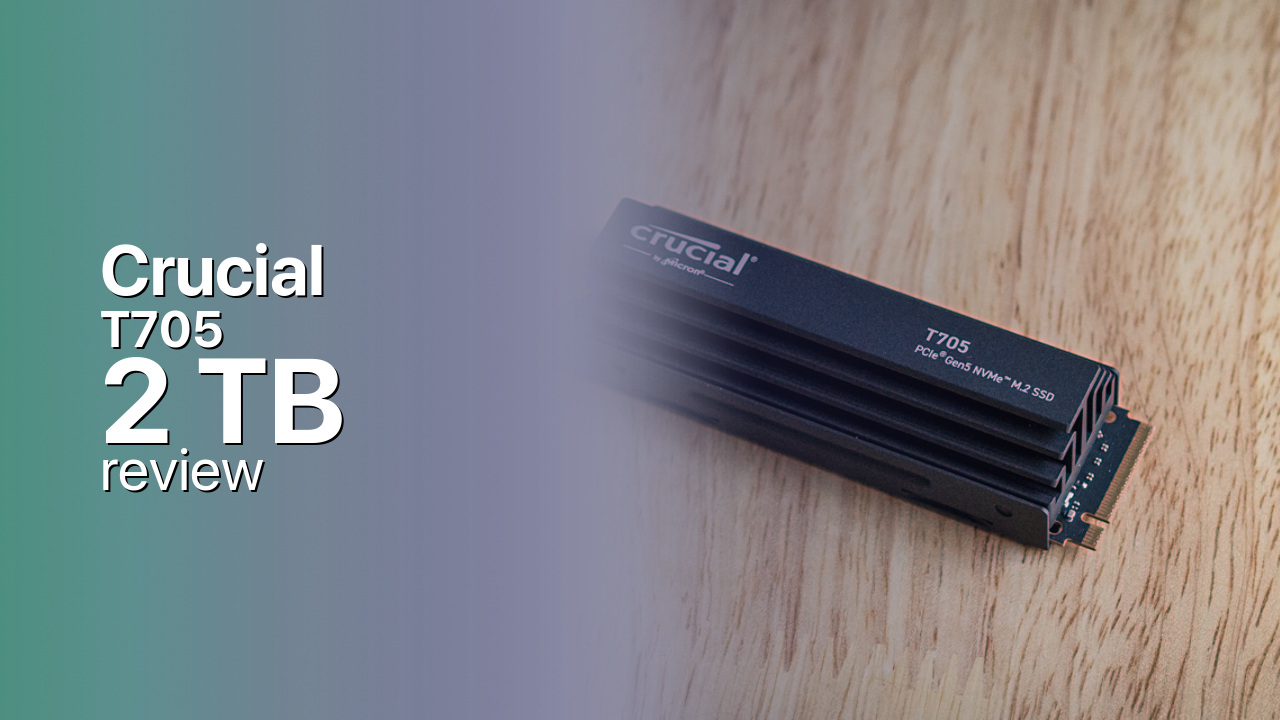
Controller & Memory
The 2TB T705 holds a specific place in Crucial's PCIe 5.0 lineup: it is the capacity at which the drive achieves its highest rated sequential reads. At 14,500 MB/s reads and 12,700 MB/s writes, it outperforms both the 1TB (13,600/10,200 MB/s) and the 4TB (14,100/12,600 MB/s). This pattern is common in multi-channel NVMe SSDs — the mid-range capacity often achieves the best throughput because the NAND die count distributes optimally across all eight controller channels, enabling maximum parallelism.
The foundation is the Phison PS5026-E26, the 8-channel PCIe 5.0 controller that has powered the fastest consumer drives since 2023. Crucial pairs it with Micron 232-layer B58R 3D TLC NAND — a first-party die, given that Crucial is Micron's consumer brand. That vertical integration matters for consistency: the NAND and controller combination has been reviewed extensively across multiple drive brands using the same platform, and the reliability profile is well-established. Dedicated DRAM keeps the drive off the Host Memory Buffer path, which maintains low latency random I/O regardless of available system RAM.
Crucial offers the 2TB T705 in three configurations: a bare drive (CT2000T705SSD3), a standard heatsink SKU (CT2000T705SSD5), and a limited edition white heatsink (CT2000T705SSD5A). PCIe 5.0 SSDs run warmer than PCIe 4.0 drives under sustained load; the heatsink SKU is practical for systems without a quality M.2 thermal cover on the motherboard. All three fit the standard M.2 2280 form factor.
At this capacity, the T705 competes with the Corsair MP700 PRO SE 2TB at the high end of the PCIe 5.0 tier, and positions comfortably above the Samsung 990 Pro 2TB and WD Black SN850X 2TB on the PCIe 4.0 side. The PCIe 5.0 speed advantage over PCIe 4.0 is most tangible in sustained sequential transfers — large video file copies, drive-to-drive migrations, game library moves — where the doubling of bandwidth translates directly into halved transfer time.
Storage Comparisons:
T705 Performance & Benchmarks
Crucial rates the T705 2TB at 14,500 MB/s sequential reads and 12,700 MB/s sequential writes — the fastest specifications in the T705 family. Random performance is specified at 1,550,000 read IOPS and 1,800,000 write IOPS at queue depth 32. Tom's Hardware's 2024 review of the 2TB model described it as the fastest consumer SSD available at that time, with sequential benchmarks matching or exceeding the rated speeds.
Crucial T705 2 TB vs M.2 5.0 peers
Switch between sequential throughput and random IOPS to see how this drive stacks up against other M.2 5.0 SSDs in our database. The highlighted bar is the drive on this page — click any other bar to open that drive.
- Corsair MP700 Pro XT 1 TB: 14,900 MB/s read, 14,200 MB/s write
- Corsair MP700 Pro XT 2 TB: 14,900 MB/s read, 14,500 MB/s write
- Corsair MP700 Pro XT 4 TB: 14,900 MB/s read, 14,400 MB/s write
- Crucial T710 1 TB: 14,900 MB/s read, 13,800 MB/s write
- Crucial T705 2 TB (this drive): 14,500 MB/s read, 12,700 MB/s write
The 2TB model's write speed advantage over the 1TB is meaningful in practice. Sequential write operations at 12,700 MB/s versus 10,200 MB/s represent a 25 percent improvement — perceptible in large file copy operations. Compared to the 4TB model (12,600 MB/s write), the difference is marginal. The read speed advantage over the 4TB (14,500 vs 14,100 MB/s) is a 3 percent difference that is difficult to detect outside synthetic benchmarks.
Random IOPS at low queue depths are strong across all queue depths, with the dedicated DRAM cache ensuring consistent latency that HMB-based designs cannot match under concurrent I/O. Under sustained sequential writes that exhaust the SLC write cache — copying many hundreds of gigabytes in a single session — throughput drops to direct TLC write speeds, which is normal behavior for all TLC-based SSDs at any PCIe generation. The 2TB NAND pool provides a proportionally larger SLC cache than the 1TB model, making cache exhaustion less likely under typical workloads.
Full performance requires a PCIe 5.0 x4 M.2 slot; in a PCIe 4.0 host the drive operates at PCIe 4.0 speeds, roughly 7,000 MB/s sequential reads.
Crucial T705 vs Competitors
See how the T705 stacks up against other M.2 5.0 drives in our database:
Compare with rival drives:
Endurance, TBW & Warranty
The Crucial T705 2TB is covered by a five-year limited warranty from the date of original purchase, with a 1,200 TBW endurance rating on the 2TB model. The warranty is governed by whichever limit is reached first — five years of ownership or 1,200 TBW written. At 1,200 TBW, the drive accommodates up to 240 TB written per year across the warranty period. A user writing 100 GB per day — a demanding workload covering heavy gaming installs, video editing scratch, and regular system backups — accumulates roughly 36 TB per year, reaching the TBW threshold in approximately 33 years. Even at 500 GB written daily, the endurance budget lasts over six years. For the vast majority of buyers, the five-year warranty expiration is the governing limit, not the TBW figure. MTBF is rated at 2 million hours.
Crucial T705 2 TB Specifications
| Category | Value |
|---|---|
| Capacity [?] | 2 TB |
| Interface [?] | M.2 5.0 |
| Controller [?] | Phison PS5026-E26 8 channel |
| Memory type [?] | Micron 232-L B58R 3D TLC |
| DRAM [?] | Yes |
| Read speed (MB/s) [?] | 14500 |
| Write speed (MB/s) [?] | 12700 |
| Read IOPS [?] | 1550000 |
| Write IOPS [?] | 1800000 |
| Endurance (TBW) [?] | 1200 |
| MTBF (million hours) [?] | 2000000 |
| Warranty (years) [?] | 5 |
Verdict: Is the T705 Worth It in 2026?
The Crucial T705 2TB offers the strongest combination of capacity and peak sequential performance in the T705 lineup. It reaches the highest read speeds of any T705 variant, provides a substantial sequential write speed improvement over the 1TB entry, and does so at a capacity that is genuinely useful for a primary NVMe drive in a gaming PC, workstation, or content creation system. The five-year warranty and 1,200 TBW endurance rating are strong for a consumer drive at this tier.
Buyers who should look at the 1TB instead: those who need the lowest PCIe 5.0 price point and have modest storage needs. Those who should consider the 4TB: anyone whose primary concern is maximum capacity rather than peak performance. For most buyers upgrading a primary drive on a PCIe 5.0-capable platform, the 2TB T705 is the capacity where the platform performs at its best.
+ Pros
- 14,500 MB/s sequential reads — the highest in the T705 lineup, beating both the 1TB and 4TB models
- 12,700 MB/s sequential writes — 25 percent faster than the 1TB entry variant
- Phison PS5026-E26 8-channel controller with dedicated DRAM across all SKUs
- Micron 232-layer B58R TLC NAND — first-party integration with established reliability data
- 1,200 TBW endurance and five-year warranty — strong coverage for a 2TB consumer drive
- Available in bare drive, standard heatsink, and limited edition white heatsink configurations
- Cons
- Requires a PCIe 5.0 x4 M.2 slot for rated speeds; PCIe 4.0 systems will see roughly half the sequential throughput
- Sustained writes after SLC cache exhaustion drop to direct TLC write rates — expected for all TLC drives
- PCIe 5.0 thermal output requires a good motherboard M.2 heatsink or the heatsink SKU
- Price premium over the Samsung 990 Pro 2TB and WD Black SN850X 2TB is significant for workloads that stay within PCIe 4.0 bandwidth
- No published DRAM size from Crucial; estimated at 4GB based on the 2GB-per-TB E26 reference ratio
Buy this or similar SSD Storage:
Video Review
Faster than a 9100 PRO? - Crucial T705 Gen5 NVMe SSD Review