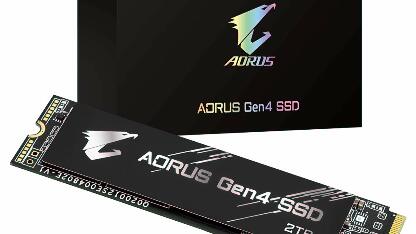
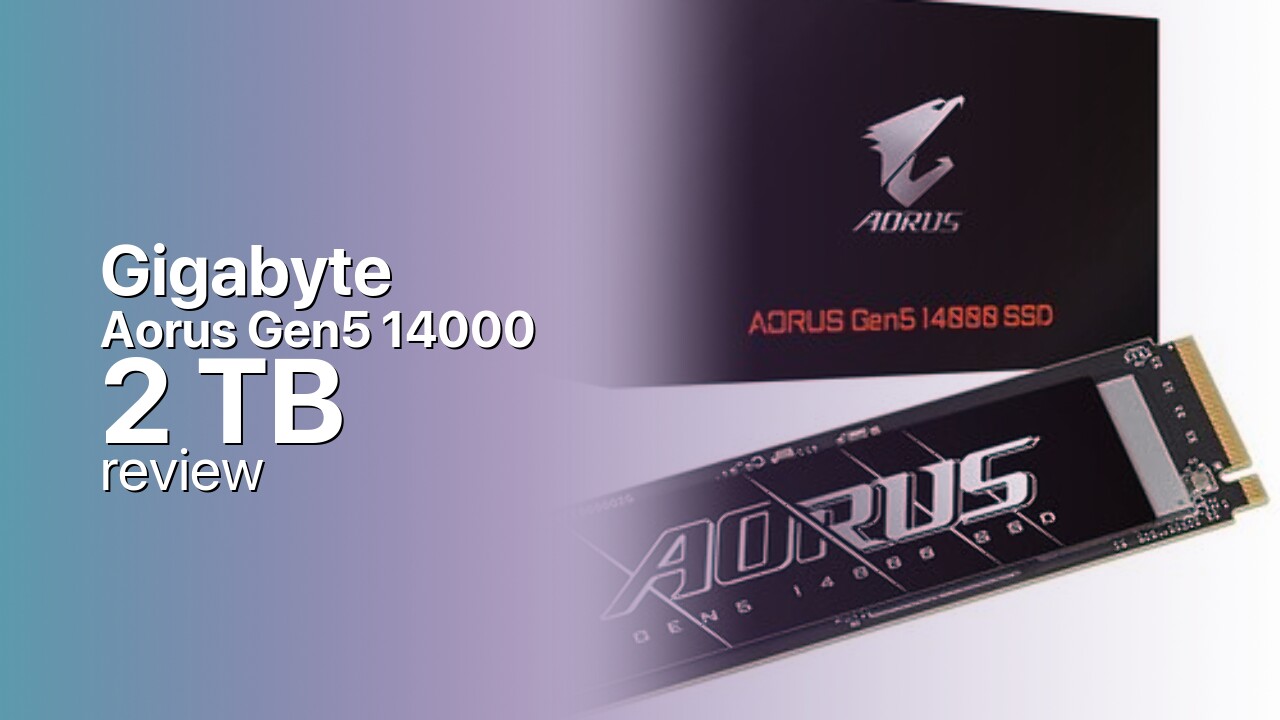
Gigabyte Aorus Gen5 14000 2TB PCIe 5.0 NVMe SSD Review (2026)
Quick answer
The 2 TB Aorus Gen5 14000 is the capacity we would actually buy in this lineup, since it carries the full 14,500 MB/s read and 12,700 MB/s write rating along with a healthy 1,400 TBW of endurance.
Read: 14500 MB/s Write: 12700 MB/s Endurance: 1400 TBW Warranty: 5 years Interface: M.2 5.0
The Gigabyte Aorus Gen5 14000 2 TB is the flagship capacity of Gigabyte's PCIe 5.0 lineup, hitting the drive's peak 14,500 MB/s read and 12,700 MB/s write ratings on the Phison E26 platform.
Controller & Memory
Inside the 2 TB Aorus Gen5 14000 sits the Phison PS5026-E26 controller, an eight-channel PCIe 5.0 design built on TSMC's 12 nm process, paired with Micron's 232-layer 3D TLC NAND. A 4 GB LPDDR4 DRAM buffer handles the flash translation layer, and the drive speaks NVMe 2.0 over a PCIe 5.0 x4 link. The drive ships bare, so you must pair it with a motherboard heatsink, an active M.2 fan, or a dedicated aftermarket cooler, as Gigabyte explicitly states in its spec sheet.
This 2 TB model is the capacity to buy if you want the full headline performance. Unlike the 1 TB variant, which drops to 10,200 MB/s writes, the 2 TB carries the complete 14,500 MB/s read and 12,700 MB/s write rating, and its 1,400 TBW endurance doubles the smaller capacity's 700 TBW. The 4 TB sibling scales endurance further to 3,000 TBW with nearly identical speeds, but at a steep capacity premium. For most enthusiasts and creators, the 2 TB is the sweet spot in the lineup.
The direct rivals at this tier are other first-wave PCIe 5.0 drives on the same E26 platform, namely the Crucial T705 and T700, the Corsair MP700 Pro, and the Inland TD510. Against Gen4 flagships like the Samsung 990 Pro and WD Black SN850X, the Aorus roughly doubles sequential bandwidth on paper, though for pure gaming the real-world gap is much narrower. Compatibility is limited to platforms with a physical PCIe 5.0 M.2 slot, which today means Intel 600-series and AMD 800-series chipsets, plus a handful of late 700-series boards.
Storage Comparisons:
Aorus Gen5 14000 Performance & Benchmarks
Gigabyte rates the 2 TB Aorus Gen5 14000 for up to 14,500 MB/s sequential reads and 12,700 MB/s sequential writes, which sits right at the PCIe 5.0 x4 interface ceiling. Random performance is rated up to 1.5 million read IOPS and roughly 1.5 million write IOPS, in line with other E26 drives on the same Micron 232-layer TLC platform, though Gigabyte does not publish an official IOPS figure on its spec page. Those random numbers are best-case QD32 figures, not what a single-queue desktop workload will actually see.
Gigabyte Aorus Gen5 14000 2 TB vs M.2 5.0 peers
Switch between sequential throughput and random IOPS to see how this drive stacks up against other M.2 5.0 SSDs in our database. The highlighted bar is the drive on this page — click any other bar to open that drive.
- Corsair MP700 Pro XT 1 TB: 14,900 MB/s read, 14,200 MB/s write
- Corsair MP700 Pro XT 2 TB: 14,900 MB/s read, 14,500 MB/s write
- Corsair MP700 Pro XT 4 TB: 14,900 MB/s read, 14,400 MB/s write
- Crucial T710 1 TB: 14,900 MB/s read, 13,800 MB/s write
- Gigabyte Aorus Gen5 14000 2 TB (this drive): 14,500 MB/s read, 12,700 MB/s write
In practice, the headline sequential gain over PCIe 4.0 shows up most clearly in large-file transfers and synthetic benchmarks. For OS boot, application launches, and game load times, the delta against a fast Gen4 drive like the Samsung 990 Pro is usually small, often within margin of error, because most current game engines are not yet bandwidth-bound on storage. Where PCIe 5.0 starts to matter is DirectStorage-enabled titles, large video scratch disks, and workstation workflows that move tens of gigabytes per pass. Like all E26 drives, the Aorus uses an SLC cache that holds burst speeds for a finite window and then drops to native TLC write rates once the cache fills, so sustained writes will settle below the 12,700 MB/s peak.
Gigabyte Aorus Gen5 14000 vs Competitors
See how the Aorus Gen5 14000 stacks up against other M.2 5.0 drives in our database:
Compare with rival drives:
Endurance, TBW & Warranty
Gigabyte covers the Aorus Gen5 14000 2 TB with a limited 5-year warranty, terminating at 1,400 TBW, whichever comes first. The TBW rating is evaluated under JEDEC workload standards, and the drive's SMART Percentage Used attribute (SMART ID 05) is what Gigabyte's SSD Toolbox watches to determine warranty status; hitting 100 percent means out of warranty. At a typical mixed consumer workload of roughly 20 to 50 GB of writes per day, 1,400 TBW translates into many decades of theoretical headroom, so for a boot drive or game library the calendar term rather than the endurance ceiling is what will expire first. The rated MTBF is 1.6 million hours, a population statistic rather than a per-drive guarantee. The warranty is handled direct through Gigabyte, not the retailer, and the drive must be used with a motherboard heatsink to stay within spec.
Gigabyte Aorus Gen5 14000 2 TB Specifications
| Category | Value |
|---|---|
| Capacity [?] | 2 TB |
| Interface [?] | M.2 5.0 |
| Controller [?] | Phison PS5026-E26 8 Channel |
| Memory type [?] | Micron 232-L TLC |
| DRAM [?] | Yes |
| Read speed (MB/s) [?] | 14500 |
| Write speed (MB/s) [?] | 12700 |
| Read IOPS [?] | 1500000 |
| Write IOPS [?] | 1500000 |
| Endurance (TBW) [?] | 1400 |
| MTBF (million hours) [?] | 2000000 |
| Warranty (years) [?] | 5 |
Verdict: Is the Aorus Gen5 14000 Worth It in 2026?
The 2 TB Aorus Gen5 14000 is the capacity we would actually buy in this lineup, since it carries the full 14,500 MB/s read and 12,700 MB/s write rating along with a healthy 1,400 TBW of endurance. It makes sense for an enthusiast building a fresh PCIe 5.0 platform who wants peak sequential bandwidth for large-file work, video scratch, or a DirectStorage-ready game library. Skip it if your motherboard only has PCIe 4.0 M.2 slots, or if your workload is mostly OS and gaming, where a Samsung 990 Pro or WD Black SN850X delivers nearly identical real-world feel for less. The Corsair MP700 Pro and Crucial T705 are the closest peers on the same E26 platform and are worth cross-shopping on price and bundled cooler. Overall, this is a strong flagship-class Gen5 drive that earns its premium only on a true PCIe 5.0 build.
+ Pros
- 14,500 MB/s sequential reads at PCIe 5.0 ceiling
- 12,700 MB/s sequential writes, full rating
- Phison E26 with Micron 232-layer TLC
- 4 GB LPDDR4 DRAM cache
- 5-year warranty with 1,400 TBW
- 1.6 million hour MTBF rating
- Cons
- Requires a motherboard heatsink, not included
- Needs a PCIe 5.0 platform to be useful
- Gen5 price premium over comparable Gen4
- SLC cache is finite for sustained writes
- Idle power higher than DRAM-less Gen4 drives
Buy this or similar SSD Storage:
Video Review
PCIe 5.0 элита от Gigabyte - обзор SSD AORUS Gen5 14000 2TB (AG514K2TB)