The Mainstream PCIe Gen 5 Drive for Gaming and Content Creation (2026)
Quick answer
The Crucial T710 2TB is the strongest option in the T710 range for most buyers: it delivers the drive's full 2.2 million IOPS in both directions, carries 2GB of DRAM, and offers 1,200 TBW of endurance at a capacity that fits a real gaming library or content creation workspace.
Read: 14500 MB/s Write: 13800 MB/s Endurance: 1200 TBW Warranty: 5 years Interface: M.2 5.0
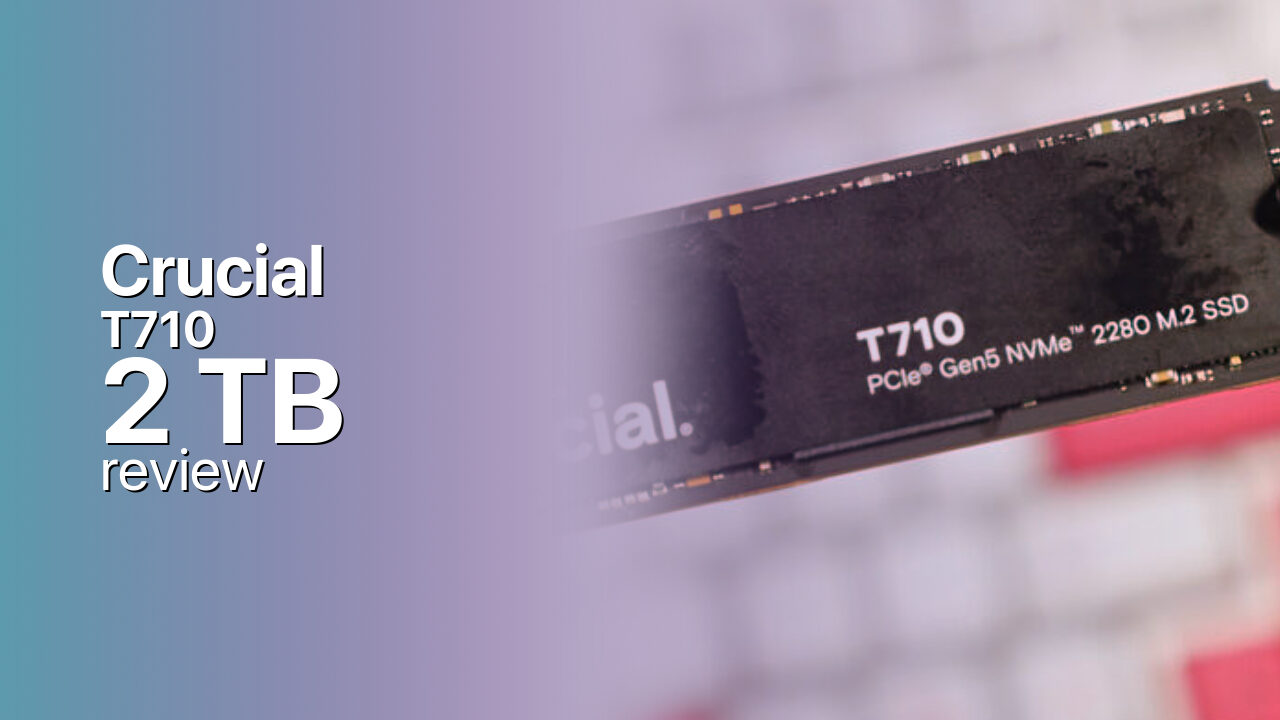
The Crucial T710 2TB pairs Micron's 276-layer G9 TLC NAND with the Silicon Motion SM2508 controller to reach 14,500 MB/s sequential reads and a full 2.2 million IOPS in both read and write directions.
Controller & Memory
The Crucial T710 2TB occupies the strongest position in the T710 range: it reaches the drive's full 2.2 million IOPS on both read and write, carries 2GB of LPDDR4-4266 DRAM, and provides 1,200 TBW of endurance — twice what the 1TB model offers. For a gaming system or content creation workstation where storage demands are high but not extreme, the 2TB is the natural choice.
The drive is built on Micron's G9 276-layer 3D TLC NAND, the newest flash generation in Micron's lineup at the time of launch. Competing PCIe 5.0 drives, including the Corsair MP700 Pro XT and the predecessor T705, use 232-layer B58R NAND. The additional layers allow each die to reach 3.6 GT/s IO speed — roughly 50% faster than the earlier generation — which the SM2508 controller's eight channels are designed to leverage. The result is that the T710 achieves its sequential speeds with fewer total dies than a comparable 232-layer design, contributing to an active power draw of 8.25 watts compared to the T705's 11.25 watts.
The SM2508 controller is manufactured on TSMC's 6nm process and supports NVMe 2.0, the L1.2 low-power state, AES-256 encryption with TCG Opal 2.01, and DirectStorage. The 2GB DRAM cache on the 2TB model doubles the mapping table capacity over the 1TB, maintaining low latency across both small random and large sequential workloads. At 2.2 million read IOPS and 2.2 million write IOPS, the 2TB reaches the T710's peak random performance — both directions equal, unlike the 1TB where write IOPS exceed read.
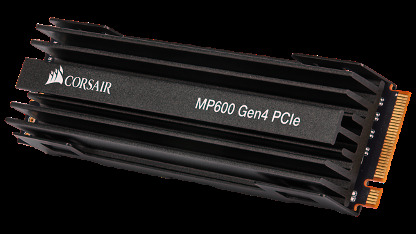
For gaming, the 2TB comfortably holds a modern game library alongside the operating system. Current AAA titles range from 50 to 150GB, placing 10 to 15 large games within reach at one time. For content creation, 14,500 MB/s sequential reads and 13,800 MB/s sequential writes handle 4K video project timelines, large asset libraries, and render scratch space without storage becoming a bottleneck. The Corsair MP700 Pro XT 2TB competes at a similar price with 14,000 MB/s reads. The ADATA XPG Legend 970 Pro 2TB matches the T710 on sequential read at 14,500 MB/s but trails on write at 13,000 MB/s. The predecessor T705 2TB also reaches 14,500 MB/s read but only 12,700 MB/s write, and uses the older 232-layer NAND throughout.
Storage Comparisons:
T710 Performance & Benchmarks
Crucial rates the T710 2TB at 14,500 MB/s sequential read and 13,800 MB/s sequential write. Random performance reaches 2.2 million read IOPS and 2.2 million write IOPS at QD32, representing the full rated IOPS capability of the SM2508 platform. This is a step above the 1TB, which is rated at 1.8 million read IOPS due to fewer NAND dies in parallel.
Crucial T710 2 TB vs M.2 5.0 peers
Switch between sequential throughput and random IOPS to see how this drive stacks up against other M.2 5.0 SSDs in our database. The highlighted bar is the drive on this page — click any other bar to open that drive.
- Corsair MP700 Pro XT 1 TB: 14,900 MB/s read, 14,200 MB/s write
- Corsair MP700 Pro XT 2 TB: 14,900 MB/s read, 14,500 MB/s write
- Corsair MP700 Pro XT 4 TB: 14,900 MB/s read, 14,400 MB/s write
- Crucial T710 1 TB: 14,900 MB/s read, 13,800 MB/s write
- Crucial T710 2 TB (this drive): 14,500 MB/s read, 13,800 MB/s write
The 14,500 MB/s sequential read figure is relevant for workloads that move large contiguous data: game installs from local network, video project source media, and disk image operations. Sequential write at 13,800 MB/s is meaningfully ahead of the T705 2TB's 12,700 MB/s and the Corsair MP700 Pro XT 2TB's 11,800 MB/s — that gap shows up in export times, large file copies, and capture-to-SSD workflows.
The 2GB LPDDR4-4266 DRAM cache provides sufficient mapping table coverage for the 2TB capacity, keeping 4K random read latency consistent under typical mixed workloads. Sustained write performance will eventually drop to NAND native speed once the SLC write cache fills, which is standard for TLC drives. At 2TB, the SLC cache region is larger than the 1TB, meaning cache exhaustion under continuous writes is less frequent in practice.
Crucial T710 vs Competitors
See how the T710 stacks up against other M.2 5.0 drives in our database:
Compare with rival drives:
Endurance, TBW & Warranty
Crucial covers the T710 2TB with a five-year limited warranty and an endurance rating of 1,200 TBW. At a content creator's daily write rate of 50 to 100GB, 1,200 TBW projects to 12 to 24 years of use — well beyond the warranty period. Endurance follows Crucial's standard 600 TBW per terabyte of capacity: 600 TBW on the 1TB and 2,400 TBW on the 4TB. The MTBF rating is 2,000,000 hours. The warranty covers manufacturing defects and drive failure within the endurance threshold. For gaming and content creation workflows that generate moderate to high daily writes, the 1,200 TBW on the 2TB model provides substantial headroom.
Crucial T710 2 TB Specifications
| Category | Value |
|---|---|
| Capacity [?] | 2 TB |
| Interface [?] | M.2 5.0 |
| Controller [?] | Silicon Motion SM2508 |
| Memory type [?] | Micron G9 276-L TLC |
| DRAM [?] | Yes |
| Read speed (MB/s) [?] | 14500 |
| Write speed (MB/s) [?] | 13800 |
| Read IOPS [?] | 2200000 |
| Write IOPS [?] | 2200000 |
| Endurance (TBW) [?] | 1200 |
| MTBF (million hours) [?] | 2000000 |
| Warranty (years) [?] | 5 |
Verdict: Is the T710 Worth It in 2026?
The Crucial T710 2TB is the strongest option in the T710 range for most buyers: it delivers the drive's full 2.2 million IOPS in both directions, carries 2GB of DRAM, and offers 1,200 TBW of endurance at a capacity that fits a real gaming library or content creation workspace. The 276-layer G9 NAND is the hardware differentiator over the T705 and competing Gen 5 drives, translating to a 1,100 MB/s write speed advantage over the T705 2TB and measurably lower power draw across the platform.
+ Pros
- 276-layer G9 NAND delivers higher per-die IO speed than 232-layer competitors including the T705 and MP700 Pro XT
- Full platform IOPS: 2.2 million read and 2.2 million write at QD32
- 13,800 MB/s sequential write leads the 2TB PCIe 5.0 class at launch
- 2GB LPDDR4-4266 DRAM cache maintains strong random latency at 2TB scale
- 1,200 TBW endurance with a 5-year limited warranty
- 8.25W active power — 26.6% lower than the T705, reducing thermal management demands
- Cons
- 14,500 MB/s sequential read is slightly lower than the 1TB model's 14,900 MB/s
- Full rated speed requires a PCIe 5.0 x4 M.2 slot; performance is capped near 7,000 MB/s on PCIe 4.0 platforms
- No heatsink in the base model; a motherboard or aftermarket cooler is required for sustained workloads
- Premium over the T705 2TB may be difficult to justify for buyers who do not push sustained write performance
- 276-layer NAND advantage is primarily in write speed and power — sequential read is unchanged from the T705
Buy this or similar SSD Storage:
Video Review
Crucial T710 Gen 5 SSD Review - Pointlessly Fast