Digma Mega G1 2TB Review — Budget DRAM-Less NVMe SSD (2026)
Quick answer
The Digma Mega G1 2TB is a competent budget SSD delivering solid PCIe 3.0 x4 performance at an entry-level price point.
Read: 3300 MB/s Write: 2800 MB/s Endurance: 2000 TBW Warranty: 3 years Interface: M.2 3.0 x 4
The Digma Mega G1 2TB is a budget NVMe SSD built around the Innogrit IG5216 controller and 3D TLC NAND for PCIe Gen3 speeds at an entry-level price.
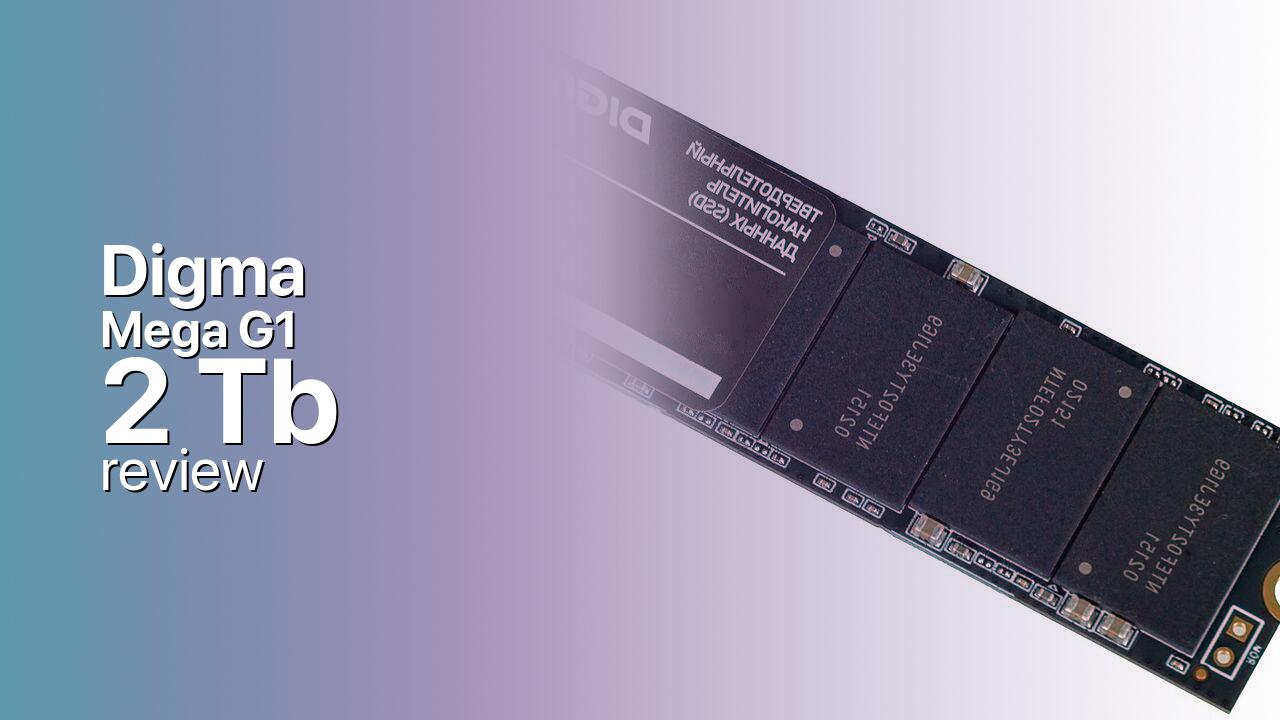
Controller & Memory
The Digma Mega G1 targets the value segment of the M.2 SSD market, where price per gigabyte matters more than benchmark leadership. Its Innogrit IG5216 controller — also known as Shasta+ — is a PCIe 3.0 x4 design that reaches up to 3.2 GB/s sequential read and 2.5 GB/s write in typical implementations. Digma rates this 2 TB model at 3,300 MB/s read and 2,800 MB/s write, which pushes the IG5216 to the upper edge of what the PCIe 3.0 x4 bus can deliver.
This is a DRAM-less drive that relies on Host Memory Buffer (HMB) architecture, borrowing a small slice of system RAM for the flash translation layer instead of dedicating a DDR chip on the PCB. HMB has matured significantly since its introduction, and for everyday desktop tasks — web browsing, office applications, game loading — the performance difference between a DRAM-equipped SSD and an HMB drive is often imperceptible. Under heavy sustained mixed workloads, however, the lack of dedicated DRAM becomes noticeable as latency increases.
The 2 TB capacity is the Mega G1's main selling point. At this size, the drive works well as a secondary game library, a media storage volume, or a budget boot drive for users who do not need PCIe 4.0 bandwidth. The 3D NAND type is unspecified by Digma — the company sources components from multiple vendors and may change suppliers between production batches without updating the product name. The endurance rating of 2,000 TBW is reasonable for 2 TB TLC NAND, though without a published warranty period, the practical guarantee coverage is unclear.
Against competitors, the Mega G1 sits alongside other budget DRAM-less 2 TB offerings like the HP EX900 Plus (which uses the same IG5216 controller), the TeamGroup MP33, and the Kingston A2000 in its later revisions. All target sub-3,500 MB/s read speeds on PCIe 3.0, and all trade DRAM cache for lower retail pricing.
Storage Comparisons:
Mega G1 Performance & Benchmarks
Sequential performance of 3,300 MB/s read and 2,800 MB/s write is fast for a PCIe 3.0 x4 drive, approaching the practical limit of the interface. The Innogrit IG5216 controller uses SRAM with ECC protection and Host Memory Buffer for address translation, which keeps random access latency acceptable for everyday use but cannot match the sustained mixed-workload performance of DRAM-equipped drives. In desktop tasks like OS boot, application launches, and file browsing, the experience is smooth and responsive.
Digma Mega G1 2 TB vs M.2 3.0 x 4 peers
Switch between sequential throughput and random IOPS to see how this drive stacks up against other M.2 3.0 x 4 SSDs in our database. The highlighted bar is the drive on this page — click any other bar to open that drive.
- ADATA SX 8800 Pro 512 GB: 3,500 MB/s read, 2,700 MB/s write
- ADATA SX 8800 Pro 1 TB: 3,500 MB/s read, 2,700 MB/s write
- ADATA XPG Spectrix S40G RGB 256 GB: 3,500 MB/s read, 3,000 MB/s write
- ADATA XPG Spectrix S40G RGB 512 GB: 3,500 MB/s read, 3,000 MB/s write
- Digma Mega G1 2 TB (this drive): 3,300 MB/s read, 2,800 MB/s write
The DRAM-less design becomes most apparent during sustained writes that exceed the SLC cache window. Once the cache exhausts, write speeds drop to the direct NAND write rate, which on TLC drives of this class typically falls to 300–600 MB/s. For typical consumer use — installing games, copying documents, streaming media — the SLC cache provides ample headroom. Thermals on the IG5216 are modest compared to hotter PCIe 4.0 controllers; the drive runs cool enough that a heatsink is optional, though a basic motherboard M.2 thermal plate does not hurt. Note that the interface is PCIe 3.0 x4 — it will work in a PCIe 4.0 slot but will not exceed Gen3 bandwidth.
Digma Mega G1 vs Competitors
See how the Mega G1 stacks up against other M.2 3.0 x 4 drives in our database:
Compare with rival drives:
Endurance, TBW & Warranty
Digma does not publish a specific warranty period for the Mega G1 in its publicly available documentation. The endurance rating is listed at 2,000 TBW for the 2 TB capacity, which is a credible figure for TLC NAND at this size — roughly equivalent to 1 TB of writes per day over a five-year period, or 2 TB per day over three years. Without confirmed warranty coverage, buyers should assume the statutory minimum for their region. MTBF is not published. For light to moderate consumer use, the endurance rating provides substantial headroom regardless of the warranty situation, but users planning heavy workstation workloads may prefer a drive with clearly stated warranty terms.
Digma Mega G1 2 TB Specifications
| Category | Value |
|---|---|
| Capacity [?] | 2 TB |
| Interface [?] | M.2 3.0 x 4 |
| Controller [?] | Innogrit IG5216 |
| Memory type [?] | 3D TLC |
| DRAM [?] | HMB |
| Read speed (MB/s) [?] | 3300 |
| Write speed (MB/s) [?] | 2800 |
| Read IOPS [?] | 190000 |
| Write IOPS [?] | 146000 |
| Endurance (TBW) [?] | 2000 |
| MTBF (million hours) [?] | 1500000 |
| Warranty (years) [?] | 3 |
Verdict: Is the Mega G1 Worth It in 2026?
The Digma Mega G1 2TB is a competent budget SSD delivering solid PCIe 3.0 x4 performance at an entry-level price point. The Innogrit IG5216 controller and Host Memory Buffer architecture keep costs down while maintaining acceptable everyday responsiveness for office tasks and gaming. The 2 TB capacity makes it useful as a game library or secondary storage volume. The lack of a published warranty period and the DRAM-less design are the primary trade-offs. For users who need bulk M.2 storage on a tight budget without PCIe 4.0 bandwidth requirements, the Mega G1 is a reasonable and affordable choice.
+ Pros
- 2 TB capacity at budget-friendly pricing
- 3,300 MB/s read approaches PCIe 3.0 x4 limit
- HMB architecture eliminates DRAM cost
- IG5216 controller runs cool without heatsink
- 2,000 TBW endurance for 2 TB TLC NAND
- Cons
- No published warranty period
- DRAM-less design increases latency under heavy loads
- NAND vendor may change between batches
- PCIe 3.0 only — not a Gen4 drive
Buy this or similar SSD Storage:



Video Review
Самый дешевый и с гарантией - SSD DIGMA MEGA G1 2TB (DGSM3002TG13T)