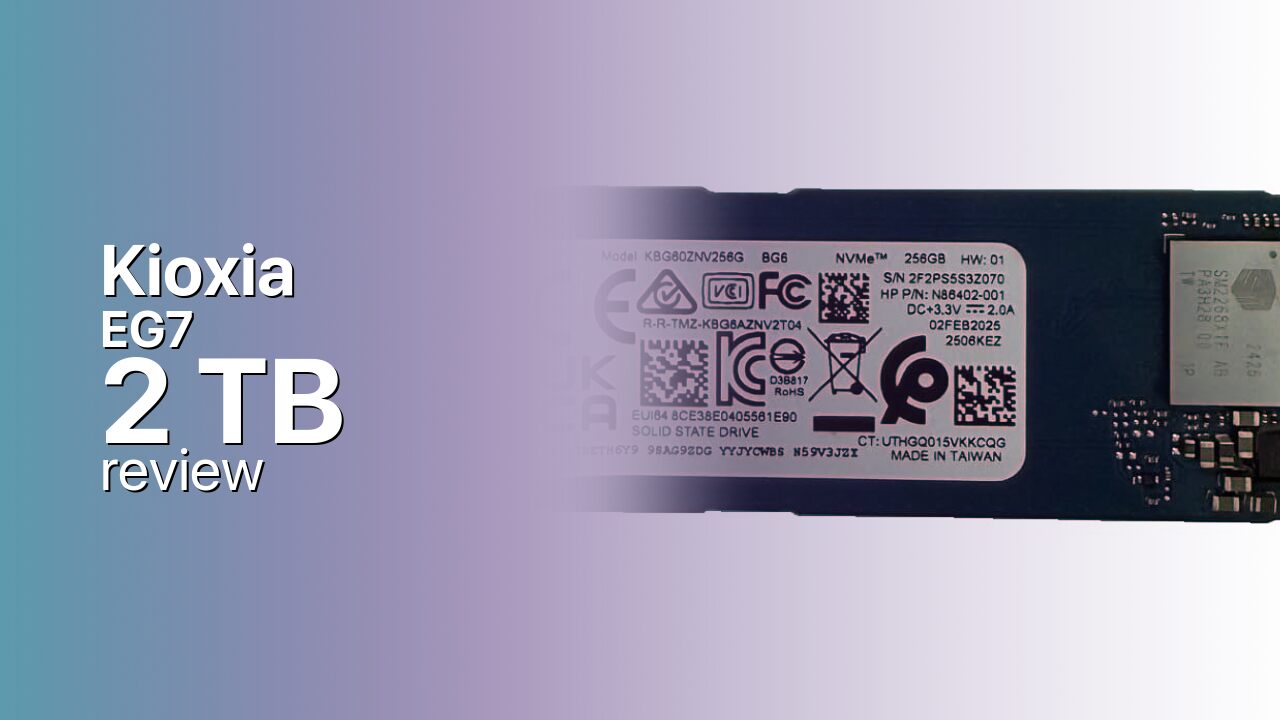
Why the Kioxia EG7 2TB tops Kioxia's first QLC family (2026)
Quick answer
The EG7 2TB is the most complete expression of Kioxia's QLC value formula: full-family speed of 7,000/6,200 MB/s, the largest pseudo-SLC cache of the three sizes, and room for an operating system, applications and a sprawling game collection.
Read: 7000 MB/s Write: 6200 MB/s Endurance: 600 TBW Warranty: 5 years Interface: M.2 4.0 x 4
The Kioxia EG7 2TB runs the full 7,000/6,200 MB/s rating of Kioxia's first QLC client line, serving as the high-capacity storage option inside OEM-built systems.
Controller & Memory
Announced in April 2026, the EG7 Series is Kioxia's first client SSD family built on BiCS FLASH generation 8 QLC NAND - 218-layer die with CMOS directly bonded to array (CBA) for higher density at lower cost. Kioxia positions the range as a budget alternative to its TLC-based BG7, claiming the newest QLC behaves close enough to TLC for mainstream workloads. A Kioxia controller manages everything DRAM-less via Host Memory Buffer, across PCIe 4.0 x4 using the NVMe 2.0d specification.
As the top capacity, this model posts the family's best numbers: 7,000 MB/s sequential read, 6,200 MB/s sequential write, and random activity rated up to a million IOPS in both directions. Extra NAND also enlarges the pseudo-SLC cache, letting sustained writes hold boosted speed longer than on smaller EG7 models before dropping toward native QLC rates. Beneath it, the 512 GB variant concedes 600 MB/s of read headroom and 1,200 MB/s of write headroom. All three sizes share the DRAM-less architecture, single-sided M.2 2230/2242/2280 construction, and an optional TCG Opal 2.02 self-encrypting variant.
Against retail QLC competition - the Crucial P3 Plus and Kingston NV3 being the closest analogues - the 2 TB EG7 matches or beats their headline specifications, yet remains an OEM-first part that seldom appears in stores. Upgrade-minded readers will gravitate toward those retail rivals or Kioxia's Exceria family; the EG7 matters most as the premium storage option in configured laptops and desktops.
Storage Comparisons:
EG7 Performance & Benchmarks
This capacity carries the series' peak ratings: up to 7,000 MB/s sequential reads, 6,200 MB/s sequential writes, and 1,000,000 IOPS each way for random traffic, measured with Host Memory Buffer enabled. Two terabytes of NAND give the pseudo-SLC cache maximum room within the lineup, so sustained transfers hold boosted speed longer here than on any smaller EG7 before dropping to native QLC rates. Real-world effects follow directly: fast boots and installs, quick level loads, and comfortable headroom for mixed read-heavy usage typical of a main drive.
Kioxia EG7 2 TB vs M.2 4.0 x 4 peers
Switch between sequential throughput and random IOPS to see how this drive stacks up against other M.2 4.0 x 4 SSDs in our database. The highlighted bar is the drive on this page — click any other bar to open that drive.
- Patriot Viper PV593 1 TB: 14,500 MB/s read, 14,000 MB/s write
- Patriot Viper PV593 2 TB: 14,500 MB/s read, 14,000 MB/s write
- Patriot Viper PV593 4 TB: 14,500 MB/s read, 14,000 MB/s write
- Patriot Viper PV573 2 TB: 14,000 MB/s read, 12,000 MB/s write
- Kioxia EG7 2 TB (this drive): 7,000 MB/s read, 6,200 MB/s write
Because Kioxia distributes the EG7 through PC manufacturers rather than retail, no independent benchmark reviews existed at launch; every number here is manufacturer-rated, not third-party measured. Skepticism about QLC matching TLC is reasonable - ServeTheHome explicitly noted that advertised figures likely describe cached performance, with steeper drop-offs once the cache empties. Even so, the 2 TB model's larger cache mitigates that issue longest of the three capacities, making it the most resilient EG7 choice for anyone who receives one inside a prebuilt system. For ordinary desktop duty, the gap between cached and native speed rarely registers.
Kioxia EG7 vs Competitors
See how the EG7 stacks up against other M.2 4.0 x 4 drives in our database:
Compare with rival drives:
Endurance, TBW & Warranty
Kioxia publishes no retail endurance or warranty figures for the EG7 Series; as OEM inventory, terms attach to contracts with system builders instead of consumer datasheets, and no official TBW rating exists in public documentation. Placeholder endurance values seen in some databases stem from that paperwork gap, not from verified measurement. Context helps: two terabytes is where QLC endurance budgets look least concerning, because comparable retail drives commonly warrant hundreds of terabytes written - scaling upward with capacity - across multi-year terms. Hardware expectations should therefore stay positive even where documentation is absent. Service for a failed EG7-equipped machine routes through the original equipment manufacturer's channel, and any exact endurance claim circulating online warrants checking against an official Kioxia source first.
Kioxia EG7 2 TB Specifications
| Category | Value |
|---|---|
| Capacity [?] | 2 TB |
| Interface [?] | M.2 4.0 x 4 |
| Controller [?] | Kioxia |
| Memory type [?] | BICS QLC |
| DRAM [?] | No |
| Read speed (MB/s) [?] | 7000 |
| Write speed (MB/s) [?] | 6200 |
| Read IOPS [?] | 1000000 |
| Write IOPS [?] | 1000000 |
| Endurance (TBW) [?] | 600 |
| MTBF (million hours) [?] | 1500000 |
| Warranty (years) [?] | 5 |
Verdict: Is the EG7 Worth It in 2026?
The EG7 2TB is the most complete expression of Kioxia's QLC value formula: full-family speed of 7,000/6,200 MB/s, the largest pseudo-SLC cache of the three sizes, and room for an operating system, applications and a sprawling game collection. It makes sense wherever a system builder slots it, giving premium-budget laptops and compact desktops flagship-adjacent performance without flagship pricing. Direct purchasers face the usual catch - OEM lines rarely sell boxed - pushing upgrade-minded readers toward the Crucial P3 Plus, Kingston NV3, or Kioxia's retail Exceria drives instead. Within its intended habitat, however, this is the EG7 capacity to hope for: the series' best-rated performance with QLC economics behind it.
+ Pros
- Line-leading 7,000/6,200 MB/s rated speeds
- Random performance rated up to 1M IOPS
- Largest pseudo-SLC cache in the EG7 family
- Room for large game libraries and archives
- Single-sided M.2 keeps compatibility broad
- Cons
- Cached speeds fall hard on long sustained writes
- OEM-only availability frustrates standalone buyers
- No published TBW or consumer warranty terms
- QLC endurance trails TLC alternatives per cell
Buy this or similar SSD Storage:



Video Review
Best SSDs for PC & Playstation 5