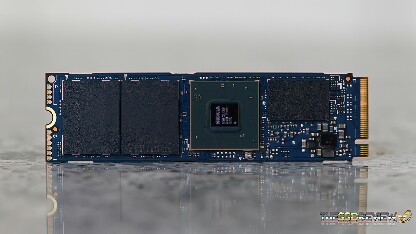
Where the Kioxia EG7 1TB lands in Kioxia's QLC lineup (2026)
Quick answer
Inside a value laptop or commercial desktop, the Kioxia EG7 1TB is exactly the sort of storage you want: flagship-tier 7,000 MB/s reads, sensible power draw, and enough room for Windows plus a serious game library.
Read: 7000 MB/s Write: 6000 MB/s Endurance: 300 TBW Warranty: 5 years Interface: M.2 4.0 x 4
The Kioxia EG7 1TB pairs full-line 7,000 MB/s read speed with new BiCS 8 QLC NAND, appearing mostly as stock storage inside value notebooks and prebuilts.
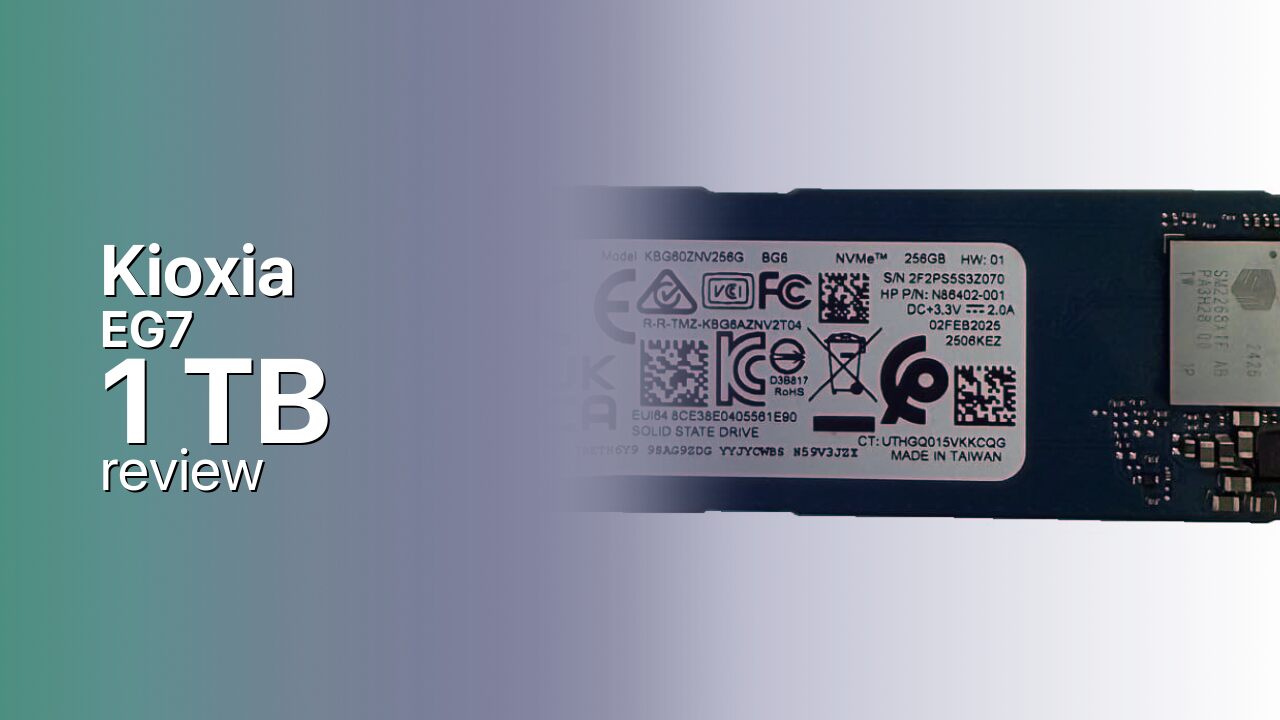
Controller & Memory
Kioxia announced the EG7 Series in April 2026 as its first client SSD family to use BiCS FLASH generation 8 QLC NAND, a 218-layer design with CMOS directly bonded to array (CBA). Although four bits per cell usually means slow flash, Kioxia claims refined flash management closes most of the distance to TLC-class parts like its own BG7. A Kioxia controller runs the drive DRAM-less through Host Memory Buffer, over PCIe 4.0 x4 with NVMe 2.0d compliance, on single-sided M.2 2230, 2242 or 2280 boards.
The 1 TB model occupies the middle of the three-size lineup and matches the flagship's 7,000 MB/s sequential read while writing at a rated 6,000 MB/s, with random performance quoted at up to 850,000 read and 950,000 write IOPS. Only the step-up 2 TB pushes writes further, to 6,200 MB/s. Because Kioxia sells the series through PC manufacturers, this capacity shows up chiefly inside budget ultrabooks and commercial desktops; its single-sided construction suits thin chassis, and a self-encrypting variant gives corporate buyers the TCG Opal 2.02 option.
Measured against retail QLC alternatives like the Crucial P3 Plus and Kingston NV3, the EG7 1TB posts similar paper numbers while remaining hard to buy as a standalone part. Upgrade shoppers will find those rivals - or Kioxia's TLC-based Exceria line - far more accessible. For anyone who receives one inside a machine, the practical benefit is balance: 1 TB holds Windows, a full software setup and a growing game library without pressure.
Storage Comparisons:
EG7 Performance & Benchmarks
Rated figures for this capacity reach 7,000 MB/s sequential reads and 6,000 MB/s sequential writes over PCIe 4.0 x4, plus 850,000 random-read and 950,000 random-write IOPS, all measured with Host Memory Buffer active. Like any QLC drive, the EG7 leans on a pseudo-SLC cache whose generous size at 1 TB absorbs everyday writes; only very long sustained transfers exhaust it and expose native QLC speeds, which sit far below the headline. Boot times, application launches and game loading all benefit from Gen4 read bandwidth regardless.
Kioxia EG7 1 TB vs M.2 4.0 x 4 peers
Switch between sequential throughput and random IOPS to see how this drive stacks up against other M.2 4.0 x 4 SSDs in our database. The highlighted bar is the drive on this page — click any other bar to open that drive.
- Patriot Viper PV593 1 TB: 14,500 MB/s read, 14,000 MB/s write
- Patriot Viper PV593 2 TB: 14,500 MB/s read, 14,000 MB/s write
- Patriot Viper PV593 4 TB: 14,500 MB/s read, 14,000 MB/s write
- Patriot Viper PV573 2 TB: 14,000 MB/s read, 12,000 MB/s write
- Kioxia EG7 1 TB (this drive): 7,000 MB/s read, 6,000 MB/s write
Independent lab reviews were unavailable at launch because distribution runs through PC builders rather than retail boxes, so every cited number is manufacturer-rated rather than third-party measured. Expectations stay simple: Windows boots in seconds, big libraries load markedly faster than SATA allows, and general multitasking feels immediate. Sustained professional workloads - hours of video ingest or bulk archiving - are where a DRAM-equipped TLC drive would hold rated speeds longer, and where this budget-oriented QLC design eventually shows its limits.
Kioxia EG7 vs Competitors
See how the EG7 stacks up against other M.2 4.0 x 4 drives in our database:
Compare with rival drives:
Endurance, TBW & Warranty
As an OEM-focused product line, the EG7 ships without a published retail endurance rating or warranty term; Kioxia negotiates those conditions with system builders contract by contract, leaving no official TBW figure in public documentation. The nominal endurance value carried in some databases reflects that paperwork gap rather than a verified specification. Retail QLC drives of equivalent class generally promise several hundred terabytes written at 1 TB with multi-year coverage attached, which offers reasonable context for what the hardware itself should tolerate. Practical ownership matters more: if a notebook containing this drive fails, service flows through the PC maker's warranty process rather than through Kioxia directly, so keep backups independent of internal storage. Verify any exact endurance claim against an official Kioxia datasheet before trusting it.
Kioxia EG7 1 TB Specifications
| Category | Value |
|---|---|
| Capacity [?] | 1 TB |
| Interface [?] | M.2 4.0 x 4 |
| Controller [?] | Kioxia |
| Memory type [?] | BICS QLC |
| DRAM [?] | No |
| Read speed (MB/s) [?] | 7000 |
| Write speed (MB/s) [?] | 6000 |
| Read IOPS [?] | 850000 |
| Write IOPS [?] | 950000 |
| Endurance (TBW) [?] | 300 |
| MTBF (million hours) [?] | 1500000 |
| Warranty (years) [?] | 5 |
Verdict: Is the EG7 Worth It in 2026?
Inside a value laptop or commercial desktop, the Kioxia EG7 1TB is exactly the sort of storage you want: flagship-tier 7,000 MB/s reads, sensible power draw, and enough room for Windows plus a serious game library. It also sidesteps the entry model's reduced ratings, matching the flagship on reads while conceding only 200 MB/s of write speed. Weaknesses surface only under sustained heavy writing, where QLC without DRAM cannot match pricier TLC hardware. Standalone buyers face the availability catch and should pick the Crucial P3 Plus, Kingston NV3, or Kioxia's retail Exceria range instead. For its intended role as built-in system storage, the EG7 1TB earns an easy recommendation.
+ Pros
- 7,000 MB/s reads match the 2 TB flagship
- 6,000 MB/s writes clear the entry tier comfortably
- BiCS 8 QLC balances density with responsiveness
- Single-sided M.2 fits thin laptop slots
- Optional TCG Opal 2.02 self-encryption
- Cons
- Sustained writes fall once SLC cache empties
- Not sold through normal retail channels
- No official TBW or warranty disclosure
- DRAM-less design borrows system memory
Buy this or similar SSD Storage:
Video Review
Best SSDs for PC & Playstation 5