What the Kioxia EG7 512GB delivers in slim laptops (2026)
Quick answer
If your slim laptop shipped with a Kioxia EG7 512GB inside, you have competent mainstream storage: quick enough for daily computing, power-efficient, and built on fresh-generation QLC that keeps system costs down.
Read: 6400 MB/s Write: 5000 MB/s Endurance: 150 TBW Warranty: 5 years Interface: M.2 4.0 x 4
The Kioxia EG7 512GB is the entry capacity of Kioxia's first QLC client SSD line, rated at 6,400 MB/s and found mostly inside value-oriented slim laptops.
Controller & Memory
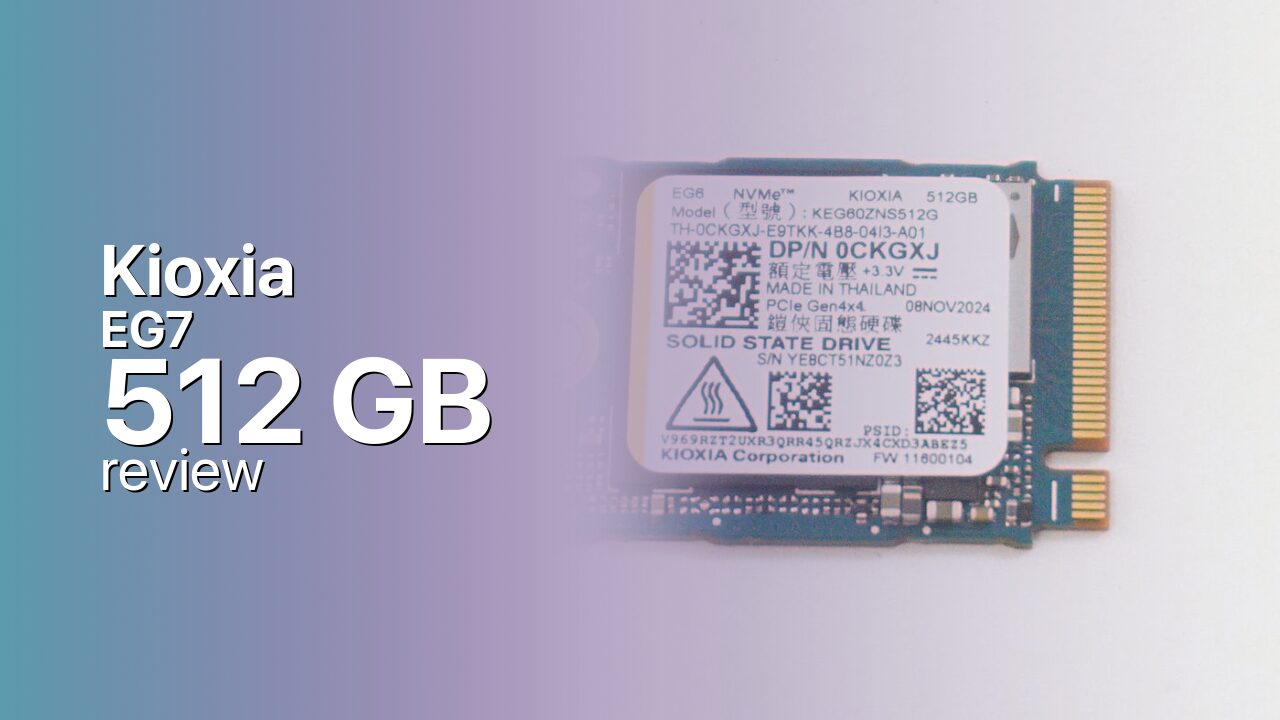
Announced in April 2026, the EG7 series is Kioxia's first client SSD family to use BiCS FLASH generation 8 QLC NAND - 218-layer memory with CMOS directly bonded to array (CBA) technology that lets inexpensive four-bit cells approach TLC-class responsiveness. The drive pairs that NAND with a Kioxia-designed controller and runs PCIe 4.0 x4 over the NVMe 2.0d protocol, leaning on Host Memory Buffer instead of a dedicated DRAM package. Everything sits on single-sided M.2 boards offered in 2230, 2242 and 2280 lengths, one reason laptop makers like the layout for thin chassis.
This is an OEM-first product, so you will meet the EG7 pre-installed in budget ultrabooks, 2-in-1 notebooks and compact prebuilt desktops far more often than on a store shelf. At 512 GB it sits at the bottom of the lineup, which also spans 1 TB and 2 TB, and it trades some speed for position: rated throughput is 6,400 MB/s reading and 5,000 MB/s writing versus 7,000/6,200 MB/s on the flagship, with random performance of up to 550,000 read and 850,000 write IOPS. A self-encrypting variant supporting TCG Opal 2.02 exists for business deployments.
Against retail QLC rivals such as the Crucial P3 Plus and Kingston NV3, this drive plays the same value-first game while remaining primarily a system-integrator part. If you are shopping for an upgrade outright, those two are easier to buy; shoppers who want a Kioxia-branded consumer drive should look at the TLC-based Exceria range instead.
Storage Comparisons:
EG7 Performance & Benchmarks
Kioxia rates the 512 GB model at up to 6,400 MB/s sequential reads and 5,000 MB/s sequential writes over PCIe 4.0 x4, alongside 550,000 random-read and 850,000 random-write IOPS. Those figures were captured with Host Memory Buffer enabled, so how much system RAM your machine allocates influences what you actually see. As with every QLC drive, headline numbers describe pseudo-SLC cached performance: once the cache fills during a long sustained transfer, throughput falls back toward native QLC speeds, which sit far below the headline. Everyday laptop loads - app installs, game launches, document and photo copies - rarely push far enough to hit that wall.
Kioxia EG7 512 GB vs M.2 4.0 x 4 peers
Switch between sequential throughput and random IOPS to see how this drive stacks up against other M.2 4.0 x 4 SSDs in our database. The highlighted bar is the drive on this page — click any other bar to open that drive.
- Patriot Viper PV593 1 TB: 14,500 MB/s read, 14,000 MB/s write
- Patriot Viper PV593 2 TB: 14,500 MB/s read, 14,000 MB/s write
- Patriot Viper PV593 4 TB: 14,500 MB/s read, 14,000 MB/s write
- Patriot Viper PV573 2 TB: 14,000 MB/s read, 12,000 MB/s write
- Kioxia EG7 512 GB (this drive): 6,400 MB/s read, 5,000 MB/s write
No independent benchmark reviews of the EG7 existed at launch because Kioxia ships it through PC manufacturers rather than retail channels, so treat every number here as manufacturer-rated rather than third-party verified. Expectations remain straightforward nonetheless: Windows boots in seconds, large applications open without delay, and game load times land well below SATA levels. Where the drive visibly trails DRAM-equipped TLC hardware is sustained copying - video ingest, bulk archiving, full-drive migrations - exactly the workloads budget QLC designs are not built for.
Kioxia EG7 vs Competitors
See how the EG7 stacks up against other M.2 4.0 x 4 drives in our database:
Compare with rival drives:
Endurance, TBW & Warranty
Kioxia has not published a retail endurance rating or warranty term for the EG7 Series, because the line is supplied to PC manufacturers under OEM agreements where support terms are negotiated per contract rather than printed on a box. That is why no TBW figure appears here - a gap in public documentation rather than an omission of a known number. Comparable retail QLC drives typically carry endurance budgets of a few hundred terabytes written at this capacity alongside multi-year coverage, so there is little reason to expect weaker hardware, only less public paperwork. If an EG7-equipped notebook develops storage trouble, warranty handling runs through the laptop maker or system integrator rather than through Kioxia directly. Any precise TBW figure quoted elsewhere deserves skepticism unless it cites an official Kioxia datasheet.
Kioxia EG7 512 GB Specifications
| Category | Value |
|---|---|
| Capacity [?] | 512 GB |
| Interface [?] | M.2 4.0 x 4 |
| Controller [?] | Kioxia |
| Memory type [?] | BICS QLC |
| DRAM [?] | No |
| Read speed (MB/s) [?] | 6400 |
| Write speed (MB/s) [?] | 5000 |
| Read IOPS [?] | 550000 |
| Write IOPS [?] | 850000 |
| Endurance (TBW) [?] | 150 |
| MTBF (million hours) [?] | 1500000 |
| Warranty (years) [?] | 5 |
Verdict: Is the EG7 Worth It in 2026?
If your slim laptop shipped with a Kioxia EG7 512GB inside, you have competent mainstream storage: quick enough for daily computing, power-efficient, and built on fresh-generation QLC that keeps system costs down. There is little reason to replace it unless you regularly move very large files, where the DRAM-less architecture and mid-tier write speed show their limits. Buyers choosing a drive for an upgrade build should look elsewhere, since this model rarely reaches retail shelves; the Crucial P3 Plus and Kingston NV3 cover the same QLC value niche with easier availability, while Kioxia's own Exceria range serves shoppers who want the brand's TLC-based consumer hardware. As stock storage in a value notebook, though, the EG7 does exactly the job Kioxia designed it for.
+ Pros
- Rated 6,400 MB/s sequential reads on PCIe 4.0
- Single-sided M.2 in 2230, 2242 and 2280 lengths
- BiCS 8 QLC NAND keeps cost per gigabyte low
- Host Memory Buffer replaces DRAM without a big penalty
- TCG Opal 2.02 self-encrypting model available
- Cons
- Write speed drops sharply once SLC cache empties
- OEM-first availability makes standalone upgrades impractical
- No published TBW or warranty rating
- Writes trail the 2 TB flagship by 1,200 MB/s
Buy this or similar SSD Storage:
Video Review
Best SSDs for PC & Playstation 5