Kingston KC2500 1TB NVMe SSD Review (2026)
Quick answer
The Kingston KC2500 1TB is a well-balanced high-end PCIe 3.0 NVMe SSD that delivers flagship-tier performance with the added value of hardware encryption.
Read: 3500 MB/s Write: 2900 MB/s Endurance: 600 TBW Warranty: 5 years Interface: M.2 3.0 x 4
The Kingston KC2500 1TB is the capacity where Kingston's performance NVMe line hits its full stride, combining flagship-tier read and write speeds with hardware encryption and a generous endurance rating.
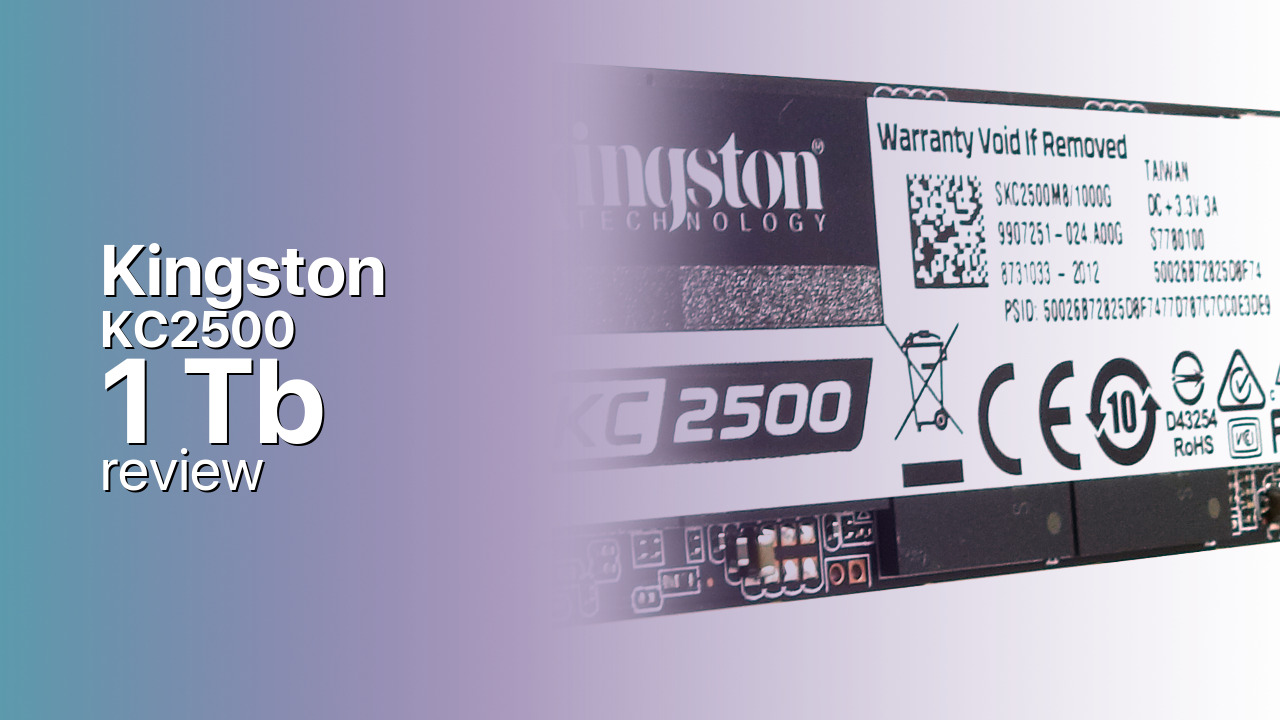
Controller & Memory
The KC2500 1 TB pairs the Silicon Motion SM2262EN eight-channel controller with 96-layer 3D TLC NAND and a DDR3L DRAM chip. The drive is an M.2 2280 on PCIe 3.0 x4, using a double-sided PCB layout with NAND on both sides.
Sequential throughput reaches the series maximum: 3,500 MB/s reads and 2,900 MB/s writes. Random IOPS hold at 375,000 reads and 300,000 writes. Endurance is rated at 600 TBW over a 5-year warranty -- 0.3 drive writes per day. The 1 TB and 2 TB models share identical peak performance; the 2 TB simply doubles endurance.
The KC2500 competes with high-end PCIe 3.0 NVMe drives like the Samsung 970 EVO Plus 1 TB, ADATA SX8200 Pro 1 TB, and Western Digital Black SN750 1 TB. Its differentiator is XTS-AES 256-bit encryption, TCG Opal 2.0, and eDrive support, which are rare at this price tier and valuable for business deployments.
Storage Comparisons:
KC2500 Performance & Benchmarks
At 3,500 MB/s reads and 2,900 MB/s writes, the KC2500 1 TB effectively saturates the PCIe 3.0 x4 interface. APH Networks found the 1 TB model competitive with the ADATA SX8200 Pro and Samsung 970 EVO Plus across CrystalDiskMark, ATTO, and PCMark benchmarks. The SM2262EN controller's mature firmware delivers consistent performance with no surprises.
Kingston KC2500 1 TB vs M.2 3.0 x 4 peers
Switch between sequential throughput and random IOPS to see how this drive stacks up against other M.2 3.0 x 4 SSDs in our database. The highlighted bar is the drive on this page — click any other bar to open that drive.
- Kingston KC2500 1 TB (this drive): 3,500 MB/s read, 2,900 MB/s write
- ADATA SX 8800 Pro 512 GB: 3,500 MB/s read, 2,700 MB/s write
- ADATA SX 8800 Pro 1 TB: 3,500 MB/s read, 2,700 MB/s write
- ADATA XPG Spectrix S40G RGB 256 GB: 3,500 MB/s read, 3,000 MB/s write
- ADATA XPG Spectrix S40G RGB 512 GB: 3,500 MB/s read, 3,000 MB/s write
Random IOPS of 375,000 reads and 300,000 writes are strong for a PCIe 3.0 drive. Real-world game load times, application launches, and file transfers are indistinguishable from other top-tier PCIe 3.0 drives. Sustained writes hold up well past the SLC cache boundary on the 1 TB model.
The encryption support (XTS-AES 256, TCG Opal, eDrive) does not impact performance in normal use and is transparent to the user when enabled through the OS or management software.
Kingston KC2500 vs Competitors
See how the KC2500 stacks up against other M.2 3.0 x 4 drives in our database:
Compare with rival drives:
Endurance, TBW & Warranty
Kingston rates the KC2500 1 TB at 600 TBW over its 5-year warranty, which equals roughly 329 GB of writes per day. At 0.3 drive writes per day, this matches the mainstream TLC endurance standard and is adequate for virtually any consumer workload. The 2 million hour MTBF is a population reliability metric. Kingston provides a 5-year limited warranty with free technical support.
Kingston KC2500 1 TB Specifications
| Category | Value |
|---|---|
| Capacity [?] | 1 TB |
| Interface [?] | M.2 3.0 x 4 |
| Controller [?] | Silicon Motion SM2262EN |
| Memory type [?] | 96-layer 3D TLC |
| DRAM [?] | DDR3L |
| Read speed (MB/s) [?] | 3500 |
| Write speed (MB/s) [?] | 2900 |
| Read IOPS [?] | 375000 |
| Write IOPS [?] | 300000 |
| Endurance (TBW) [?] | 600 |
| MTBF (million hours) [?] | 2 |
| Warranty (years) [?] | 5 |
Verdict: Is the KC2500 Worth It in 2026?
The Kingston KC2500 1TB is a well-balanced high-end PCIe 3.0 NVMe SSD that delivers flagship-tier performance with the added value of hardware encryption. It is best suited for users who want a single-drive solution for OS, applications, and a game library, particularly those who value encryption for business or security reasons. Against the Samsung 970 EVO Plus, the KC2500 matches on reads, trails slightly on writes, and wins on encryption support. For a reliable, encrypted NVMe SSD at 1 TB, the KC2500 is a strong pick.
+ Pros
- 3,500 MB/s sequential reads
- 2,900 MB/s sequential writes
- 600 TBW endurance (0.3 DWPD)
- XTS-AES 256-bit hardware encryption
- TCG Opal 2.0 and eDrive support
- DRAM cache (DDR3L)
- 5-year warranty with free tech support
- Cons
- PCIe 3.0 only, no PCIe 4.0
- Double-sided PCB may not fit some ultra-thin laptops
- No included heatsink
- Slightly slower writes than Samsung 970 EVO Plus
Buy this or similar SSD Storage:
Video Review
Kingston KC2500: Most Secure NVMe SSD Yet?