Intel SSD 760P 128GB NVMe SSD Review (2026)
Quick answer
Budget builders who need a cheap NVMe boot drive and nothing more will find the Intel 760P 128 GB adequate, but anyone with room in the budget should step up to the 512 GB model for double the endurance and nearly double the throughput.
Read: 1640 MB/s Write: 650 MB/s Endurance: 72 TBW Warranty: 5 years Interface: M.2 3.0 x 4
The Intel 760P 128GB is the entry point of Intel's mainstream NVMe line, pairing a Silicon Motion SM2262 controller with 64-layer Intel TLC at a capacity that trades peak speed for a low entry price.
Controller & Memory
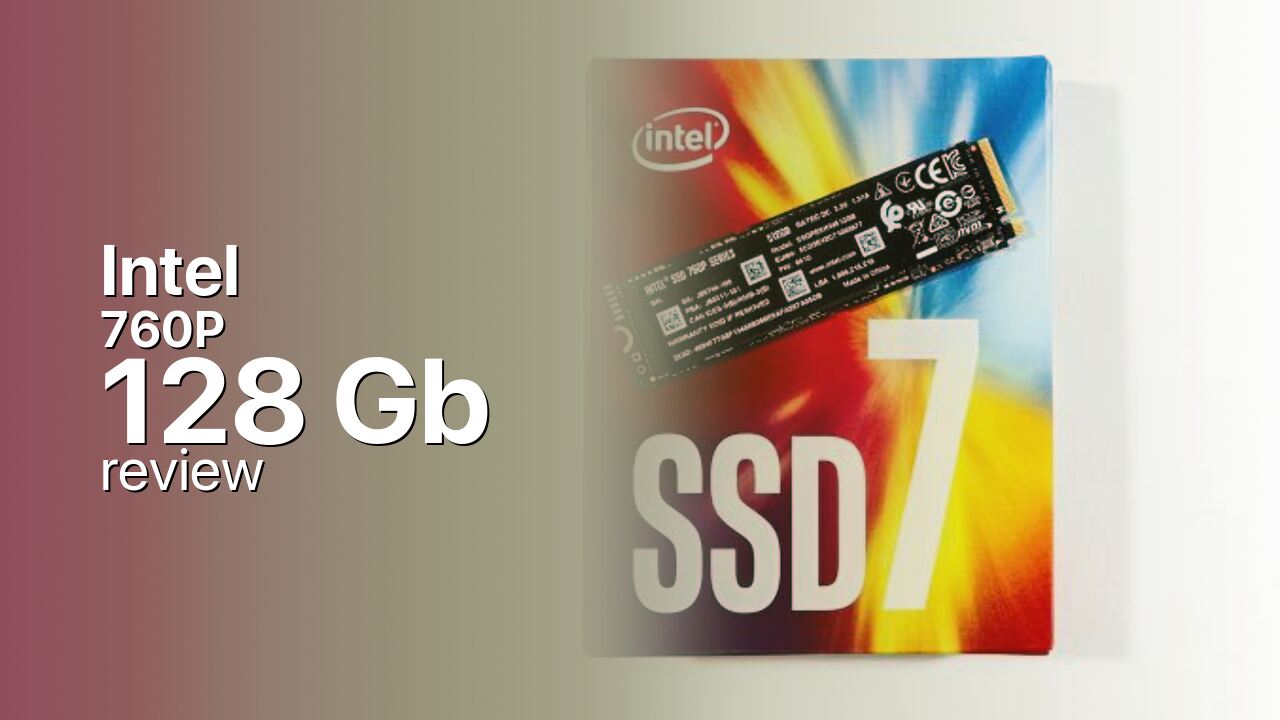
Inside the 760P 128GB is an Intel-customized Silicon Motion SM2262 eight-channel controller paired with Intel 64-layer 256Gb 3D TLC NAND. The drive uses a Micron DDR3 DRAM chip for the flash translation layer and ships in a single-sided M.2 2280 form factor. Being the smallest capacity in the lineup, it has the fewest NAND dies and therefore the lowest parallelism, which directly impacts sequential throughput.
The 760P series also comes in 256 GB, 512 GB, 1 TB, and 2 TB variants. The 512 GB and larger capacities all share the flagship read speed of 3,230 MB/s, while this 128 GB model drops to 1,640 MB/s reads and 650 MB/s writes -- roughly half the throughput of its bigger siblings. Endurance scales linearly at 72 TBW per 128 GB of capacity.
At this capacity, the 760P competes with entry-level NVMe drives like the Crucial P1 1 TB and Western Digital Blue SN500 250 GB rather than high-end PCIe 3.0 drives. It is a reasonable OS or boot drive for a budget desktop build, but anyone doing frequent large-file transfers should step up to the 512 GB or 1 TB model.
Storage Comparisons:
760P Performance & Benchmarks
Rated at 1,640 MB/s sequential reads and 650 MB/s sequential writes, the 128 GB 760P is markedly slower than the 512 GB flagship. The gap comes down to NAND channel utilization: with fewer dies to stripe across, the controller cannot saturate the PCIe 3.0 x4 bus. Random performance lands at 105,000 read IOPS and 160,000 write IOPS -- respectable for a 128 GB drive, though well below the 340,000 read IOPS the 512 GB variant achieves.
Intel 760P 128 GB vs M.2 3.0 x 4 peers
Switch between sequential throughput and random IOPS to see how this drive stacks up against other M.2 3.0 x 4 SSDs in our database. The highlighted bar is the drive on this page — click any other bar to open that drive.
- ADATA SX 8800 Pro 512 GB: 3,500 MB/s read, 2,700 MB/s write
- ADATA SX 8800 Pro 1 TB: 3,500 MB/s read, 2,700 MB/s write
- ADATA XPG Spectrix S40G RGB 256 GB: 3,500 MB/s read, 3,000 MB/s write
- ADATA XPG Spectrix S40G RGB 512 GB: 3,500 MB/s read, 3,000 MB/s write
- Intel 760P 128 GB (this drive): 1,640 MB/s read, 650 MB/s write
In everyday desktop workloads -- booting Windows, launching applications, web browsing -- the 760P 128 GB is indistinguishable from any other NVMe SSD. The bottleneck only appears during sustained writes or when copying files larger than the SLC cache, which is small at this capacity. For a pure OS drive in a non-gaming desktop or a secondary cache drive, the performance is adequate.
Intel 760P vs Competitors
See how the 760P stacks up against other M.2 3.0 x 4 drives in our database:
Compare with rival drives:
Endurance, TBW & Warranty
Intel rates the 760P 128 GB at 72 TBW (terabytes written) over its 5-year warranty period. That works out to roughly 40 GB of writes per day, every day, for five years -- far more than a typical OS-and-apps drive experiences. Intel also quotes an MTBF of 1.5 million hours, a population statistic that indicates reliability at scale rather than a guarantee for any individual unit. The warranty is handled through Intel's standard RMA process and is limited by whichever comes first: the 5-year term or the TBW threshold.
Intel 760P 128 GB Specifications
| Category | Value |
|---|---|
| Capacity [?] | 128 GB |
| Interface [?] | M.2 3.0 x 4 |
| Controller [?] | Silicon Motion SM2262 |
| Memory type [?] | Intel TLC |
| DRAM [?] | Micron 256 - 1TB DDR3 |
| Read speed (MB/s) [?] | 1640 |
| Write speed (MB/s) [?] | 650 |
| Read IOPS [?] | 105000 |
| Write IOPS [?] | 160000 |
| Endurance (TBW) [?] | 72 |
| MTBF (million hours) [?] | 1.5 |
| Warranty (years) [?] | 5 |
Verdict: Is the 760P Worth It in 2026?
Budget builders who need a cheap NVMe boot drive and nothing more will find the Intel 760P 128 GB adequate, but anyone with room in the budget should step up to the 512 GB model for double the endurance and nearly double the throughput. The 256 GB variant, at roughly the same write speed but twice the read throughput, is a better sweet spot if the price difference is small. Competing drives like the Kingston A2000 250 GB offer similar or better performance at this tier.
+ Pros
- Low entry price for NVMe
- Single-sided M.2 2280 fits thin laptops
- 72 TBW endurance for a 128 GB drive
- 5-year warranty from Intel
- Low idle power draw (25 mW)
- Cons
- 1,640 MB/s reads, well below PCIe 3.0 ceiling
- 650 MB/s writes, slower than many SATA SSDs
- Only 105,000 random read IOPS
- Small SLC cache limits burst writes
- No included heatsink
Buy this or similar SSD Storage:



Video Review
Intel 760p NVMe M.2 SSD - Performance on a Budget - Review