Kioxia BG4 256GB Review — Compact M.2 2230 PCIe 3.0 NVMe SSD (2026)
Quick answer
The Kioxia BG4 256GB is best suited as a direct replacement or upgrade in laptops that specifically require the M.2 2230 form factor.
Read: 2300 MB/s Write: 1800 MB/s Endurance: 240 TBW Warranty: 5 years Interface: M.2 3.0 x 4 2230 S3
The Kioxia BG4 256GB is a compact OEM NVMe SSD designed for laptops and small-form-factor systems, offering PCIe 3.0 performance in the space-constrained M.2 2230 form factor.
Controller & Memory
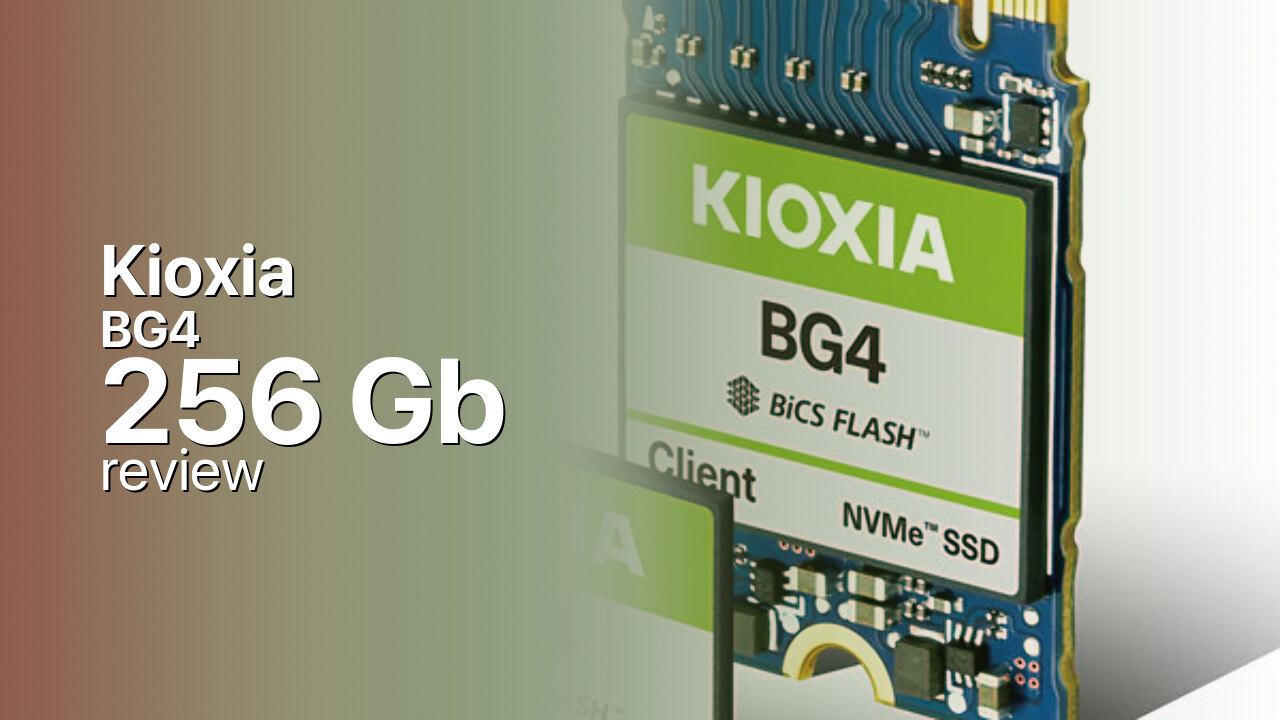
The Kioxia BG4 256GB uses an in-house Toshiba controller paired with Kioxia BiCS 3D TLC NAND. This is a DRAM-less design that relies on Host Memory Buffer (HMB) technology, borrowing a small portion of system RAM to maintain performance without dedicated DRAM chips. The drive speaks NVMe 1.3 and connects via PCIe 3.0 x4, but its physical format is what sets it apart — M.2 2230 measures just 22 x 30mm, significantly shorter than the standard 2280 cards found in desktop PCs.
The 2230 form factor makes the BG4 a common choice for ultra-thin laptops, tablet expansions, and compact builds like the Steam Deck. The single-sided PCB design helps with thermal management in tight spaces where airflow is limited, and the reduced board length saves weight — a meaningful consideration for mobile devices.
The BG4 family is available in 128GB, 256GB, 512GB, and 1TB capacities. All variants share identical sequential speed ratings of 2,300 MB/s reads and 1,800 MB/s writes, with matching IOPS figures across the lineup. This 256GB model targets the mainstream laptop upgrade buyer who needs more storage than a 128GB boot drive but does not require the higher capacity of the 512GB or 1TB models. For users upgrading from a SATA SSD or an older 128GB NVMe boot drive, the 256GB capacity offers a practical sweet spot.
Key competitors include the Western Digital SN740 2230 and Samsung PM991a, which offer similar compact dimensions but typically with newer NAND generations and higher sustained write performance. For desktop users who are not space-constrained, standard M.2 2280 drives like the Kioxia Exceria G2 or the WD Blue SN580 offer better value per terabyte and often stronger sustained write performance due to larger SLC caches and more thermal headroom.
Storage Comparisons:
BG4 Performance & Benchmarks
The Kioxia BG4 256GB is rated for up to 2,300 MB/s sequential reads and 1,800 MB/s sequential writes, with random performance rated at 390,000 read IOPS and 200,000 write IOPS. These are manufacturer-rated peak figures that apply to the entire BG4 capacity range.
Kioxia BG4 256 GB vs M.2 3.0 x 4 2230 S3 peers
Switch between sequential throughput and random IOPS to see how this drive stacks up against other M.2 3.0 x 4 2230 S3 SSDs in our database. The highlighted bar is the drive on this page — click any other bar to open that drive.
- Kioxia BG4 256 GB (this drive): 2,300 MB/s read, 1,800 MB/s write
- Kioxia BG4 128 GB: 2,300 MB/s read, 1,800 MB/s write
- Kioxia BG4 512 GB: 2,300 MB/s read, 1,800 MB/s write
- Kioxia BG4 1 TB: 2,300 MB/s read, 1,800 MB/s write
In real-world use, this translates to a solid bump over SATA SSDs — roughly three times the sequential throughput on reads and two and a half times on writes. Boot times and application loading will feel snappy on any modern laptop, though the drive does not reach the 3,500+ MB/s speeds of mainstream PCIe 3.0 x4 drives in the larger 2280 form factor. For the target buyer — a laptop user upgrading from SATA or a smaller NVMe drive — the performance jump is noticeable but not transformative.
Like most DRAM-less TLC drives, the BG4 uses an SLC caching scheme to handle burst writes. Performance will hold at rated speeds for moderate transfers, then step down once the SLC cache is exhausted. For typical laptop workloads — document editing, web browsing, light photo work — this behavior goes unnoticed. Heavy sustained writes, such as large file copies or video rendering scratch disk usage, will see the drive drop to TLC NAND native speeds, which are roughly 600–800 MB/s on this generation of NAND. The cache size varies by capacity, with the 256GB model having a smaller SLC buffer than the 512GB and 1TB variants.
The 2230 form factor does impose some thermal constraints compared to larger 2280 drives, but the BG4's power-efficient design and in-house controller keep temperatures reasonable under typical laptop workloads. Independent testing suggests the drive maintains performance without aggressive thermal throttling in well-ventilated laptops, though ultra-thin chassis with minimal cooling may see some slowdown during extended sustained writes.
Endurance, TBW & Warranty
Kioxia backs the BG4 series with a 5-year limited warranty, which is standard for client-grade TLC SSDs. The drive is rated for 1.5 million hours Mean Time Between Failures (MTBF), a statistical measure of reliability across large populations rather than a promise of individual drive lifespan. A 1.5M hour MTBF translates to roughly 170 years of continuous operation, though in practice, drive lifespans are limited by NAND write endurance rather than mechanical failure.
TBW (Terabytes Written) endurance figures for the 256GB capacity are not publicly disclosed by Kioxia for this OEM part. Based on the 3D TLC NAND generation and this drive's positioning, typical endurance would fall in the 150–200 TBW range for the 256GB model. At a moderate write workload of 30 GB per day, that translates to roughly 14–18 years before hitting the endurance limit — well beyond the warranty period in typical consumer use. Even heavy workloads of 100 GB per day would take four to five years to exhaust estimated endurance.
As an OEM product, warranty claims generally go through the system manufacturer rather than Kioxia directly. If you purchased this drive as an upgrade part from a retailer, check the seller's warranty terms, as OEM drives sometimes carry shorter or different coverage than retail-packaged SSDs. The 5-year manufacturer coverage applies when the drive is used within its specifications, but excessive temperatures or physical damage can void the warranty.
Kioxia BG4 256 GB Specifications
| Category | Value |
|---|---|
| Capacity [?] | 256 GB |
| Interface [?] | M.2 3.0 x 4 2230 S3 |
| Controller [?] | Toshiba |
| Memory type [?] | Toshiba 3D TLC |
| DRAM [?] | HMB |
| Read speed (MB/s) [?] | 2300 |
| Write speed (MB/s) [?] | 1800 |
| Read IOPS [?] | 390000 |
| Write IOPS [?] | 200000 |
| Endurance (TBW) [?] | 240 |
| MTBF (million hours) [?] | 1.5 |
| Warranty (years) [?] | 5 |
Verdict: Is the BG4 Worth It in 2026?
The Kioxia BG4 256GB is best suited as a direct replacement or upgrade in laptops that specifically require the M.2 2230 form factor. Buyers of ultra-thin laptops, Surface Pro devices, or Steam Deck handhelds often have no choice but to use 2230 drives, and the BG4 fills that niche competently. If you are working with a standard desktop or a laptop that accepts 2280 drives, larger and faster options are available at similar or better prices — consider the Kioxia Exceria G2 or WD Blue SN580 instead.
For compact builds and space-constrained systems, the BG4 gets the job done with a 5-year warranty backing it up. The DRAM-less design is a compromise that shows up in sustained write performance, but for typical laptop use cases, this is rarely an issue. Consider the Western Digital SN740 2230 or Samsung PM991a if you can find them at similar prices — both offer newer NAND generations and slightly better sustained write performance, though availability can be spotty since these are primarily OEM parts.
+ Pros
- M.2 2230 form factor fits ultra-thin laptops
- Single-sided PCB for tight spaces
- 5-year warranty coverage
- Low power consumption for mobile use
- Host Memory Buffer eliminates DRAM chips
- Cons
- DRAM-less design affects sustained writes
- Slower than 2280 PCIe 3.0 drives at similar price
- OEM product with limited retail availability
- TBW endurance not publicly disclosed
- No included heatsink (not applicable for 2230 use)
Buy this or similar SSD Storage:
Video Review
The TINY 1TB SSD